
Family Business Succession Planning: Tax, Legal and Wealth Management Considerations

TL;DR Family Business Succession Planning is the process of transferring ownership, control, management responsibility, and wealth from one generation to the next without disrupting the business. A good succession plan should cover tax impact, legal documentation, ownership rights, management roles, family governance, wealth protection, asset transfer, estate planning, and dispute prevention. For Indian family businesses, succession planning should not begin after a crisis. It should begin while the current generation is active, capable, and able to guide the transition. Why Succession Planning Matters for Family Businesses Family businesses are built on trust, relationships, reputation, and years of effort. But without proper succession planning, even profitable businesses can face disputes, uncertainty, tax issues, and operational disruption. Many family businesses delay succession planning because the topic feels sensitive. Owners may assume that the next generation will naturally take over or that family members will resolve matters internally when the time comes. In practice, unclear succession often creates problems such as: Disputes between family members Unclear ownership rights Confusion over management control Tax exposure during asset transfer Delayed decision-making Business valuation disputes Family wealth fragmentation Legal challenges after the founder’s death Conflict between active and non-active family members Loss of business continuity Succession planning is not only about inheritance. It is about continuity. A strong plan protects the family, the business, employees, creditors, customers, and future generations. What Is Family Business Succession Planning? Family Business Succession Planning is a structured process through which a family decides how business ownership, control, wealth, responsibilities, and decision-making will pass from one generation to another. It generally includes: Ownership transfer Management transition Tax planning Legal documentation Family wealth protection Governance rules Role clarity Business continuity planning Dispute prevention Estate planning Asset allocation Retirement planning for senior generation The goal is to ensure that business value does not get destroyed during transition. A good succession plan answers three important questions: Who will own the business? Who will manage the business? How will wealth and control be protected fairly? Ownership Succession vs Management Succession One of the biggest mistakes family businesses make is assuming that ownership and management are the same. They are different. Ownership Succession Ownership succession decides who will hold shares, partnership interest, business assets, voting rights, economic rights, and family wealth. This may involve: Shares Partnership rights LLP contribution Business assets Immovable property Investments Family trusts Wills Gift deeds Family settlement agreements Management Succession Management succession decides who will run the business. This includes: Managing director role Board participation Operational leadership Finance control Signing authority Strategic decision-making Professional management involvement Role of next-generation family members A family member may own part of the business but may not be involved in management. Clear separation prevents conflict. Key Tax Considerations in Family Business Succession Planning Tax planning is one of the most important parts of succession. Poorly planned transfers can create unnecessary tax liability, cash-flow pressure, stamp duty exposure, compliance issues, and disputes. 1. Capital Gains Impact Transfer of shares, property, business assets, or ownership rights may trigger capital gains tax depending on the mode of transfer. Families should review: Nature of asset Holding period Cost of acquisition Fair market value Transfer method Exemptions available Tax reporting requirements Example If business property is transferred without proper planning, the family may face capital gains and stamp duty implications. A professional review helps identify the most tax-efficient route. 2. Gift and Family Transfer Planning Gifts between specified relatives may receive favourable tax treatment under certain conditions. However, documentation is still important. Families should not treat informal transfers casually. Proper documentation may include: Gift deed Board approval Share transfer forms Valuation report Family settlement agreement Bank trail Accounting entries Tax disclosure Even when a transfer is exempt, documentation protects the family during future tax review or dispute. 3. Stamp Duty and Documentation Asset transfers may attract stamp duty depending on the asset type and state law. This is especially relevant for: Immovable property Share transfers Partnership reconstitution Business restructuring Family settlements Trust deeds Gift deeds Before executing any succession document, stamp duty and registration requirements should be evaluated. 4. Trust Taxation Private family trusts are increasingly used for wealth protection and succession planning. However, taxation depends on the type of trust. Common trust structures include: Specific trust Discretionary trust Revocable trust Irrevocable trust Tax treatment may differ based on whether beneficiaries are identifiable, whether shares are determinate, and whether the trust earns business income. A trust should not be created only for control. It must be designed carefully from tax, legal, governance, and family perspectives. 5. Business Restructuring Sometimes succession requires restructuring before transfer. This may include: Converting proprietorship into LLP or company Separating business assets from personal assets Creating holding company structures Demerging different business verticals Separating real estate from operating business Issuing shares to family members Reorganising partnership rights Creating family investment entities Restructuring should be done before succession pressure arises. Last-minute restructuring can create tax and compliance complications. Key Legal Considerations Succession planning must be legally enforceable. Verbal understanding within the family is not enough. 1. Wills A will is one of the most basic estate planning documents. It helps define how assets should pass after the owner’s death. A will may cover: Shares Bank accounts Immovable property Investments Personal assets Business interests Family heirlooms However, a will may not always be enough for complex family businesses. It may not address management control, business continuity, voting rights, or active vs non-active family members. 2. Family Settlement Agreement A family settlement agreement records how family members agree to distribute assets, rights, responsibilities, and claims. It is useful when: Multiple heirs are involved Business branches need separation Ownership needs clarity Disputes need prevention Active and passive members need defined rights Family assets need division A well-drafted family settlement can reduce future litigation. 3. Private Family Trusts A private family trust can help manage family wealth and business interests across generations. It may help with: Asset protection Continuity of ownership Wealth preservation Controlled distribution Protection for minors Governance
Professional Tax Planning for Business Profitability
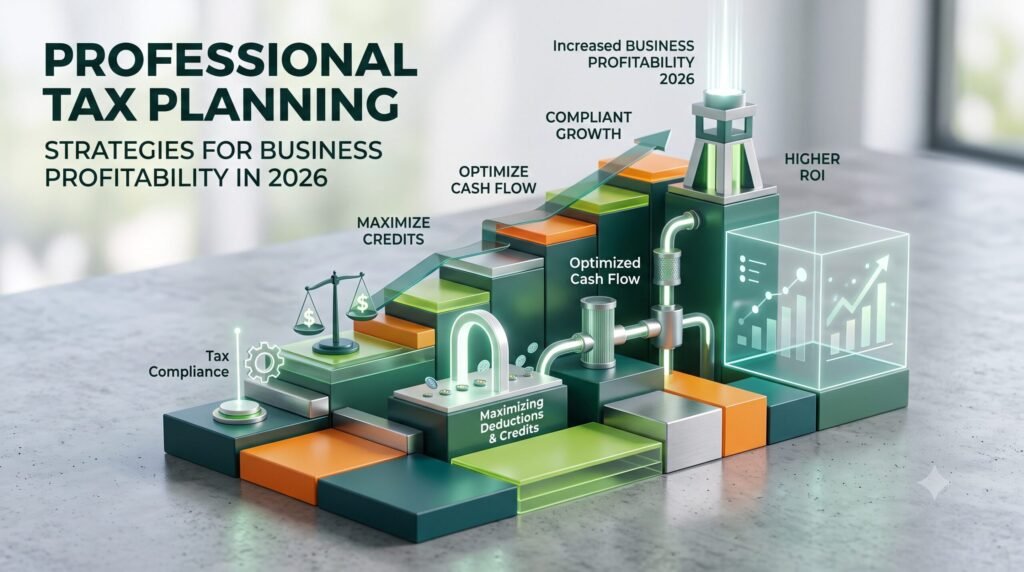
TL;DR Professional Tax Planning helps businesses improve profitability by legally reducing avoidable tax leakage, improving cash-flow planning, optimising expenses, managing GST input tax credit, planning advance tax, avoiding penalties, and making better financial decisions throughout the year. Tax planning is not only about saving tax at the end of the financial year. For growing businesses, it should be a year-round financial strategy. The businesses that plan taxes early usually manage cash better, reduce compliance risk, and retain more profit. Why Tax Planning Matters for Profitability Many business owners think tax planning means finding last-minute deductions before filing returns. That is only a small part of the process. Real business tax planning is much broader. It connects taxation with: Cash flow Profit margins Business structure GST input tax credit Expense planning Advance tax Investment decisions Compliance timelines Audit readiness Owner remuneration Expansion strategy A business may earn good revenue but still lose money through poor tax planning. This happens when taxes are paid late, deductions are missed, GST credits are not claimed correctly, expenses are poorly documented, or financial decisions are made without understanding tax impact. In 2026, businesses need professional tax planning not just to reduce tax but to protect profit. What Is Professional Tax Planning? Professional Tax Planning is the process of legally arranging business income, expenses, investments, compliance, entity structure, GST credits, tax payments, and documentation to reduce avoidable tax costs and improve financial efficiency. It involves reviewing: Business income Expense eligibility Tax deductions Depreciation GST input tax credit TDS compliance Advance tax Owner remuneration Business structure Capital expenditure Related-party transactions Cash flow impact Compliance deadlines The objective is simple: Pay the right tax legally, avoid unnecessary leakage, and improve business profitability. Tax Planning vs Tax Saving vs Tax Evasion Business owners must understand the difference. Term Meaning Legal Status Tax Planning Legal arrangement of business finances to optimise tax Legal Tax Saving Using eligible deductions, exemptions and benefits Legal Tax Avoidance Aggressive arrangements exploiting loopholes Risky Tax Evasion Hiding income or false reporting Illegal Professional Tax Planning is legal, documented, and based on real business activity. It does not involve hiding income, fake bills, inflated expenses, or artificial transactions. How Professional Tax Planning Improves Profitability 1. Better Cash Flow Management Taxes affect cash flow. If a business does not plan tax payments in advance, it may face sudden cash pressure near due dates. Common examples include: Advance tax payments GST liability TDS payments Income tax payments Tax audit-related adjustments Interest due to delayed payments Professional tax planning helps businesses forecast tax outflows in advance. This allows owners to plan working capital, vendor payments, salaries, inventory purchases, and expansion decisions more confidently. Example A business that estimates tax liability quarterly can set aside funds each month instead of facing a large tax payment at the last moment. This improves cash control and reduces stress. 2. Lower Avoidable Tax Leakage Tax leakage happens when a business pays more tax than necessary because of poor planning or weak documentation. Common causes include: Missed deductions Incorrect expense classification Unclaimed depreciation Ineligible tax positions Lost GST input tax credit Late filing penalties Interest on delayed payments Poor TDS compliance Incomplete records Professional tax planning identifies these leakages before they become costly. Profitability improves not only by increasing revenue but also by reducing avoidable loss. 3. Optimised Business Expenses Not every expense is automatically allowed as a business deduction. Expenses should be: Genuine Business-related Properly documented Paid through traceable channels Supported by invoices or agreements Compliant with TDS and GST rules where applicable Professional review helps businesses classify expenses correctly and maintain evidence. Common expense areas requiring review include: Consultancy fees Professional charges Marketing expenses Travel Software subscriptions Rent Repairs Interest Director remuneration Employee benefits When expenses are planned and documented properly, tax positions become stronger. 4. Improved GST and ITC Control GST input tax credit has a direct impact on cash flow. If ITC is missed, blocked, reversed, or incorrectly claimed, profitability suffers. Professional tax planning includes GST review to ensure: Eligible ITC is claimed Ineligible ITC is not claimed GSTR-2B is reconciled Vendor compliance is monitored GST returns match books Credit notes are tracked Reverse charge is reviewed GST liability is planned A business that manages ITC well can reduce unnecessary cash blockage. 5. Better Advance Tax Planning Advance tax is often ignored until due dates approach. This creates two risks: Cash-flow pressure Interest liability Professional tax planning helps estimate tax liability throughout the year. Businesses should review profits quarterly and plan advance tax accordingly. This is especially important for businesses with: Seasonal income Large contracts High profits Capital gains New branches Rapid growth Variable margins Advance tax planning avoids last-minute surprises. 6. Stronger Entity and Salary Structuring Business structure affects tax efficiency. The tax impact may differ depending on whether the business operates as: Proprietorship Partnership LLP Private Limited Company Professional firm Group entity Professional planning helps evaluate: Founder remuneration Partner remuneration Director salary Dividend policy Profit retention Loan structure Related-party transactions Business expansion structure The right structure can support long-term profitability and compliance. 7. Fewer Penalties and Interest Costs Penalties and interest are avoidable costs. They usually arise due to: Late GST filing Late TDS payment Incorrect TDS deduction Delayed income tax filing Incorrect advance tax payment Wrong GST reporting Tax audit delays ROC compliance gaps Professional tax planning creates a compliance calendar and review process. This reduces avoidable costs that directly reduce business profit. 8. Better Investment and Expansion Decisions Tax planning also helps with business decisions. Before making major decisions, owners should review tax impact. Examples: Buying machinery Hiring senior employees Opening a new branch Raising funds Taking business loans Purchasing commercial property Launching a new product Entering export markets Giving discounts Changing pricing models A business decision that looks profitable before tax may look different after tax. Professional advice helps owners evaluate the real financial impact. Tax Planning Checklist for Businesses in 2026 Area What to Review Frequency Profit Projection Estimated annual profit Quarterly Advance
GST Reconciliation Best Practices for Businesses
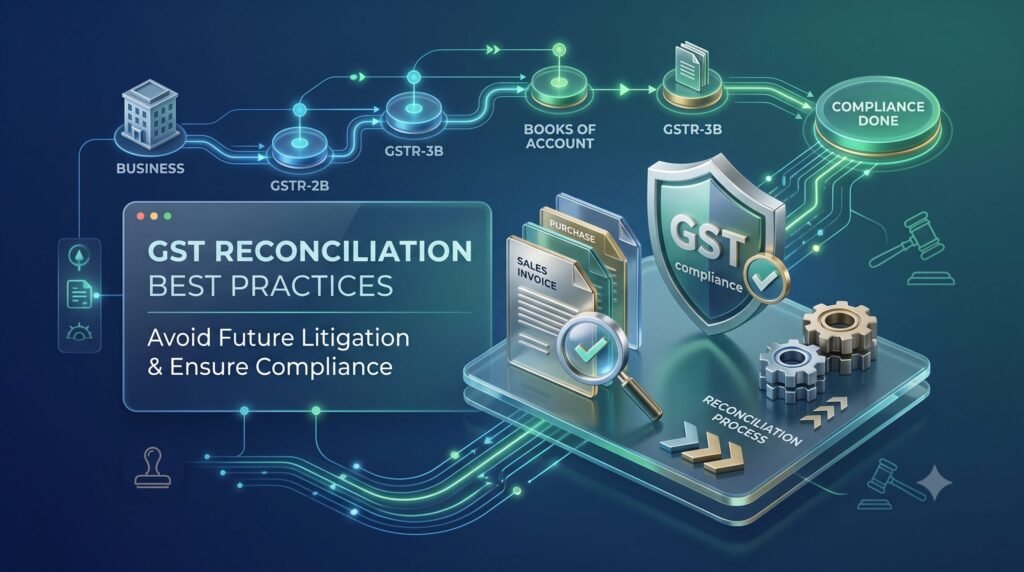
TL;DR GST reconciliation is the process of matching GST returns, books of accounts, purchase records, sales records, GSTR-2B, GSTR-1, GSTR-3B, e-invoices, and vendor filings to ensure that tax reporting is accurate. Businesses that do not reconcile GST data regularly may face input tax credit mismatches, tax notices, interest, penalties, blocked credits, vendor disputes, and future litigation. The best approach is simple: reconcile GST every month, document every difference, follow up with vendors, correct errors early, and maintain a clear audit trail. Why GST Reconciliation Matters in 2026 GST compliance has become more data-driven and system-led. The GST portal, e-invoicing system, GSTR-2B, GSTR-1, GSTR-3B, e-way bills, and accounting records are now closely connected. If one record does not match another, the mismatch can create future tax risk. Earlier, many businesses treated GST reconciliation as a year-end exercise. That approach is no longer safe. A small mismatch today can become: ITC reversal Interest liability GST notice Department scrutiny Vendor dispute Cash flow blockage Audit objection Litigation risk For growing businesses, GST reconciliation is not just a compliance task. It is a financial control process. What Is GST Reconciliation? GST reconciliation means comparing GST data across different records to confirm that sales, purchases, tax liability, input tax credit, debit notes, credit notes, reverse charge, and tax payments are correctly reported. In simple terms, GST reconciliation answers four questions: Have all sales been reported correctly? Has the correct tax liability been paid? Is input tax credit claimed only where eligible? Do GST returns match books of accounts? If the answer to any of these is unclear, the business has a compliance risk. Key GST Records Businesses Must Reconcile 1. GSTR-1 GSTR-1 contains invoice-level details of outward supplies. Businesses should reconcile GSTR-1 with: Sales register E-invoices Credit notes Debit notes Export invoices B2B and B2C sales records Mistakes in GSTR-1 can affect the buyer’s ITC and create disputes with customers. 2. GSTR-3B GSTR-3B is the summary return showing tax liability, input tax credit, reversals, and tax payment. Businesses should compare GSTR-3B with: GSTR-1 Sales register Purchase register GSTR-2B Tax payment challans Accounting records Mismatch between GSTR-1 and GSTR-3B is one of the most common GST risk areas. 3. GSTR-2B GSTR-2B is a static auto-drafted input tax credit statement. It shows ITC available based on supplier filings. Businesses should reconcile GSTR-2B with: Purchase register Vendor invoices Goods received records Expense invoices Debit notes Credit notes Claiming ITC without checking GSTR-2B can lead to mismatch and future dispute. 4. Purchase Register The purchase register is the internal record of all purchases and expenses. It should be checked for: Correct GSTIN Invoice number Invoice date Taxable value GST rate CGST, SGST, IGST Reverse charge applicability Vendor filing status ITC eligibility A clean purchase register is essential for accurate ITC claims. 5. Sales Register The sales register should match outward supplies reported in GSTR-1 and books. Review: Invoice values GST rates HSN/SAC codes Place of supply B2B/B2C classification Export invoices Credit notes Debit notes Incorrect sales reporting can lead to tax liability mismatch. 6. E-Invoices and E-Way Bills Businesses covered under e-invoicing or e-way bill requirements must ensure that portal data matches accounting records. Mismatch may arise due to: Cancelled invoices Duplicate invoices Wrong invoice values Incorrect GSTIN Delayed accounting entries Incorrect movement details These differences should be reviewed before return filing. Common GST Mismatches That Lead to Notices Mismatch Type Possible Risk GSTR-1 vs GSTR-3B mismatch Tax demand or scrutiny GSTR-2B vs purchase register mismatch ITC reversal Books vs GST returns mismatch Audit objection E-invoice vs GSTR-1 mismatch Reporting issue GST vs income tax turnover mismatch Cross-tax scrutiny Vendor not filing returns ITC dispute Incorrect GST rate Tax short payment Wrong place of supply CGST/SGST/IGST error Duplicate ITC claim Penalty risk Missing credit notes Excess or short reporting GST Reconciliation Best Practices 1. Reconcile GST Monthly, Not Annually GST reconciliation should be done every month. Annual reconciliation often identifies problems too late. Monthly reconciliation helps businesses: Correct errors early Follow up with vendors Avoid ITC loss Reduce interest exposure Prevent return mismatches Maintain audit-ready records 2. Match GSTR-1 with Sales Register Before Filing Before filing GSTR-1, compare it with internal sales data. Check: Invoice numbers Invoice dates Customer GSTIN Taxable value GST rate Tax amount Credit notes Debit notes Export details This reduces customer disputes and return mismatch risk. 3. Match GSTR-3B with GSTR-1 GSTR-3B should not be filed casually. Before filing, check whether outward supply and tax liability match GSTR-1. If differences exist, document the reason. Common reasons may include: Amendments Credit notes Timing differences Advances Exempt supplies Rounding differences Every difference should be explainable. 4. Reconcile GSTR-2B with Purchase Register This is one of the most important GST controls. Compare GSTR-2B with purchase records to identify: Invoices present in books but missing in GSTR-2B Invoices present in GSTR-2B but missing in books Value mismatch GSTIN mismatch Duplicate invoices Ineligible ITC Blocked credits Vendor filing delays Do not blindly claim ITC only because an invoice is in the books. 5. Track Vendor Compliance Your ITC depends heavily on vendor compliance. Businesses should monitor whether vendors: File GSTR-1 on time Report invoices correctly Use correct GSTIN Mention correct invoice value Correct mismatches promptly Issue valid tax invoices Create a vendor compliance scorecard for major suppliers. 6. Maintain an ITC Eligibility Review Not every GST invoice gives eligible ITC. Review blocked and ineligible credits carefully. Common areas include: Personal expenses Motor vehicle-related restrictions Food and beverages Club memberships Employee benefits Construction-related restrictions Expenses not used for business Claiming ineligible ITC can lead to reversal, interest, and litigation. 7. Document Every Difference Not every mismatch is an error. Some differences are due to timing. However, every difference must be documented. Maintain a reconciliation sheet with: Invoice number Vendor/customer name GSTIN Difference amount Reason for mismatch Action required Responsible person Closure date This creates a strong audit trail. 8. Review Credit Notes and Debit Notes Carefully Credit notes and debit notes often create GST mismatches. Check whether: Credit notes are
Outsourced Accounting vs In-House Finance Team: Cost Comparison for Indian Businesses
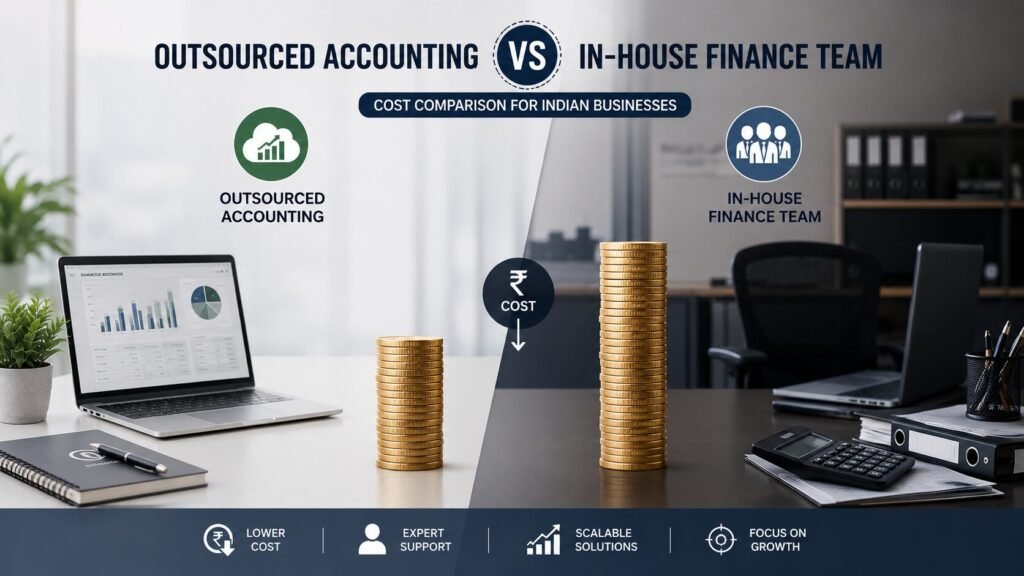
TL;DR Outsourced Accounting is often more cost-effective for Indian SMEs, startups, consultants, service businesses, and growing companies that need reliable bookkeeping, GST compliance, TDS support, tax coordination, MIS reporting, and financial review without hiring a full finance team. An in-house finance team gives stronger daily control but comes with salary, recruitment, training, software, supervision, compliance, and employee overhead costs. For many Indian businesses, the best model is not purely outsourced or fully in-house. A hybrid model works better: internal operational support plus outsourced CA-led accounting, compliance, reporting, and advisory review. Why This Decision Matters for Indian Businesses Every business needs accurate accounting. But not every business needs a full in-house finance department from day one. As businesses grow, financial work becomes more complex. Owners must manage: Sales entries Purchase records Bank reconciliation GST returns TDS compliance Payroll entries Vendor payments Customer collections Cash flow reporting Financial statements Audit support Income tax planning Management reports At this point, many business owners ask a practical question: Should we outsource accounting or hire an in-house finance team? The right answer depends on size, transaction volume, compliance complexity, management control, budget, and growth stage. This guide explains the real cost difference between outsourced accounting and in-house finance teams for Indian businesses. What Is Outsourced Accounting? Outsourced Accounting means hiring an external professional firm or accounting team to manage your accounting, bookkeeping, compliance, reporting, and related finance functions. Depending on the scope, outsourced accounting may include: Bookkeeping Bank reconciliation Accounts payable Accounts receivable GST data preparation TDS coordination Payroll accounting MIS reports Financial statements Audit support Tax filing support Compliance tracking Virtual CFO-style review For SMEs, outsourced accounting gives access to accounting expertise without building a full internal department. What Is an In-House Finance Team? An in-house finance team means hiring employees within the business to manage accounting and finance work. A basic in-house setup may include: Junior accountant Senior accountant Accounts manager Finance manager Tax/compliance executive CFO or controller, for larger companies This model offers daily internal access and stronger operational control. However, it also comes with fixed monthly costs and supervision responsibility. Cost Comparison: Outsourced Accounting vs In-House Finance 1. Salary Cost Salary is the most visible cost of an in-house finance team. A small business may begin with one accountant. But as compliance and reporting needs increase, one person may not be enough. Typical In-House Cost Components Role Approximate Annual Cost Range Junior Accountant ₹3 lakh – ₹5 lakh Senior Accountant ₹5 lakh – ₹9 lakh Accounts Manager ₹8 lakh – ₹15 lakh Finance Manager ₹12 lakh – ₹25 lakh CFO / Senior Finance Head ₹30 lakh+ Apart from salary, employers may also bear: Bonus PF/ESI, where applicable Leave encashment Gratuity Recruitment cost Replacement cost Training cost Office space Software subscriptions Outsourced accounting usually works on a monthly retainer or service package, which is easier to budget. 2. Recruitment and Training Cost Hiring finance employees takes time. Business owners must spend time on: Screening candidates Interviews Salary negotiation Onboarding Training Process handover Monitoring performance If the employee leaves, the process repeats. In accounting, employee turnover can create serious problems because the person leaving may know vendor balances, customer dues, tax records, filing history, and internal processes. Outsourced accounting reduces this dependency because the service is handled by a team rather than one individual. 3. Software and Infrastructure Cost In-house teams need tools. Common costs include: Accounting software Payroll software GST reconciliation tools TDS tools Cloud storage Office systems Data backup Cybersecurity Workstation cost Internet and admin support Outsourced accounting firms often already have trained teams and established systems, reducing the need for the business to invest separately in every tool. 4. Compliance Expertise Cost Indian businesses deal with multiple compliance areas: GST TDS Income tax ROC Payroll compliance Professional tax Audit requirements E-invoicing, where applicable Tax audit, where applicable A single in-house accountant may not have expertise across all areas. This creates two options: Hire multiple specialists Use external professional support Outsourced accounting gives access to broader expertise without hiring separate employees for every function. 5. Management Time Cost Many owners underestimate this cost. An in-house finance team still needs supervision. The business owner or senior management must review: Accuracy of entries Pending reconciliations GST filing data Vendor payments Customer collections Salary processing Tax deadlines Monthly reports If the owner spends several hours every week correcting finance issues, that is a real cost. A professional outsourced accounting setup can reduce management involvement by creating structured reports and review systems. Outsourced Accounting vs In-House Finance: Practical Cost Table Cost Factor Outsourced Accounting In-House Finance Team Monthly Cost Predictable retainer Fixed salary cost Recruitment Not required by business Required Training Handled by service provider Business responsibility Software Often included or guided Business pays directly Compliance Expertise Team-based Depends on hired staff Scalability Easy to upgrade Requires hiring Supervision Lower Higher Data Access Structured sharing required Immediate internal access Best For SMEs, startups, growing businesses Larger businesses with high daily volume Benefits of Outsourced Accounting 1. Lower Fixed Cost Outsourcing converts a fixed employee cost into a service cost. This is useful for businesses that need accounting support but do not yet need a full-time team. 2. Access to Wider Expertise Instead of depending on one accountant, businesses can access professionals familiar with GST, TDS, bookkeeping, tax planning, audit support, and financial reporting. 3. Better Compliance Tracking Professional accounting firms usually follow due-date calendars and compliance review systems. This reduces the risk of missed filings. 4. Scalable Support As the business grows, the accounting scope can expand. For example: Basic bookkeeping GST reconciliation Monthly MIS Payroll accounting Tax planning Audit support Virtual CFO advisory 5. Reduced Employee Dependency If one internal accountant leaves, work may stop. With outsourcing, continuity is easier because the service provider manages team backup. 6. Better Reporting Discipline Outsourced accounting can improve monthly reporting through structured deliverables such as: Profit & Loss Statement Balance Sheet Cash Flow Statement Debtor ageing Creditor ageing GST summary Expense analysis MIS dashboard Benefits of
Financial Red Flags Every Business Owner Should Monitor Before They Become Costly
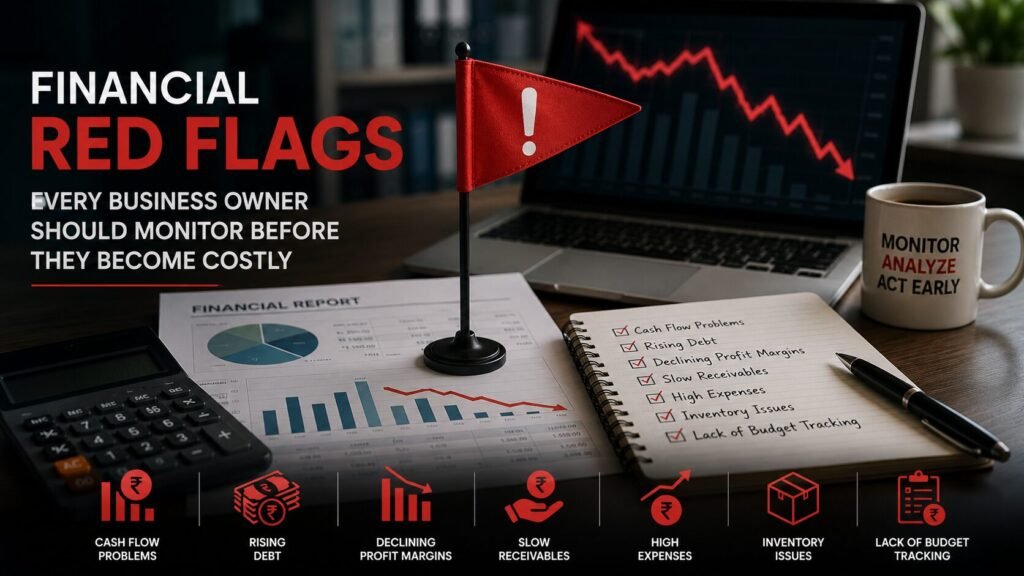
TL;DR Financial red flags are early warning signs that a business may face cash flow stress, declining profitability, tax issues, compliance problems, rising debt, or poor financial control. The most common red flags include profits not converting into cash, rising receivables, falling margins, uncontrolled expenses, delayed tax payments, excessive borrowing, poor reconciliation, slow inventory movement, and unclear financial reporting. Business owners should not wait for year-end accounts to identify these problems. A monthly financial review can help detect issues early and prevent costly damage. Why Financial Red Flags Should Never Be Ignored Most business problems do not appear suddenly. They build slowly. A business may look stable from the outside while financial pressure develops inside. Sales may be growing, but collections may be delayed. Profit may appear healthy, but cash may be stuck in receivables. GST or TDS payments may be postponed once, then repeatedly. Expenses may rise month after month without proper review. By the time these problems become visible, the business may already be under pressure. That is why business owners must monitor financial red flags before they become costly. Financial discipline is not only for large companies. SMEs, startups, traders, manufacturers, consultants, agencies, and service businesses all need regular financial visibility. What Are Financial Red Flags? Financial red flags are warning signs that indicate possible weakness in business performance, accounting quality, cash flow, compliance, profitability, or internal controls. They do not always mean the business is failing. However, they signal that something requires attention. For example: Sales are rising but bank balance is falling Profit margins are shrinking Customers are taking longer to pay Tax payments are being delayed Inventory is not moving Expenses are increasing without explanation Loans are used for daily operations Financial reports are not ready on time These signs should be investigated early. 12 Financial Red Flags Every Business Owner Should Monitor 1. Profit Is Growing but Cash Is Not This is one of the most dangerous financial red flags. A business may show profit in the Profit & Loss Statement but still struggle with cash. This usually happens when: Customers delay payments Inventory blocks working capital Expenses are paid before collections Revenue is booked but cash is not received Loans and EMIs consume cash Tax liabilities are not planned Example A business shows ₹20 lakh monthly sales and healthy profit, but ₹12 lakh remains unpaid by customers every month. The P&L may look good, but cash flow becomes weak. What to Monitor Operating cash flow Bank balance trend Receivable ageing Cash conversion cycle Monthly cash surplus or deficit Profit is important, but cash keeps the business running. 2. Receivables Are Increasing Faster Than Sales If customers are taking longer to pay, the business effectively finances its customers. This creates pressure on: Vendor payments Salary payments Tax payments Loan repayments Working capital Warning Signs Debtors older than 60 or 90 days No follow-up system Credit sales without policy Large unpaid invoices Repeated payment delays from key clients What to Do Prepare debtor ageing monthly Set credit limits Follow up before due dates Stop extending credit to risky customers Link sales incentives to collections, not just billing High sales with poor collections can quietly damage cash flow. 3. Gross Margins Are Falling Gross margin shows whether your core business is profitable before overheads. Falling gross margins may indicate: Rising purchase costs Poor pricing Discounts given too frequently Product mix issues Wastage Vendor cost increases Underbilling Operational inefficiency What to Monitor Gross margin by product or service Cost of goods sold Purchase price changes Discount levels Client-wise profitability Project-wise profitability If margins fall for multiple months, the business must review pricing and costs immediately. 4. Expenses Are Rising Without Revenue Growth Every business has expenses. The problem starts when expenses grow faster than revenue. Common uncontrolled expenses include: Marketing costs Rent Salaries Travel Software subscriptions Consultant payments Business promotion expenses Interest costs Admin expenses Warning Signs Monthly expenses increase but sales remain flat Multiple small expenses go unchecked Subscription costs are not reviewed Personal and business expenses mix No budget approval process What to Do Create a monthly expense variance report. Compare: Budget vs actual Current month vs previous month Current year vs previous year Expense as percentage of revenue Cost control does not mean cutting essential expenses. It means spending with visibility. 5. Business Depends Too Much on Short-Term Borrowing Loans are not always bad. Borrowing can support growth. But if short-term borrowing is regularly used to cover daily expenses, it is a red flag. Warning Signs Overdraft limit always fully used Credit card used for business expenses Vendor payments delayed due to cash shortage Loans used to pay taxes or salaries New borrowing used to repay old borrowing Interest cost increasing every month What to Monitor Debt-to-equity ratio Interest coverage EMI schedule Working capital cycle Borrowing purpose Cash flow forecast Borrowing should support growth, not hide poor cash flow. 6. GST, TDS or Tax Dues Are Getting Delayed Tax delays are not only compliance issues. They are also cash-flow warning signs. If a business repeatedly delays GST, TDS, income tax, advance tax, PF, professional tax, or ROC payments, it may indicate poor planning. Risks Interest Penalties Notices Blocked credits Audit issues Reputation concerns Funding due diligence problems What to Do Maintain a statutory dues calendar. Review tax liabilities before the due date, not on the due date. 7. Inventory Is Moving Slowly For trading, manufacturing, retail, and D2C businesses, slow inventory is a serious red flag. Inventory blocks cash. Warning Signs Old stock remains unsold High inventory but low cash Frequent stock write-offs Dead stock not identified Purchase decisions made without demand planning Inventory records do not match physical stock What to Monitor Inventory ageing Stock turnover ratio Dead stock value Fast-moving vs slow-moving products Purchase-to-sales ratio A business can be profitable on paper but cash-starved because too much money is sitting in stock. 8. Bank Reconciliation Is Not Updated Bank reconciliation is basic but critical. If bank reconciliation is not updated
Why Businesses Receive Income Tax Notices and How to Prevent Them Legally
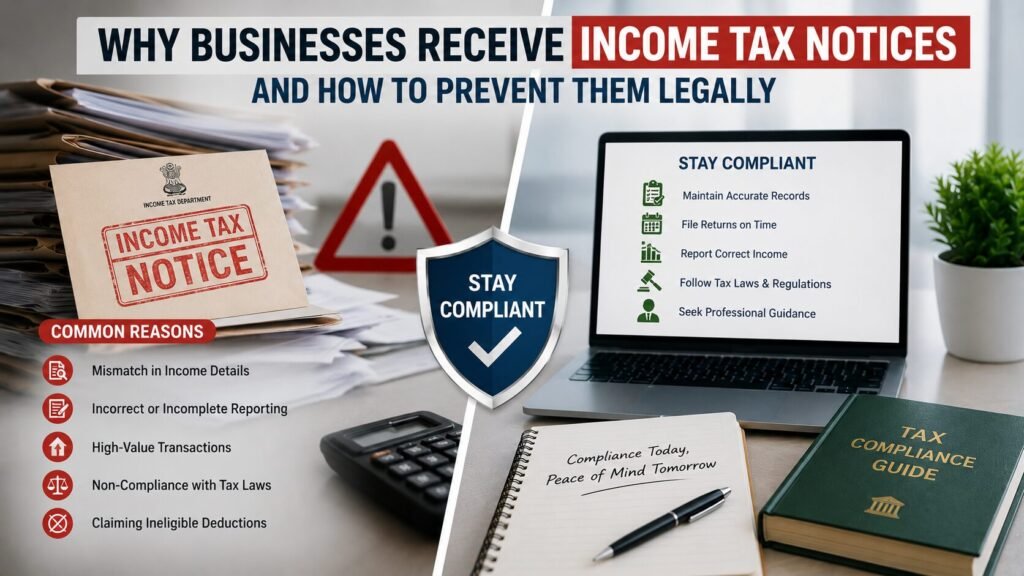
TL;DR Businesses usually receive an income tax notice because the Income Tax Department finds a mismatch, missing disclosure, delayed filing, high-value transaction, incorrect claim, or unexplained entry in the return. Common triggers include AIS mismatch, Form 26AS mismatch, TDS differences, GST turnover mismatch, high-value transactions, incorrect income reporting, excessive deductions, defective returns, and tax audit issues. Most notices can be prevented legally through accurate bookkeeping, timely filing, proper reconciliation, supporting documentation, tax planning, and professional review before filing returns. Why Income Tax Notices Are Becoming More Common Income tax compliance in India has become heavily data-driven. The Income Tax Department now receives financial information from multiple reporting sources such as banks, stock exchanges, mutual funds, property registrars, GST records, TDS statements, TCS reports, and other specified financial transaction reports. This data appears in documents such as: AIS TIS Form 26AS TDS statements TCS statements GST returns SFT reports Bank transaction reports When the income tax return does not match the data available with the department, the system can flag the case for review. For businesses, this means one thing clearly: Tax filing is no longer only about entering numbers in the return. It is about making sure every reported figure matches supporting records across multiple systems. What Is an Income Tax Notice? An income tax notice is an official communication from the Income Tax Department asking the taxpayer to explain, correct, verify, or respond to a specific issue. A notice may be issued for: Mismatch in income Missing disclosure Defective return Scrutiny assessment High-value transaction TDS mismatch Tax demand Non-filing of return Reassessment Refund adjustment Clarification of records Not every notice means tax fraud or penalty. Many notices are triggered by data mismatch, reporting differences, or clerical errors. However, ignoring a notice can make the matter serious. Common Reasons Businesses Receive Income Tax Notices 1. AIS, TIS and Form 26AS Mismatches AIS, TIS and Form 26AS are important tax information records. They may contain details of: Interest income TDS deducted TCS collected Sale of securities Mutual fund transactions Property transactions Dividend income Business receipts High-value transactions If the income reported in the ITR does not match these records, a notice may be triggered. Example A business reports ₹85 lakh turnover in its ITR, but the information available in AIS indicates receipts of ₹95 lakh through reported transactions. This difference can create a mismatch and lead to a notice. Prevention Before filing the return: Download AIS Review TIS Check Form 26AS Match with books of accounts Submit AIS feedback where data is incorrect Keep supporting documents ready 2. TDS and TCS Differences TDS and TCS mismatches are common in business tax filing. Reasons include: Deductor filed incorrect TDS return PAN mismatch TDS not reflected in Form 26AS Income booked in a different year Wrong section used by deductor TDS claimed without corresponding income TCS shown but transaction not disclosed Prevention Reconcile TDS and TCS with: Books of accounts Form 26AS AIS Customer/vendor confirmations Tax credit statements Never claim tax credit without checking whether the related income has also been reported correctly. 3. High-Value Transactions High-value transactions are reported to the Income Tax Department by banks, registrars, mutual funds, credit card companies, and other reporting entities. Examples may include: Large cash deposits Property purchases Sale of immovable property High credit card payments Large investments Share and mutual fund transactions Foreign remittances Fixed deposit transactions If these transactions are not properly explained in the ITR or books, a notice may follow. Prevention Maintain proper source documentation for every major transaction. Examples: Bank statements Sale deeds Investment statements Loan agreements Gift deeds Board approvals Capital introduction records Customer receipts The goal is not to avoid legitimate transactions. The goal is to ensure they are properly reported and explainable. 4. GST Turnover vs Income Tax Return Mismatch For businesses registered under GST, turnover reported in GST returns may be compared with income reported in the income tax return. Mismatch may arise due to: Different reporting periods Credit notes Debit notes Advances Exempt supplies Export turnover Accounting errors Unreconciled sales Incorrect GST reporting Example GST returns show outward taxable supplies of ₹1.8 crore, but the business reports gross receipts of ₹1.55 crore in the ITR without proper reconciliation. This can lead to scrutiny. Prevention Prepare a GST-to-ITR turnover reconciliation before filing income tax returns. 5. Incorrect Income Reporting Businesses may receive notices when income is underreported, misclassified, or omitted. Common issues include: Business income shown as other income Interest income not reported Rental income missed Capital gains not disclosed Foreign income omitted Professional receipts not fully reported Commission income ignored Cash sales not recorded Prevention Create an income classification review before return filing. Every receipt should be mapped to the correct tax head. 6. Excessive or Unsupported Expense Claims The department may question expenses that appear unusual, excessive, unsupported, or unrelated to business. Commonly reviewed expenses include: Travel Consultancy charges Commission payments Advertisement expenses Repairs and maintenance Cash expenses Related-party payments Professional fees Business promotion expenses Prevention Maintain: Bills Agreements Payment proofs Work completion evidence GST invoices TDS compliance records Board approvals where required Expenses should be genuine, business-related, and properly documented. 7. Delayed or Non-Filing of Income Tax Return Late filing or non-filing can trigger notices. Businesses may be flagged if: Tax has been deducted but return is not filed GST turnover exists but ITR is missing High-value transactions exist but no return is filed Previous years were filed but current year is missing Advance tax was paid but return is not filed Prevention Maintain a compliance calendar. Track: ITR due dates Tax audit due dates Advance tax dates TDS return dates GST return dates ROC filing dates 8. Defective Return Filing A return may be treated as defective when key information is incomplete, inconsistent, or technically incorrect. Common causes include: Wrong ITR form Missing balance sheet details Missing P&L details Incorrect audit information Mismatch in tax paid Incomplete schedules Wrong business code Missing partner/director details Prevention Review the return carefully before filing. A
LLP vs Private Limited Company: A Complete Decision Guide for Entrepreneurs
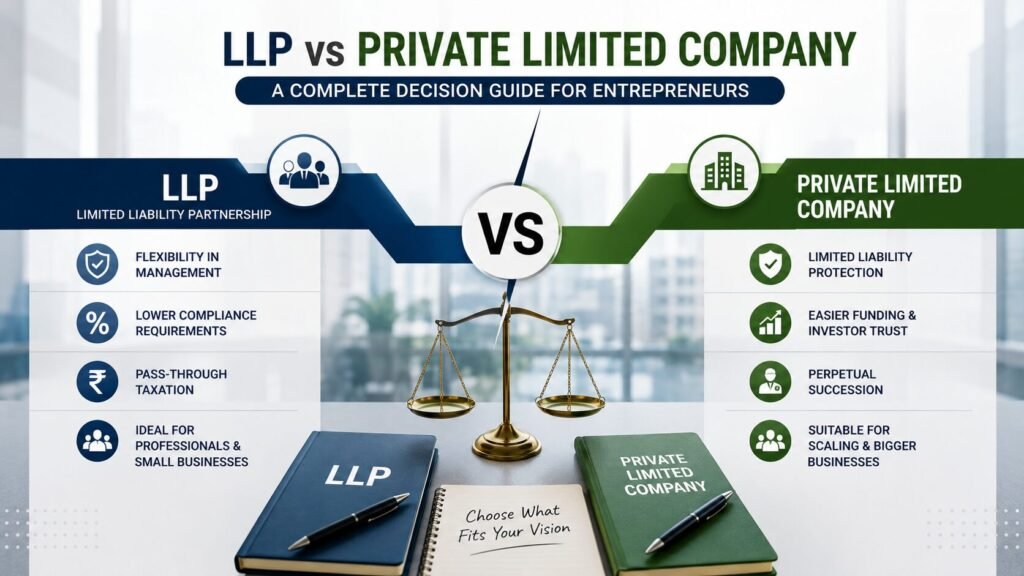
TL;DR Choosing between an LLP and a Private Limited Company depends on your business model, funding plans, compliance capacity, ownership structure, and long-term growth vision. An LLP is generally suitable for professionals, consultants, service businesses, and closely held ventures that want limited liability with relatively simpler compliance. A Private Limited Company is better suited for startups, scalable businesses, investor-backed ventures, and companies planning to raise funds, issue shares, build ESOPs, or expand aggressively. For most entrepreneurs, the right question is not “Which structure is cheaper?” The better question is: Which structure supports your business goals for the next 3–5 years? Why Choosing the Right Business Structure Matters Business registration is one of the first major decisions an entrepreneur makes. It affects taxation, compliance, investor confidence, ownership rights, liability, fundraising, governance, and future expansion. Many founders choose an entity based only on reg istration cost. That is a mistake. A structure that looks affordable today may become restrictive lat er. For example, an LLP may work well for a consulting firm, but it may not be ideal for a startup planning to raise venture capital. Similarly, a Private Limited Company may offer strong credibility but also comes with higher compliance responsibilities. Entrepreneurs should choose the structure based on: Business model Number of founders Funding plans Expected revenue scale Compliance capacity Tax planning Exit strategy Investor expectations Long-term expansion goals This guide explains the difference between LLP vs Private Limited Company in practical terms. What Is an LLP? LLP stands for Limited Liability Partnership. It combines features of a partnership firm and a company. Partners can manage the business directly while enjoying limited liability protection. In an LLP, the liability of partners is generally limited to their agreed contribution. This means personal assets are usually protected against business liabilities, subject to fraud, negligence, or personal guarantees. LLPs are commonly preferred by: Consultants Chartered accountants Lawyers Architects Small service businesses Family-run ventures Professional firms Agencies Closely held businesses An LLP is flexible, relatively easier to manage, and suitable where external equity funding is not a major goal. What Is a Private Limited Company? A Private Limited Company is a separate legal entity registered under the Companies Act, 2013. It has shareholders, directors, share capital, board governance, statutory records, and formal compliance requirements. Private Limited Companies are commonly preferred by: Startups Technology companies D2C brands SaaS businesses Manufacturing companies Fundraising-focused ventures Scalable service businesses Companies planning ESOPs Businesses targeting institutional investors A Private Limited Company is usually seen as more structured, scalable, and investor-friendly. LLP vs Private Limited Company: Quick Comparison Factor LLP Private Limited Company Governing Law LLP Act, 2008 Companies Act, 2013 Owners Partners Shareholders Management Designated Partners Directors Liability Limited Limited Compliance Moderate Higher Investor Funding Limited suitability Highly suitable ESOPs Not ideal Suitable Ownership Transfer Less flexible More flexible Credibility Good Stronger for scaling Best For Professionals, consultants, SMEs Startups, scalable companies, investor-backed ventures Key Differences Entrepreneurs Should Understand 1. Ownership Structure In an LLP, ownership rests with partners. Their rights, profit-sharing ratio, capital contribution, and responsibilities are governed by the LLP agreement. In a Private Limited Company, ownership is represented through shares. Shareholders own the company, while directors manage operations. This difference becomes important when: New investors enter Founders exit Ownership changes ESOPs are issued Shares are transferred Valuation is negotiated A Private Limited Company offers a clearer ownership structure for investor-backed businesses. 2. Liability Protection Both LLP and Private Limited Company provide limited liability protection. However, limited liability does not mean unlimited protection. Founders or partners may still become personally liable in cases involving: Fraud Misrepresentation Personal guarantees Non-compliance Wrongful conduct Statutory defaults For normal business risks, both structures protect personal assets better than a traditional partnership or proprietorship. 3. Compliance Burden Compliance is one of the biggest practical differences. An LLP generally has fewer annual compliance requirements compared to a Private Limited Company. Typical LLP compliances include: Annual return filing Statement of accounts and solvency Income tax return Audit, if applicable Partner-related filings when changes occur A Private Limited Company generally requires: Annual ROC filings Board meetings Shareholder meetings Statutory registers Director KYC Financial statements Auditor appointment Income tax filing GST and TDS compliance, if applicable Event-based MCA filings If simplicity is the main priority, LLP may be better. If scalability and investor readiness matter more, Private Limited Company is usually stronger. 4. Taxation Taxation should not be viewed only from the rate perspective. The overall tax impact depends on profits, withdrawals, remuneration, dividends, business model, and future plans. An LLP is taxed as a firm. Partners may receive remuneration or profit share depending on the LLP agreement and tax provisions. A Private Limited Company pays corporate tax, and distribution of profits to shareholders may have additional tax implications depending on the method of extraction. Entrepreneurs should review: Expected profits Founder remuneration Dividend plans Reinvestment requirements Investor entry Tax audit applicability GST and TDS obligations A CA should evaluate the tax impact before finalising the structure. 5. Funding and Investment This is where Private Limited Company usually has a clear advantage. Most angel investors, venture capital firms, private equity investors, and institutional investors prefer Private Limited Companies because shares can be issued, transferred, valued, and documented more easily. A Private Limited Company is better suited for: Angel funding Venture capital ESOPs Convertible instruments Share transfers Strategic investment Future acquisition An LLP is not the preferred structure for equity fundraising. If your business plans to raise funds, issue ESOPs, or bring in investors, Private Limited Company is usually the better choice. 6. Scalability A Private Limited Company generally offers better scalability because it has a formal governance structure. It is suitable for businesses planning: Multiple founders Senior leadership hiring Investor reporting Large contracts Expansion to multiple states Bank funding Institutional partnerships Employee stock options Merger or acquisition opportunities LLPs can also grow, but they are usually better suited for businesses where ownership remains closely held. 7. Credibility A Private Limited Company often carries stronger credibility with
Learn how Virtual CFO services help SMEs and startups manage cash flow, compliance, financial planning, fundraising, and ROI.
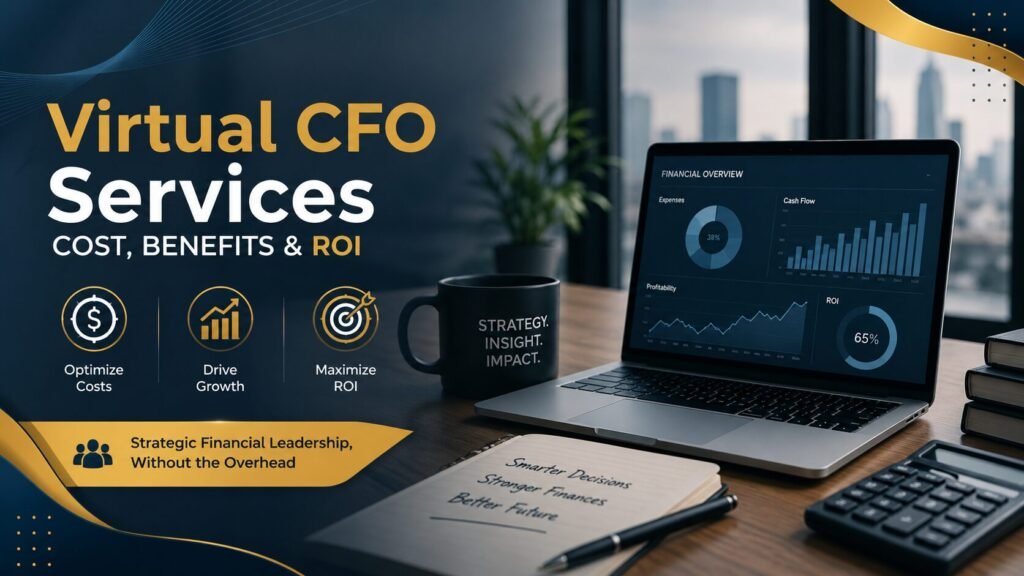
TL;DR Virtual CFO Services give SMEs and startups access to senior financial leadership without hiring a full-time CFO. A Virtual CFO helps with budgeting, cash flow, MIS reporting, compliance, financial controls, fundraising readiness, profitability analysis, and decision-making. For many growing businesses, the real ROI comes from better cash flow control, fewer compliance mistakes, stronger margins, improved investor confidence, and faster financial decisions. What Are Virtual CFO Services? Virtual CFO Services are outsourced or part-time CFO-level services provided to businesses that need strategic financial leadership but do not yet require or cannot justify a full-time CFO. A Virtual CFO works closely with business owners, founders, finance teams, accountants, and management to improve financial visibility and decision-making. Unlike a regular accountant who mainly records transactions, a Virtual CFO focuses on interpreting financial data and helping the business make better decisions. In simple terms: An accountant records what happened. A Virtual CFO explains what it means and what the business should do next. Why SMEs and Startups Need CFO-Level Support Many SMEs and startups grow faster than their financial systems. At the early stage, founders often manage finance through basic accounting software, internal staff, or outsourced bookkeeping. This works for a while. But once revenue, expenses, vendors, GST, payroll, loans, investors, and expansion plans increase, basic accounting is not enough. Common problems include: Poor cash flow visibility Delayed receivables High operating costs Weak budgeting GST and TDS compliance gaps No monthly financial review Unclear profitability Lack of investor-ready reports Poor working capital planning Founder decisions based on guesswork These issues do not always appear immediately. But they quietly affect profitability, compliance, and growth. A Virtual CFO brings structure before financial confusion becomes expensive. What Does a Virtual CFO Actually Do? A Virtual CFO does not only review accounts. The role is broader, strategic, and decision-focused. 1. Financial Planning and Budgeting A Virtual CFO helps businesses create realistic budgets based on actual revenue, expenses, margins, and growth targets. This includes: Annual budgets Monthly expense planning Department-wise budgets Revenue projections Hiring cost planning Marketing spend planning Expansion budgeting Without budgeting, businesses often discover cash shortages too late. A Virtual CFO helps founders understand how much they can spend, where they should control costs, and when expansion is financially safe. 2. Cash Flow Management Profit and cash flow are not the same. A business can be profitable on paper and still struggle to pay salaries, vendors, taxes, or loan EMIs. A Virtual CFO helps monitor: Cash inflows Cash outflows Receivables Payables Working capital Tax liabilities Monthly cash runway For startups, cash runway is critical. For SMEs, working capital discipline can decide whether growth remains sustainable. 3. MIS Reporting MIS reports help management understand business performance. A good Virtual CFO creates clear monthly reports such as: Profit & Loss summary Balance Sheet review Cash Flow Statement Revenue trend report Expense analysis Debtor ageing Creditor ageing GST liability summary Tax provision summary Margin analysis These reports allow business owners to make decisions based on numbers rather than assumptions. 4. Compliance Oversight Growing businesses face multiple compliance requirements. A Virtual CFO works with the accounting and compliance team to ensure proper tracking of: GST returns TDS compliance Income tax planning ROC compliance Audit requirements Payroll compliance Vendor documentation Statutory dues Compliance mistakes can lead to penalties, notices, blocked credits, and audit issues. Virtual CFO support helps reduce these risks through regular review. 5. Fundraising and Investor Readiness Startups preparing to raise funds need clean financial records. Investors usually review: Revenue numbers Burn rate Cash runway Margins Tax compliance Cap table Monthly MIS Financial projections Due diligence documents A Virtual CFO helps prepare investor-ready financials and strengthens founder confidence during fundraising discussions. For startups, this can directly improve credibility. 6. Profitability and Cost Control Many businesses focus heavily on sales but ignore margins. A Virtual CFO helps identify: High-cost activities Low-margin products Unprofitable clients Excess overheads Pricing issues Cash leakage Working capital inefficiencies Revenue growth without margin control can create financial stress. A Virtual CFO ensures growth is profitable, not just visible. Virtual CFO Services vs Accountant vs Full-Time CFO Role Best For Key Function Limitation Accountant Basic bookkeeping Records transactions Limited strategic advice Tax Consultant Compliance Tax filing and advisory May not manage business finance Virtual CFO SMEs and startups Financial strategy, reporting, cash flow, compliance oversight Part-time or outsourced model Full-Time CFO Larger companies Complete finance leadership Higher fixed cost For most growing SMEs and startups, Virtual CFO Services offer the right balance between expertise and affordability. Virtual CFO Services Cost in India Virtual CFO cost depends on business size, transaction volume, reporting needs, compliance complexity, and involvement level. Typical cost factors include: Monthly revenue size Number of transactions GST and TDS complexity Number of entities Fundraising support required MIS reporting frequency Audit readiness needs Team supervision requirements Common Pricing Models Model Suitable For Cost Nature Monthly Retainer SMEs and startups Fixed monthly fee Project-Based Fundraising, cleanup, due diligence One-time fee Hourly Advisory Specific financial decisions Pay-as-needed Hybrid Model Growing companies Retainer + project support Instead of looking only at cost, businesses should evaluate whether the service improves financial control, saves management time, prevents mistakes, and supports better decisions. Key Benefits of Virtual CFO Services 1. Better Financial Visibility Business owners get clear monthly reports instead of scattered numbers. This improves decision-making. 2. Improved Cash Flow Control A Virtual CFO helps track receivables, payables, tax dues, and runway. This reduces cash surprises. 3. Stronger Compliance Discipline Regular review helps prevent missed filings, GST mismatches, TDS errors, and audit gaps. 4. Better Profitability Expense analysis and margin tracking help identify where profits are leaking. 5. Investor Readiness Startups can prepare financial projections, MIS reports, and due diligence documents more professionally. 6. Scalable Finance Function Businesses get CFO-level support without immediately hiring a full-time finance leader. 7. Better Founder Focus Founders can spend more time on sales, product, operations, and growth while finance gets structured oversight. How to Measure ROI from Virtual CFO Services The ROI of Virtual CFO Services
How to Prepare Your Business for Investor Due Diligence and Funding Rounds

TL;DR Investor due diligence is the process investors use to verify whether your business is legally clean, financially reliable, tax compliant, commercially sound, and ready for funding. Before a funding round, founders should prepare clean financial statements, updated books of accounts, tax filings, GST records, ROC compliance documents, cap table, contracts, MIS reports, and an organised investor data room. A strong business can lose investor confidence if its records are incomplete. Funding readiness starts before the term sheet, not after it. Why Investor Due Diligence Matters Before Funding Many founders focus heavily on pitch decks, valuation, product metrics and investor meetings. These are important, but they are only the first layer of fundraising. Once an investor becomes serious, the conversation moves from vision to verification. That is where investor due diligence begins. Investors want to confirm: Is the company legally valid? Are the financial numbers accurate? Are tax filings complete? Are there hidden liabilities? Is the cap table clean? Are founder and investor rights properly documented? Are GST, TDS, ROC and income tax compliances updated? Can the business scale without regulatory or financial surprises? A business may have strong revenue, but if its compliance records are weak, investors may delay, reduce valuation, demand stronger warranties, or walk away. For Mumbai startups and growing businesses, due diligence readiness has become especially important because investors, lenders and strategic buyers now expect professional documentation from the beginning. What Investors Actually Check Investor due diligence usually covers five major areas. Due Diligence Area What Investors Check Legal Incorporation, contracts, founder agreements, IP ownership Financial Revenue, expenses, margins, cash flow, statements Tax Income tax, GST, TDS, notices, assessments Compliance ROC filings, board records, statutory registers Commercial Customers, vendors, revenue quality, business model The goal is not only to find mistakes. Investors want to understand risk. A company with clean records appears more reliable, more scalable and easier to invest in. Investor Due Diligence Checklist 1. Company and ROC Documents Start with basic corporate records. These are usually among the first documents investors ask for. Prepare: Certificate of Incorporation PAN and TAN Memorandum of Association Articles of Association Startup India / DPIIT recognition, if applicable Board resolutions Share allotment records Statutory registers Director KYC records Annual ROC filings MCA master data consistency Why this matters: Investors check whether the company has been properly incorporated, maintained and governed. Missing ROC filings or inconsistent MCA records can create immediate concerns. 2. Financial Statements Your financial records should be clean, updated and explainable. Prepare: Profit & Loss Statement Balance Sheet Cash Flow Statement Trial Balance General Ledger Bank statements Debtor ageing report Creditor ageing report Fixed asset register Loan schedules Revenue breakup Expense breakup Investors do not only look at revenue. They check whether the numbers are reliable. For example, if your pitch deck says revenue is growing but books show delayed collections, high refunds or poor margins, investors will question the quality of growth. 3. Tax and GST Compliance Tax compliance is one of the most sensitive areas in investor due diligence. Prepare: Income Tax Returns Tax audit reports, if applicable GST returns GST registration documents GSTR-1 and GSTR-3B records GSTR-2B reconciliation TDS returns Advance tax payment details Tax challans Notices received and responses filed Outstanding tax demand status Common investor concerns include: Unpaid tax dues Incorrect GST claims TDS defaults Unreconciled GST credits Pending tax notices Mismatch between books and tax filings A clean tax file improves investor confidence. 4. Accounting and MIS Reports Investors prefer businesses that understand their own numbers. Monthly MIS reports should include: Revenue trend Gross margin Net margin Cash flow position Burn rate Runway Receivables Payables Monthly expenses Tax liabilities Key performance indicators For startups, burn rate and runway are critical. For SMEs, working capital, margins and cash conversion cycles matter more. If the founder cannot explain financial performance clearly, the investor may assume weak financial control. 5. Cap Table and Shareholding A messy cap table can delay funding rounds. Prepare: Current shareholding pattern Founder equity details ESOP pool details Previous investor details Share certificates Share transfer records Convertible notes or CCD details SAFE or iSAFE documents, if applicable Board and shareholder approvals Investors want clarity on ownership. Common red flags include: Informal equity promises Undocumented advisor shares Founder disputes Missing share certificates Unclear ESOP allocations Unapproved share transfers A clean cap table makes negotiation smoother. 6. Contracts and Commercial Records Investors review contracts to understand revenue quality and business risk. Prepare: Customer agreements Vendor contracts Subscription agreements Distributor agreements Lease agreements Service agreements NDA documents Partnership agreements Loan agreements Major purchase orders Strong contracts show that business relationships are properly documented. Weak contracts can create revenue uncertainty. 7. Employee and ESOP Documents If the business has employees, maintain proper HR records. Prepare: Employment agreements Consultant agreements Offer letters NDA agreements ESOP policy ESOP grant letters Payroll records PF and professional tax records, if applicable Full and final settlement records For startups, ESOP documentation is important because investors want to know how talent incentives are structured. 8. IP and Technology Ownership For tech startups, D2C brands, SaaS companies and creative businesses, IP ownership is critical. Prepare: Trademark applications Copyright documents Patent applications, if any Domain ownership proof Software development agreements Code ownership confirmation Founder IP assignment agreements Vendor IP assignment clauses Investors want to ensure that the company owns what it is selling. If the technology, brand or product IP belongs to a founder, consultant or vendor instead of the company, it can become a serious funding risk. 9. Loans, Liabilities and Related-Party Transactions Investors look closely at hidden obligations. Prepare: Business loan documents Founder loan records Director loan details Bank overdraft records Unsecured loan confirmations Related-party transactions Outstanding vendor dues Legal claims Contingent liabilities Related-party transactions must be transparent, properly recorded and commercially justified. 10. Investor Data Room A data room is a structured digital folder where all due diligence documents are stored. Organise it into clear sections: Corporate Incorporation documents, MOA, AOA, ROC filings, board records. Financial Statements, ledgers, MIS,
Common GST Mistakes That Trigger Tax Notices for Businesses in 2026
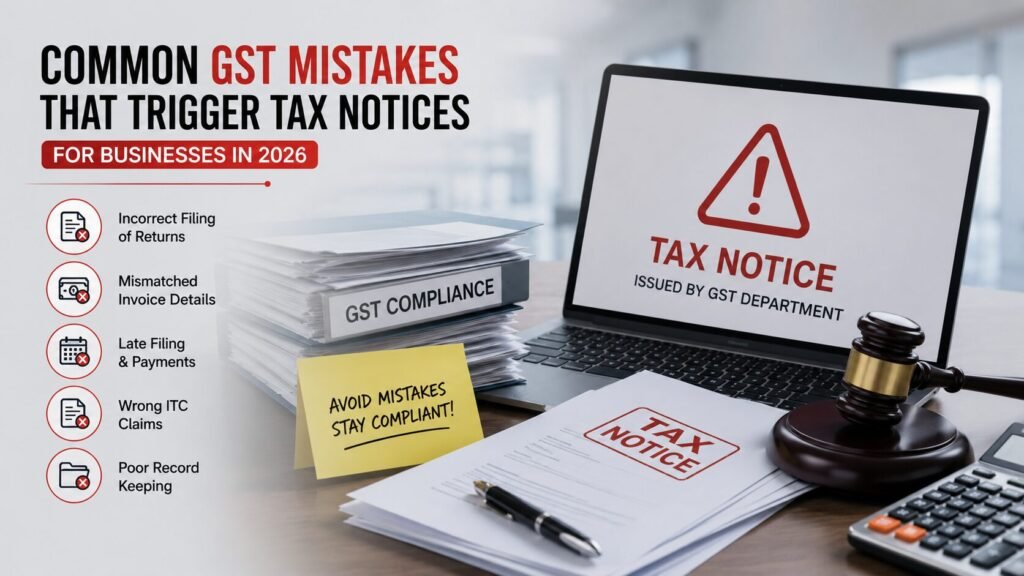
TL;DR GST mistakes authorities are using increasingly sophisticated technology to identify mismatches, unusual filing patterns, incorrect tax positions, and compliance gaps. Most GST notices are not caused by fraud. They are often triggered by preventable mistakes such as reconciliation failures, incorrect input tax credit claims, reporting inconsistencies, and filing errors. Businesses that implement regular GST mistakes reviews significantly reduce their risk of notices, penalties, and departmental scrutiny. Why GST Notices Are Increasing in 2026 GST compliance has become far more data-driven. Authorities now compare information across: GSTR-1 GSTR-3B GSTR-2B E-Invoicing systems E-Way Bills Income Tax data TDS records Banking information The result is simple: Even small inconsistencies can be identified automatically. Businesses can no longer rely solely on year-end reviews. Regular compliance monitoring has become essential. How GST Authorities Detect Compliance Issues Modern GST compliance systems rely heavily on data analytics. The department can quickly identify: Input tax credit mismatches Underreported sales Excess credit claims Suspicious vendor transactions Filing inconsistencies Revenue anomalies Many notices are now generated through automated risk assessments. This means businesses must focus on prevention rather than reaction. 10 Common GST Mistakes That Trigger Notices 1. Mismatch Between GSTR-1 and GSTR-3B This remains one of the most common causes of notices. Common Issues Sales reported differently Tax liability inconsistencies Invoice omissions Amendment errors Risk Authorities may assume underreporting of revenue. Prevention Monthly reconciliation before return submission. 2. Incorrect Input Tax Credit Claims Claiming ineligible ITC continues to attract scrutiny. Examples include: Blocked credits Unsupported expenses Vendor non-compliance Duplicate claims Risk Interest, penalties, and ITC reversals. Prevention Review ITC eligibility before claiming. 3. Failure to Reconcile GSTR-2B Many businesses claim credits without matching supplier data. Common Problems Missing supplier filings Duplicate invoices Incorrect GSTINs Prevention Monthly GSTR-2B reconciliation. 4. Incorrect GST Classification Incorrect HSN or SAC codes may result in: Wrong tax rates Incorrect reporting Additional liabilities Prevention Periodic classification review. 5. Late GST Return Filing Consistent delays increase compliance risk. Authorities often identify repeated late filers for further review. Prevention Compliance calendar and automated reminders. 6. E-Invoice Data Mismatches Businesses covered under e-invoicing requirements must ensure consistency. Mismatches between: E-Invoices GSTR-1 Accounting records can trigger notices. Prevention Automated integration and reconciliation. 7. Ignoring Vendor Compliance Your GST compliance depends partly on supplier compliance. Risks ITC denial Reversals Scrutiny Prevention Vendor compliance monitoring. 8. Wrong Place of Supply Determination Interstate transactions often create errors. Common Mistakes Wrong GST type Incorrect tax allocation Misclassification Prevention Transaction-level review. 9. Underreporting Revenue Authorities compare data across multiple systems. Differences between: Income Tax returns GST returns Financial statements often trigger scrutiny. Prevention Cross-report validation. 10. Ignoring GST Notices One of the most expensive mistakes is ignoring departmental communication. Delayed responses can lead to: Escalation Penalties Assessments Litigation Prevention Immediate professional review. Early Warning Signs of GST Risk Watch for: Frequent amendments ITC reversals Vendor mismatches Revenue inconsistencies Filing delays E-invoice discrepancies These indicators often appear before notices are issued. GST Compliance Checklist for Businesses Compliance Area Review Frequency GSTR-1 vs GSTR-3B Monthly GSTR-2B Reconciliation Monthly Vendor Compliance Review Monthly E-Invoice Validation Monthly Revenue Matching Quarterly GST Health Check Quarterly Internal GST Audit Annually What To Do If You Receive a GST Notice Step 1 Read the notice carefully. Step 2 Identify the underlying issue. Step 3 Gather supporting records. Step 4 Review reconciliations. Step 5 Prepare a structured response. Step 6 Seek professional GST advice where required. Quick and accurate responses significantly improve outcomes. How Professional GST Reviews Reduce Notice Risk A proactive GST review helps businesses: Detect mismatches early Validate ITC claims Improve reconciliations Strengthen documentation Reduce compliance gaps Improve audit readiness Preventing notices is usually far less expensive than responding to them. Conclusion Most GST notices in 2026 are triggered by avoidable compliance mistakes rather than intentional wrongdoing. Businesses that regularly reconcile data, monitor vendor compliance, validate tax positions, and maintain accurate records significantly reduce their risk of scrutiny. A proactive GST compliance framework not only minimizes notices but also improves financial accuracy, operational confidence, and long-term business stability. FAQ SECTION Why do businesses receive GST notices? Most GST notices result from mismatches, incorrect ITC claims, filing inconsistencies, delayed returns, or reconciliation failures. What is the most common GST mistake? Mismatch between GSTR-1 and GSTR-3B remains one of the most common triggers for GST scrutiny. Can incorrect ITC claims trigger notices? Yes. Ineligible or unsupported input tax credit claims frequently attract GST department review. How often should GST reconciliation be performed? Monthly reconciliation is considered best practice. Can vendor non-compliance affect my business? Yes. Vendor filing failures can impact your ITC eligibility and increase compliance risk. What should I do after receiving a GST notice? Review the notice carefully, identify the issue, gather documentation, and prepare a timely response. How can businesses reduce GST notice risk? Regular reconciliations, compliance reviews, accurate reporting, and professional oversight significantly reduce risk. BLOG BY : CA Arihant Lodha