
Capital Gains Tax Rules 2026: Latest Updates for Property, Shares & Mutual Funds

TL;DR Capital Gains Tax applies when a capital asset such as property, shares, mutual funds, or certain other investments is transferred and results in a gain. The applicable tax treatment depends on factors such as the nature of the asset, the period for which it was held, and the provisions in force for the relevant assessment year. Understanding the Capital Gains Tax Rules 2026 helps taxpayers calculate tax correctly, report gains accurately in their Income Tax Return (ITR), and evaluate available exemptions and tax planning opportunities. What is Capital Gains Tax? Capital Gains Tax is the tax payable on the profit earned from the transfer of a capital asset. A capital asset may include: Residential property Commercial property Land Listed shares Unlisted shares Mutual funds Bonds Securities Gold and certain other investments It is important to note that tax is generally calculated on the gain arising from the transfer, rather than on the total sale consideration. The method of computation and applicable tax provisions depend on the type of asset and the law applicable for the relevant financial year. What is a Capital Asset? Under the Income-tax Act, a capital asset broadly refers to property of any kind held by a taxpayer, whether connected with business or personal investments, subject to specific exclusions provided by law. Common examples include: Immovable Property Residential house Commercial building Plot of land Financial Investments Listed equity shares Unlisted shares Mutual fund units Bonds Debentures Exchange-traded funds (ETFs) Other Investments Gold Precious metals Certain valuable assets Each category may be subject to different tax provisions depending on the applicable law. Types of Capital Gains Capital gains are broadly classified into two categories based on the holding period prescribed for the relevant asset. Short-Term Capital Gains (STCG) A gain is generally treated as short-term when the capital asset is transferred before completing the applicable holding period prescribed under the Income-tax Act. Examples may include: Certain listed securities sold within the prescribed period. Property transferred before the applicable long-term holding period. Other investments held for a relatively shorter duration. The tax treatment depends on the nature of the asset and the applicable provisions. Long-Term Capital Gains (LTCG) Where a capital asset is held beyond the prescribed holding period, the resulting gain may qualify as a long-term capital gain. Long-term capital gains may be subject to different tax provisions, exemptions, or computation methods depending on the asset involved and the applicable law. Why Understanding Capital Gains Tax is Important Many taxpayers associate capital gains tax only with the sale of property. However, capital gains may arise from a wide range of investment transactions. Understanding the applicable rules helps taxpayers: Estimate potential tax liability. Maintain appropriate documentation. Report gains correctly in the Income Tax Return. Evaluate available exemptions where applicable. Improve long-term tax planning. Proper reporting also reduces the risk of notices arising from discrepancies between reported transactions and information available with the Income Tax Department. Major Capital Gains Tax Updates in 2026 Tax laws relating to capital gains continue to evolve through amendments, Finance Acts, judicial decisions, and administrative guidance. Taxpayers should always verify the provisions applicable to the relevant assessment year before making investment decisions. Some important areas requiring attention include: 1. Increased Focus on Accurate Capital Gains Reporting The Income Tax Department increasingly receives transaction information from: Stock exchanges Depositories Mutual fund registrars Banks Property registration authorities Financial institutions As a result, taxpayers should carefully reconcile: Broker statements Capital gains reports AIS Form 26AS (where relevant) Property transaction records before filing their Income Tax Return. 2. Greater Importance of Digital Reporting Investment platforms and intermediaries continue to strengthen digital reporting systems. Taxpayers should retain: Contract notes Demat statements Mutual fund statements Property purchase documents Sale deeds Payment records Digital documentation helps support capital gains calculations if verification is required. 3. Enhanced Verification Through AIS The Annual Information Statement (AIS) now provides taxpayers with greater visibility into various financial transactions reported against their PAN. Before filing an ITR, investors should compare: Purchase transactions. Sale transactions. Dividend income. Interest income. Capital gains statements. This reduces reporting mismatches and improves return accuracy. 4. Better Record-Keeping Expectations Whether selling property or redeeming mutual funds, maintaining complete records is essential. Taxpayers should preserve: Purchase agreements. Sale agreements. Improvement expenses (where relevant). Brokerage records. Stamp duty documents. Registration charges. Investment statements. Accurate records make capital gains computation more reliable and support claims made in the Income Tax Return. Who Should Pay Special Attention to These Rules? The latest Capital Gains Tax provisions are particularly relevant for: Property Owners Individuals selling residential or commercial property should understand how capital gains are computed and what documentation is required. Equity Investors Those buying and selling listed or unlisted shares should maintain proper transaction records and review broker reports before filing their ITR. Mutual Fund Investors Investors redeeming equity-oriented or debt-oriented mutual funds should verify the applicable tax treatment, holding period, and gain calculations based on current law. NRIs Non-Resident Indians should carefully review the provisions applicable to capital gains arising from assets located in India, along with any relevant Double Taxation Avoidance Agreement (DTAA), where applicable. Business Owners Businesses disposing of capital assets should ensure that gains are correctly accounted for and reported in accordance with the applicable tax provisions. Documents to Keep Ready Before Reporting Capital Gains Before preparing your Income Tax Return, keep the following documents readily available: Purchase agreement Sale agreement Sale deed Stamp duty receipts Registration receipts Broker contract notes Demat account statements Mutual fund statements Capital gains statement Bank statements Investment proofs AIS Form 26AS (where applicable) Maintaining organised documentation simplifies tax computation, supports exemption claims where eligible, and ensures accurate reporting in the Income Tax Return. Capital Gains Tax on Property The sale of residential houses, commercial properties, or land can result in capital gains tax depending on the nature of the asset, the holding period, and the applicable provisions of the Income-tax Act. When calculating capital gains on property, taxpayers should carefully determine: Cost of acquisition Cost
CBDT Latest Circulars 2026: Tax Changes That Can Affect Your ITR
TL;DR The Central Board of Direct Taxes (CBDT) regularly issues circulars, notifications, and clarifications to explain tax provisions, extend compliance deadlines, simplify procedures, and resolve practical issues faced by taxpayers. During 2026, several important updates have implications for Income Tax Return (ITR) filing, tax documentation, exemption procedures, TDS compliance, and the transition to the Income-tax Act, 2025 framework. Understanding these circulars before filing your ITR can help reduce errors, avoid notices, and ensure smooth compliance. What is the CBDT? The Central Board of Direct Taxes (CBDT) is the apex authority responsible for administering India’s direct tax laws under the Department of Revenue, Ministry of Finance. Its key responsibilities include: Issuing circulars and notifications. Clarifying provisions of tax laws. Prescribing compliance procedures. Improving taxpayer services. Guiding Income Tax authorities. Supporting uniform implementation of tax laws across the country. CBDT circulars often explain how specific legal provisions should be implemented in practice, making them valuable for taxpayers as well as tax professionals. Why Are CBDT Circulars Important? Income Tax laws are detailed and are frequently supported by notifications, rules, and administrative clarifications. CBDT circulars help taxpayers by: Explaining practical implementation of tax provisions. Clarifying procedural requirements. Addressing compliance-related difficulties. Providing relief in specified situations. Standardising tax administration. Although circulars generally do not replace the provisions of the Income-tax Act, they play an important role in explaining how the law is administered. Major CBDT Updates Every Taxpayer Should Know in 2026 1. Transition to the Income-tax Act, 2025 and Income-tax Rules, 2026 One of the most significant developments is the transition from the long-standing Income-tax Act, 1961 to the new legislative framework introduced through the Income-tax Act, 2025, supported by the Income-tax Rules, 2026. The objective is to simplify tax legislation, improve readability, and modernise tax administration while preserving continuity in compliance. Taxpayers should ensure that they use the latest forms, utilities, and official guidance applicable to the relevant assessment year. 2. Updated ITR Utilities and Filing Instructions CBDT has continued to release updated ITR utilities and filing instructions to improve the accuracy of return filing. Taxpayers should: Download the latest ITR utility before filing. Verify pre-filled information carefully. Match income with AIS and Form 26AS. Check bank account details. Review deductions and exemptions before submission. Using outdated utilities or failing to verify pre-filled data may result in filing errors. 3. Clarifications on TDS and Compliance Timelines CBDT has issued clarifications and procedural relief in certain TDS-related matters, including timelines and reporting requirements where applicable. Businesses and deductors should ensure: Timely deposit of TDS. Accurate TDS reporting. Correct PAN details. Reconciliation with Form 26AS. Proper TDS compliance helps taxpayers receive correct tax credits while reducing disputes. 4. Clarification on Registration and Exemption Procedures CBDT has also issued guidance on procedural matters affecting charitable and exempt entities, including condonation of delays in specified cases and registration-related compliance. Organisations claiming tax exemptions should review the latest procedural requirements before filing their returns or applications. 5. Continued Emphasis on Document Identification Number (DIN) CBDT continues to require the use of Document Identification Number (DIN) on specified communications issued by the Income Tax Department. Taxpayers receiving official communications should verify that applicable correspondence contains the required identification details, helping improve transparency and authenticity. How These Circulars Can Affect Your ITR While many taxpayers assume that CBDT circulars only concern tax professionals, they can directly influence the way Income Tax Returns are prepared and verified. Depending on your category of taxpayer, these updates may affect: Choice of ITR form. Reporting requirements. TDS verification. Exemption claims. Documentation requirements. Compliance timelines. Verification procedures. Processing of tax returns. Reviewing the latest CBDT guidance before filing helps ensure that your return aligns with current administrative requirements. Who Should Pay Special Attention to These Updates? The latest CBDT circulars are particularly relevant for: Salaried Employees Individuals should verify salary income, TDS credits, deductions, and pre-filled return information before filing. Freelancers and Professionals Professionals should review business income reporting, advance tax, expense records, and applicable compliance requirements. Business Owners Businesses should monitor TDS reporting, documentation, accounting records, and return filing procedures to ensure compliance with current guidance. Charitable Institutions Trusts and institutions claiming tax exemptions should carefully review registration procedures, applicable circulars, and filing timelines. Investors Taxpayers with capital gains, dividend income, or multiple investment sources should reconcile their records with AIS, Form 26AS, and the latest filing guidance before submitting their returns. Documents to Review Before Filing Your ITR Before filing your return, taxpayers should verify: PAN Aadhaar Form 16 AIS (Annual Information Statement) Form 26AS Bank statements Interest certificates Capital gains statements Investment proofs TDS certificates Tax payment challans Cross-checking these documents with the latest CBDT guidance helps improve filing accuracy and reduces the likelihood of processing issues. How the Latest CBDT Circulars Can Impact Different Taxpayers CBDT circulars are issued to clarify tax provisions, simplify procedures, and ensure uniform implementation of the Income-tax Act. Although many updates are procedural, they can have a direct impact on how taxpayers prepare and file their Income Tax Returns (ITRs). Understanding how these changes apply to your specific category of taxpayer can help reduce filing errors and improve overall compliance. Impact on Salaried Employees Salaried individuals often assume that Form 16 is sufficient for filing an Income Tax Return. However, CBDT’s continued emphasis on digital verification means taxpayers should review multiple sources of information before filing. Before submitting an ITR, salaried employees should verify: Salary details in Form 16. TDS reflected in Form 26AS. Income appearing in the Annual Information Statement (AIS). Interest income from savings and fixed deposits. Dividend income. Bank account details. Eligible deductions and exemptions. Reconciling these documents helps minimise reporting errors and supports smoother processing of tax returns. Impact on Freelancers and Professionals Freelancers, consultants, doctors, architects, lawyers, influencers, and other professionals often earn income from multiple clients and payment sources. CBDT’s focus on improved reporting and digital compliance makes it important for professionals to maintain: Accurate invoices. Expense records. Bank statements. Advance tax payment records. TDS certificates. Books of
GST Compliance Updates 2026: New Rules Every Business Owner Should Know
TL;DR GST compliance continues to evolve as India’s tax administration becomes increasingly digital and data-driven. In 2026, businesses should closely monitor updates relating to GST return filing, Input Tax Credit (ITC), e-invoicing, reconciliation, digital reporting, and documentation requirements. Staying compliant helps businesses avoid penalties, maintain uninterrupted input tax credits, improve cash flow, and reduce the likelihood of GST notices. Proactive compliance is now a key part of effective financial management. Understanding GST Compliance Goods and Services Tax (GST) is one of India’s most significant indirect tax reforms, designed to create a unified tax system across the country. While GST has simplified taxation by replacing multiple indirect taxes, it has also introduced ongoing compliance responsibilities for businesses. GST compliance involves much more than filing monthly or quarterly returns. It includes maintaining accurate records, issuing compliant invoices, reconciling purchases and sales, claiming eligible Input Tax Credit, meeting statutory deadlines, and ensuring that information reported across different returns remains consistent. As technology continues to transform tax administration, businesses are expected to maintain greater accuracy, transparency, and real-time compliance than ever before. Why GST Compliance Is More Important in 2026 The GST ecosystem has become increasingly integrated with digital reporting systems. Information reported by suppliers, buyers, banks, and other stakeholders is cross-verified using automated systems, making inconsistencies easier to identify. For businesses, strong GST compliance offers several benefits: Reduces the risk of penalties and notices. Helps preserve eligible Input Tax Credit (ITC). Improves cash flow management. Strengthens financial reporting. Enhances credibility with customers and vendors. Supports smoother statutory audits. Facilitates business expansion and funding opportunities. Rather than viewing GST compliance as a routine obligation, businesses should treat it as an important component of financial governance. Major GST Compliance Updates Businesses Should Watch in 2026 GST laws continue to evolve through amendments, notifications, circulars, and recommendations of the GST Council. While businesses should always verify the latest official notifications before making compliance decisions, several areas remain central to GST administration in 2026. 1. Greater Focus on Digital Compliance The GST framework increasingly relies on digital systems to improve transparency and reduce reporting errors. Businesses should ensure: Accounting software is updated. GST returns are filed electronically. Digital records are maintained accurately. Invoice data matches return filings. Compliance documentation is easily retrievable. A robust digital accounting system helps businesses manage compliance more efficiently and respond quickly to departmental queries. 2. Input Tax Credit (ITC) Reconciliation Input Tax Credit continues to be one of the most important aspects of GST compliance. Businesses should regularly reconcile: Purchase registers. Supplier invoices. GST return data. Eligible tax credits. Vendor compliance status. Incorrect ITC claims can affect cash flow and may result in interest, penalties, or notices. Periodic reconciliation throughout the year is far more effective than waiting until year-end. 3. E-Invoicing Compliance E-invoicing has become an important compliance requirement for eligible businesses. Businesses covered under the applicable turnover thresholds should ensure: Invoices are generated using compliant systems. Required invoice details are accurately reported. Accounting software integrates with e-invoicing requirements. Finance teams understand the latest procedural updates. Failure to comply with applicable e-invoicing provisions may lead to operational and compliance challenges. 4. Timely GST Return Filing Filing GST returns within the prescribed due dates remains one of the most fundamental compliance obligations. Businesses should establish internal processes for: Monthly reconciliations. Return preparation. Invoice verification. Tax payment. Record maintenance. Timely filing helps reduce late fees, interest, and unnecessary compliance complications. 5. Stronger Data Matching by Authorities With increasing use of analytics and automation, GST authorities can compare information from multiple sources more efficiently. Businesses should therefore ensure consistency across: GST returns. Sales records. Purchase records. E-invoices. Financial statements. Income Tax records (where relevant). Maintaining consistent reporting significantly reduces the likelihood of scrutiny. Which Businesses Are Most Affected? Although GST applies across many sectors, some businesses experience greater compliance responsibilities due to transaction volume or operational complexity. These include: Manufacturers Manufacturers often manage large purchase volumes, multiple suppliers, and complex Input Tax Credit claims. Traders Wholesale and retail businesses should ensure accurate inventory records, invoice management, and reconciliation between purchases and sales. Service Providers Consultants, agencies, software companies, healthcare providers, educational institutions, and professional firms should monitor invoicing, place-of-supply rules, and GST reporting requirements. E-Commerce Sellers Businesses selling through online marketplaces should carefully reconcile platform reports, invoices, GST returns, and settlement statements. Startups Rapidly growing startups should establish strong accounting and GST compliance processes from the beginning to avoid future operational challenges. MSMEs Small and medium enterprises often have limited finance resources, making automated accounting systems and periodic compliance reviews particularly valuable. Common GST Compliance Challenges Businesses Face Despite advances in technology, businesses continue to encounter several recurring compliance challenges. These include: Delayed invoice reconciliation. Incorrect Input Tax Credit claims. Vendor non-compliance. Late return filing. Errors in invoice preparation. Manual accounting mistakes. Inconsistent financial records. Inadequate documentation. Failure to monitor GST notifications. Lack of regular compliance reviews. Identifying these issues early enables businesses to strengthen internal controls and reduce compliance risks before they become costly problems. GST Compliance Checklist for Businesses in 2026 A structured GST compliance process helps businesses minimise errors, improve financial control, and reduce the risk of penalties or departmental notices. Instead of treating compliance as a month-end task, businesses should adopt a continuous review process. Use the following checklist to strengthen your GST compliance framework. 1. Verify GST Registration Details Review your GST registration periodically to ensure: Business name is correctly reflected. Principal place of business is updated. Additional places of business are accurately recorded. Authorised signatory details are current. Business activities are correctly classified. Contact information is up to date. Any changes should be updated promptly through the GST portal to avoid future compliance issues. 2. Maintain Accurate Books of Accounts Proper bookkeeping forms the foundation of GST compliance. Businesses should maintain: Sales register Purchase register GST invoice register Credit note register Debit note register Expense records Inventory records Bank reconciliation statements Accurate books simplify GST return preparation and reduce reconciliation errors. 3. Reconcile Purchase and Sales Data
Income Tax Notice in 2026? Latest Reasons Why Notices Are Being Sent
TL;DR Receiving an Income Tax Notice does not automatically mean you have committed tax evasion or fraud. In many cases, notices are generated because of mismatches in reported income, missing information, incorrect tax credit claims, or routine verification processes. With the Income Tax Department increasingly using technology and data analytics, taxpayers should carefully verify AIS, Form 26AS, bank interest, capital gains, and other financial information before filing their Income Tax Returns. Understanding the common reasons behind notices can help you respond appropriately and reduce the risk of future compliance issues. What is an Income Tax Notice? An Income Tax Notice is an official communication issued by the Income Tax Department when it requires additional information, clarification, verification, or action from a taxpayer. Not every notice indicates wrongdoing. Many notices are generated automatically through system-based verification when the information available with the department does not match the details reported in the Income Tax Return (ITR). Depending on the nature of the issue, a notice may request: Clarification regarding reported income. Verification of tax credits. Supporting documents. Correction of filing errors. Additional financial information. Response within a prescribed timeline. Reading the notice carefully and understanding its purpose is the first step toward resolving the matter effectively. Should You Panic After Receiving an Income Tax Notice? The simple answer is No. Receiving a notice is relatively common, especially as tax administration becomes increasingly data-driven. Many notices relate to: Routine verification. Mismatch of reported information. Missing documentation. Incorrect tax credit claims. Processing-related queries. Ignoring a notice, however, can create unnecessary complications. Responding accurately and within the specified timeline is important to ensure smooth resolution. Common Types of Income Tax Notices The Income Tax Department may issue notices for different reasons depending on the taxpayer’s filing history and reported information. Some commonly encountered notices relate to: Return Processing Issued when the department processes the Income Tax Return and identifies adjustments, refunds, outstanding demands, or other processing outcomes. Defective Return Issued when the filed return contains incomplete or incorrect information requiring correction within the prescribed time. Information Verification The department may request clarification if financial information reported by third parties differs from the details disclosed in the Income Tax Return. Scrutiny Assessment In selected cases, taxpayers may be asked to provide supporting documents or explanations regarding specific transactions or deductions claimed. Reassessment or Escaped Income Proceedings Where permitted under applicable law, the department may initiate proceedings if it believes certain income has not been properly reported. The exact nature of every notice depends on the applicable provisions of the Income-tax Act and the facts of the taxpayer’s case. Latest Reasons Income Tax Notices Are Being Sent in 2026 Advances in digital reporting and data analytics have significantly increased the ability of the Income Tax Department to compare taxpayer information from multiple sources. Below are some of the most common reasons notices may be issued. 1. AIS and Form 26AS Mismatches One of the leading reasons for notices is inconsistency between: Annual Information Statement (AIS) Form 26AS Income disclosed in the ITR For example: Interest income appearing in AIS but omitted from the return. Dividend income not reported. Incorrect TDS claims. Missing financial transactions. Taxpayers should always reconcile AIS and Form 26AS before filing. 2. High-Value Financial Transactions Banks, mutual funds, registrars, financial institutions, and other reporting entities provide specified financial information to the Income Tax Department. Large transactions such as: Significant cash deposits. Property purchases. Securities transactions. Mutual fund investments. Foreign remittances. High-value credit card payments. may be reviewed alongside the taxpayer’s declared income. Where there are inconsistencies, the department may seek clarification. 3. Unreported Interest Income Interest earned from: Savings accounts. Fixed deposits. Recurring deposits. Bonds. is frequently overlooked during ITR preparation. Since banks report certain financial information, failure to disclose taxable interest income may result in verification queries. 4. Incorrect TDS Claims Claiming tax deducted at source (TDS) that is not reflected in Form 26AS or supported by available records may lead to processing issues or notices. Before claiming tax credits, taxpayers should confirm that: TDS has been deposited by the deductor. The credit appears correctly in Form 26AS. The PAN quoted by the deductor is accurate. 5. Omission of Dividend Income Dividend income received from listed companies or mutual funds may be reflected in AIS. If this income is omitted from the Income Tax Return, the department’s systems may identify the discrepancy during processing. 6. Capital Gains Not Properly Reported With increasing investment activity, capital gains reporting has become a major area of scrutiny. Common issues include: Incorrect purchase cost. Wrong holding period. Omitted transactions. Incorrect exemption claims. Missing sale transactions. Taxpayers should reconcile broker statements, capital gains reports, and AIS before filing. 7. Business Income Discrepancies Businesses and professionals may receive notices if there are inconsistencies between: Reported turnover. GST records. Tax audit reports. Income declared in the ITR. Financial statements. Maintaining proper books of accounts significantly reduces compliance risks. Early Warning Signs That May Increase the Risk of a Notice While no taxpayer can completely eliminate the possibility of receiving a notice, certain patterns may increase the likelihood of verification. Watch out for: Differences between AIS and ITR. Missing TDS credits. Unreported interest or dividend income. Large financial transactions not reflected in income disclosures. Incorrect deduction claims. Incomplete or inaccurate ITR forms. Failure to reconcile Form 26AS. Reporting errors in capital gains. Inconsistencies between GST records and income reported by businesses. Identifying and correcting these issues before filing your Income Tax Return can significantly improve the accuracy of your return and reduce the chances of future notices. What Should You Do If You Receive an Income Tax Notice? Receiving an Income Tax Notice does not necessarily mean that you have made a serious mistake or violated tax laws. In many cases, the notice simply requests clarification, additional documents, or confirmation of information already available with the Income Tax Department. The most important step is to respond calmly, understand the reason for the notice, and act within the prescribed timeline. Ignoring
AIS vs Form 26AS in 2026: What You Must Verify Before Filing Your ITR
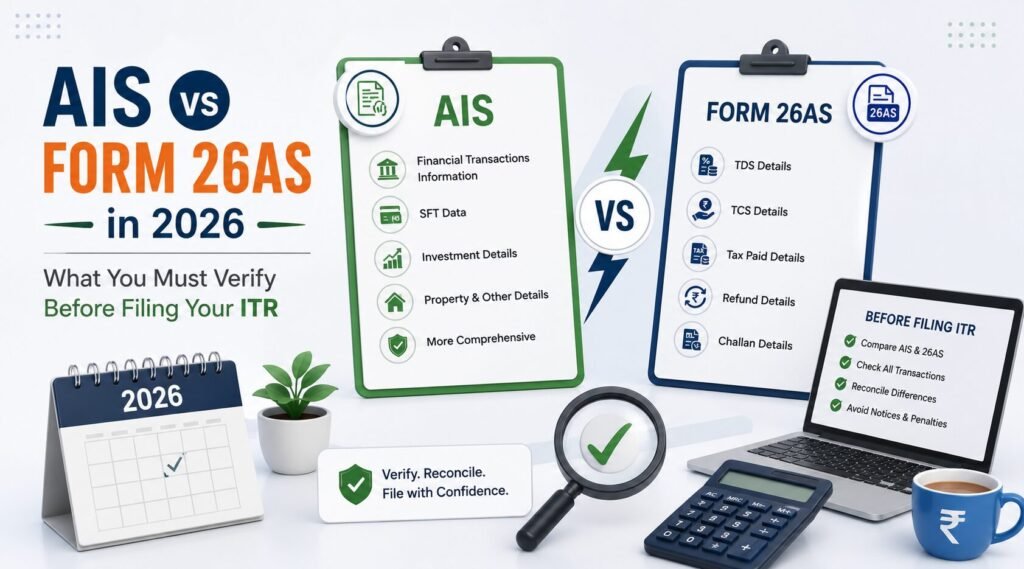
TL;DR Before filing your Income Tax Return (ITR) for AY 2027–28, reviewing both the Annual Information Statement (AIS) and Form 26AS is essential. While Form 26AS primarily reflects tax-related information such as TDS, TCS, and advance tax payments, AIS provides a broader view of your financial transactions, including interest income, dividends, securities transactions, mutual fund investments, and other reported information. Reconciling both documents helps taxpayers report income accurately, reduce the chances of receiving notices, and avoid delays in refund processing. Why Verifying Your Tax Information Before Filing Matters Income Tax Return filing is no longer limited to reporting salary income and claiming deductions. With the increasing use of data analytics and digital reporting, the Income Tax Department now receives financial information from banks, employers, financial institutions, registrars, mutual funds, stock exchanges, and other reporting entities. As a result, taxpayers should ensure that the information declared in their ITR matches the data available with the Income Tax Department. Reviewing AIS and Form 26AS before filing helps: Report all taxable income accurately. Verify TDS credits. Identify missing or incorrect entries. Prevent refund delays. Reduce the likelihood of receiving compliance-related notices. Improve the accuracy of the Income Tax Return. What is AIS (Annual Information Statement)? The Annual Information Statement (AIS) is a comprehensive statement available on the Income Tax e-Filing Portal that provides taxpayers with detailed information about various financial transactions reported against their Permanent Account Number (PAN). Unlike traditional tax statements, AIS presents a broader picture of an individual’s financial activities during the financial year. AIS may include information relating to: Salary income Savings account interest Fixed deposit interest Dividend income Securities transactions Mutual fund transactions Purchase and sale of shares Tax Deducted at Source (TDS) Tax Collected at Source (TCS) Advance tax payments Self-assessment tax Foreign remittances (where reported) High-value financial transactions reported by specified entities The purpose of AIS is to improve transparency and help taxpayers verify the information available with the Income Tax Department before filing their returns. What is Form 26AS? Form 26AS is a consolidated tax statement that primarily reflects taxes deducted or collected against a taxpayer’s PAN. It serves as an important document for verifying tax credits before filing an Income Tax Return. Form 26AS generally includes: Tax Deducted at Source (TDS) Tax Collected at Source (TCS) Advance tax payments Self-assessment tax payments Refund details Certain specified financial transaction information, as applicable Taxpayers should reconcile the tax credits appearing in Form 26AS with their salary records, bank statements, and tax payment challans to ensure that all eligible credits are correctly reflected before filing their return. AIS vs Form 26AS: Understanding the Difference Although both documents are available through the Income Tax system and are used during return filing, they serve different purposes. Feature AIS Form 26AS Purpose Comprehensive financial information Tax credit statement Income Coverage Wider range of reported financial transactions Primarily tax deductions and tax payments Salary Information Included if reported Reflected through TDS entries where applicable Bank Interest Generally available Limited relevance unless linked to tax deductions Dividend Information Included where reported May only reflect associated TDS Securities Transactions Included where reported Generally not detailed Mutual Fund Transactions Included where reported Limited information Tax Payments Included Included TDS Verification Available Primary source for verification Rather than choosing one document over the other, taxpayers should review both before filing their Income Tax Return. Why Should You Verify Both AIS and Form 26AS? Many taxpayers mistakenly assume that checking Form 26AS alone is sufficient before filing their ITR. However, AIS provides additional financial information that may not be fully reflected in Form 26AS. Reviewing both documents helps taxpayers: Report Complete Income Income from bank interest, dividends, capital gains, and other sources may appear in AIS and should be considered while preparing the return. Verify Tax Credits Form 26AS helps ensure that TDS, TCS, advance tax, and self-assessment tax payments have been correctly credited. Detect Reporting Errors Occasionally, incorrect or duplicate information may appear due to reporting issues. Identifying these discrepancies before filing helps reduce future complications. Reduce the Risk of Notices If the Income Tax Department’s records differ significantly from the information declared in the return, taxpayers may receive notices requesting clarification. Reviewing AIS and Form 26AS carefully helps minimise this risk. Income Details You Must Verify Before Filing Your ITR Before submitting your Income Tax Return, review the following information carefully: Salary income Interest from savings accounts Fixed deposit interest Dividend income Capital gains from shares and mutual funds Rental income Business or professional income TDS deducted by employers TDS deducted by banks Advance tax payments Self-assessment tax Refund details High-value financial transactions reported against your PAN Comparing these records with your own financial documents ensures greater accuracy during ITR filing. Common Reasons for Mismatches Discrepancies between AIS, Form 26AS, and your financial records can occur for several reasons, including: Delayed reporting by financial institutions. Incorrect PAN quoted by the deductor. Missing TDS entries. Duplicate reporting of transactions. Incorrect interest calculations. Omitted dividend income. Errors in reporting high-value transactions. Timing differences in reporting by banks or other institutions. Identifying these issues before filing allows taxpayers to take corrective action and prepare an accurate return. How to Reconcile AIS and Form 26AS Before Filing Your ITR Reviewing both AIS and Form 26AS should be an essential part of your Income Tax Return (ITR) preparation. Instead of relying on only one document, taxpayers should compare the information available in both statements with their own financial records. Following a systematic reconciliation process can help identify discrepancies early and reduce the chances of notices, refund delays, or incorrect tax reporting. Step 1: Download Both Documents Before preparing your ITR, download the latest versions of: Annual Information Statement (AIS) Form 26AS Since financial information may be updated periodically, ensure you are using the most recent available statements. Step 2: Verify Your Personal Details Check that your: PAN Name Assessment Year Financial Year are correctly reflected in both documents. Even minor discrepancies should be investigated before filing your return. Step
New Income Tax Bill 2026: Everything Taxpayers Need to Know

TL;DR The New Income Tax Bill 2026 is designed to modernise India’s direct tax legislation by simplifying legal language, improving readability, reducing compliance complexity, and making tax administration more transparent. While the Bill aims to streamline the existing framework, taxpayers should understand that its provisions become enforceable only after completing the legislative process and coming into effect as notified by the Government. Individuals and businesses should stay informed through official notifications and review their tax planning accordingly. What is the New Income Tax Bill 2026? India’s direct tax framework has historically been governed by the Income-tax Act, 1961, a comprehensive law that has undergone numerous amendments over the decades. As the economy has evolved, repeated amendments have made the legislation more detailed and, at times, difficult for taxpayers to interpret. The New Income Tax Bill 2026 has been introduced with the objective of presenting a more organised and easier-to-understand legal framework. Rather than simply adding more amendments to the existing Act, the Bill seeks to consolidate provisions into a modern legislative structure with clearer drafting and simplified terminology. It is important to understand that the Bill is intended to improve the accessibility and administration of tax laws. Taxpayers should always rely on the enacted law and official government notifications before making financial or compliance decisions. Why Was a New Income Tax Bill Introduced? India’s tax system has expanded significantly over the last six decades. The introduction of new income categories, digital transactions, international taxation rules, transfer pricing provisions, and compliance mechanisms has increased the complexity of tax legislation. The Government introduced the New Income Tax Bill with several broad objectives: Simplify legal language for taxpayers. Improve the structure and readability of tax provisions. Reduce ambiguity in interpretation. Make compliance easier for individuals and businesses. Support digital tax administration. Create a modern legislative framework aligned with the evolving economy. A clearer legal framework can help taxpayers better understand their obligations and reduce disputes arising from interpretational issues. Key Objectives of the New Income Tax Bill The proposed legislation focuses on making tax laws more user-friendly without compromising regulatory effectiveness. Some of the key objectives include: 1. Simplifying Tax Laws One of the primary goals is to present tax provisions in simpler language so that individuals and businesses can understand their responsibilities more easily. 2. Improving Compliance By reducing complexity, the Bill aims to encourage voluntary compliance and minimise errors during tax filing. 3. Supporting Digital Tax Administration As tax administration becomes increasingly technology-driven, the legislation seeks to complement digital filing systems, automated verification, and data-driven compliance processes. 4. Reducing Litigation Clearer drafting and better organisation of legal provisions can help minimise disputes between taxpayers and tax authorities, leading to faster resolution of tax matters. 5. Creating a Future-Ready Tax Framework The Indian economy continues to evolve with new business models, digital commerce, and global investments. A modern tax framework aims to accommodate these developments more effectively. Major Areas Covered by the New Income Tax Bill While taxpayers often expect entirely new tax rates or exemptions, the primary focus of the New Income Tax Bill is on restructuring and simplifying the legislative framework. Key areas addressed include: Income tax provisions Definitions and interpretation Tax administration Compliance procedures Filing requirements Assessment processes Appeals and dispute resolution Digital reporting Penalty provisions Administrative efficiency Taxpayers should review official updates to understand how these provisions apply once the legislation is enacted and notified. How Does the New Bill Benefit Taxpayers? The proposed reforms are expected to make tax compliance more accessible for a broad range of taxpayers. Potential benefits include: Easier-to-read legal provisions. Improved understanding of tax obligations. Simplified compliance processes. Better alignment with digital tax systems. Reduced reliance on complex legal interpretation. Greater transparency in tax administration. For salaried employees, freelancers, business owners, and startups, a clearer legislative framework can make tax planning and compliance more straightforward. Who Should Pay Close Attention to the New Income Tax Bill? The proposed legislation has relevance across different categories of taxpayers, including: Salaried Employees Individuals earning salary income should stay informed about any changes that may affect return filing, deductions, or compliance procedures. Freelancers and Professionals Independent professionals should monitor updates related to income reporting, advance tax, and business expense documentation. Business Owners Businesses should assess whether any procedural changes affect accounting practices, tax reporting, or compliance obligations. Startups Startups should evaluate how the new framework interacts with existing incentives, funding structures, and regulatory requirements. Investors Individuals earning income from capital gains, dividends, or other investments should review any relevant provisions affecting tax reporting and documentation. NRIs Non-Resident Indians with taxable income in India should remain aware of any procedural or administrative updates applicable to cross-border taxation and reporting. Why Staying Updated Matters Tax legislation evolves alongside the economy, technology, and regulatory priorities. Whether you are filing an individual return or managing business compliance, understanding proposed legal changes early allows you to: Plan taxes more effectively. Organise financial records. Stay compliant with evolving requirements. Reduce the likelihood of filing errors. Seek professional guidance where necessary. Keeping track of official notifications and consulting a qualified Chartered Accountant can help ensure that tax planning decisions remain accurate and compliant with the latest legal framework. How Does the New Income Tax Bill Compare with the Income-tax Act, 1961? The Income-tax Act, 1961 has served as the foundation of India’s direct tax system for more than six decades. During this period, numerous amendments, explanations, provisos, and judicial interpretations have been incorporated to address changing economic conditions and evolving business practices. The New Income Tax Bill 2026 is intended to reorganize and simplify the legislative framework rather than merely adding further amendments to the existing law. The emphasis is on presenting tax provisions in a more structured, reader-friendly format while supporting efficient tax administration. The broad comparison below highlights the intended direction of the proposed legislation. Aspect Income-tax Act, 1961 New Income Tax Bill 2026 Legislative Structure Built through decades of amendments Reorganized and modernized drafting Language Technical and highly legal Simpler
ITR Filing Due Date 2026–27: Last Date, Penalties, Extensions & Latest Updates
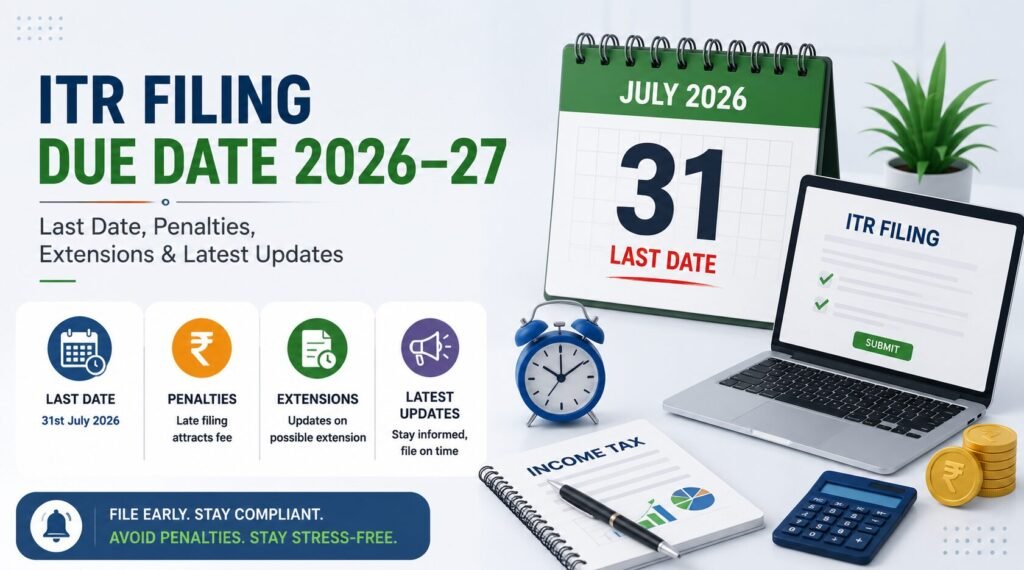
TL;DR If you’re planning to file your Income Tax Return (ITR) for the Financial Year 2026–27 (Assessment Year 2027–28), knowing the correct due date is essential. Missing the deadline can lead to late filing fees, interest on unpaid taxes, delayed refunds, restrictions on carrying forward certain losses, and increased compliance scrutiny. This guide explains the latest ITR filing due dates, who must file, the consequences of filing late, the difference between belated and updated returns, and practical tips to help individuals and businesses remain compliant. Latest ITR Filing Due Dates for AY 2027–28 The Income Tax Department prescribes different due dates depending on the category of taxpayer. While the government may extend deadlines in exceptional circumstances, taxpayers should always plan based on the officially announced due dates instead of expecting an extension. Taxpayer Category Typical Due Date* Individuals / Salaried Employees (Non-Audit Cases) 31 July 2027* Businesses Requiring Audit 31 October 2027* Taxpayers Covered under Transfer Pricing 30 November 2027* Belated / Revised Return As notified under the Income-tax Act* Note: Always verify the latest due dates through official Income Tax Department notifications, as timelines may change through circulars or government announcements. Why the ITR Filing Due Date Matters Many taxpayers assume that filing an Income Tax Return is only about paying taxes. In reality, timely ITR filing offers several financial and compliance benefits beyond meeting a legal obligation. Filing your return before the due date can help you: Avoid late filing fees and interest. Receive tax refunds faster. Maintain a strong financial record. Carry forward eligible capital and business losses (subject to applicable provisions). Simplify loan and visa applications, where ITRs are often required as proof of income. Reduce the chances of compliance-related notices arising from delayed filings. Early filing also provides sufficient time to rectify errors, verify information, and respond to any system-generated discrepancies before statutory deadlines. Who Should File Their ITR Before the Due Date? The due date applies to a wide range of taxpayers, including: Salaried Employees Individuals earning salary income should file their returns even if tax has been deducted at source (TDS). Filing ensures accurate reporting of income, enables refund claims where applicable, and helps maintain financial documentation. Self-Employed Professionals Doctors, lawyers, consultants, architects, freelancers, and other professionals should file returns based on their applicable tax provisions and maintain complete records of income and expenses. Business Owners Proprietorships, partnership firms, LLPs, and companies must comply with filing requirements applicable to their business structure and audit status. Investors Individuals earning income from capital gains, dividends, interest, mutual funds, or other investments should accurately disclose these sources in their Income Tax Return. NRIs Non-Resident Indians with taxable income in India may also have filing obligations depending on the nature and amount of income earned during the financial year. Latest Updates Every Taxpayer Should Monitor Income tax laws evolve regularly through Finance Acts, CBDT notifications, circulars, and government announcements. During every filing season, taxpayers should stay informed about updates affecting return preparation and compliance. Some important areas to watch include: Changes to ITR forms. New reporting requirements. AIS (Annual Information Statement) updates. Form 26AS reconciliation. TDS reporting changes. Tax regime provisions. Verification methods. Online filing enhancements. Compliance deadlines. Reviewing these updates before filing helps reduce errors and ensures smoother processing of returns. Common Reasons Why Taxpayers Miss the ITR Deadline Despite repeated reminders from the Income Tax Department, many taxpayers file their returns late due to avoidable reasons, such as: Waiting for the final due date. Missing Form 16 or other tax documents. Incorrect income reporting. Delay in reconciling AIS and Form 26AS. Confusion over the applicable ITR form. Lack of awareness about filing obligations. Last-minute portal congestion. Incomplete documentation. Preparing documents well in advance can significantly reduce stress and improve filing accuracy. Documents You Should Keep Ready Before Filing Before starting your Income Tax Return, organise all relevant financial records to ensure accurate reporting. Commonly required documents include: PAN Card Aadhaar Card Form 16 (for salaried individuals) Form 26AS Annual Information Statement (AIS) Salary slips Bank account statements Interest certificates Capital gains statements Investment proofs (where applicable) Home loan interest certificate Business financial statements (for business taxpayers) GST records (if applicable) Having these documents readily available makes the filing process faster and minimises the chances of errors or omissions. Can the ITR Filing Due Date Be Extended? One of the most common questions taxpayers ask every year is whether the Income Tax Return (ITR) filing due date will be extended. While the Central Board of Direct Taxes (CBDT) has extended deadlines in certain years due to exceptional circumstances such as technical issues, natural disasters, or administrative reasons, taxpayers should never plan their compliance assuming an extension will be announced. The Income Tax Department generally encourages taxpayers to file their returns well before the deadline to avoid last-minute portal congestion, technical glitches, and documentation issues. Situations Where Extensions May Be Granted Although extensions are not routine, they may be considered in circumstances such as: Major technical issues on the Income Tax e-Filing Portal. Significant changes in ITR forms or filing utilities. Natural calamities affecting taxpayers. Government-notified exceptional situations. Administrative reasons communicated through official CBDT notifications. Always rely on official announcements published by the Income Tax Department or CBDT rather than social media rumours or unofficial reports. What Happens If You Miss the ITR Filing Due Date? Missing the ITR filing deadline can lead to several financial and compliance consequences. Even if no tax is payable, filing your return on time is advisable to avoid unnecessary complications. Some common consequences include: Late filing fees under applicable provisions. Interest on outstanding tax liability. Delay in processing tax refunds. Restrictions on carrying forward certain losses. Increased compliance scrutiny. Additional documentation requirements in future assessments. Timely filing is not just a legal obligation—it also helps maintain a strong financial profile. Late Filing Fee for Missing the ITR Deadline If you fail to file your return within the prescribed due date, a late filing fee may apply as per the provisions
Union Budget 2026: Complete Tax Changes Explained for Individuals & Businesses

TL;DR The Union Budget 2026 introduces several important tax and compliance measures affecting salaried individuals, businesses, startups, investors, and MSMEs. From revised income tax provisions and GST reforms to digital compliance initiatives and investment incentives, taxpayers should understand these updates early to make informed financial decisions and remain compliant throughout FY 2026–27. Why Union Budget 2026 Matters Every Union Budget shapes India’s economic direction for the coming financial year. Beyond announcing government expenditure, the Budget introduces policy decisions that directly impact taxation, business operations, investments, compliance requirements, and long-term financial planning. For individuals, it determines how much tax they pay, which deductions remain available, and whether additional savings opportunities exist. For businesses, the Budget often influences GST compliance, corporate taxation, startup incentives, MSME support, customs duties, and digital reporting obligations. Understanding these developments early allows taxpayers to plan proactively rather than reacting after compliance deadlines arrive. Major Tax Highlights of Union Budget 2026 Some of the most significant areas taxpayers should closely monitor include: Income Tax provisions Tax regime updates GST reforms MSME incentives Startup benefits Digital compliance measures TDS and TCS amendments Capital gains taxation Investment incentives Ease of doing business reforms Each announcement has a different impact depending on whether you are a salaried employee, entrepreneur, professional, investor, or business owner. Income Tax Changes for Individuals Income tax continues to be one of the most discussed sections of every Union Budget because it directly affects millions of taxpayers across India. Although the exact provisions should always be verified against the Finance Act and official notifications, taxpayers generally need to review changes relating to: Tax slabs Rebate eligibility Standard deduction Exemptions Deductions Tax credits Return filing requirements Even a small amendment can significantly change annual tax liability. Understanding the New Tax Regime The government has increasingly encouraged taxpayers to adopt the simplified tax regime. The objective is to make tax filing easier by reducing exemptions while offering comparatively lower tax rates. Before choosing any regime, taxpayers should compare: Annual income Existing deductions Home loan benefits HRA eligibility Investment deductions Medical insurance deductions Retirement contributions A detailed tax comparison prepared by a Chartered Accountant often helps determine which option offers the greatest savings. Standard Deduction and Rebates Many salaried taxpayers focus primarily on tax slabs while overlooking the impact of standard deductions and rebates. Even modest revisions can reduce taxable income substantially. Reviewing salary structure before the financial year ends allows employees to maximise available benefits while remaining compliant with applicable regulations. TDS Changes Budget announcements frequently modify TDS provisions to simplify reporting and improve tax collection. Businesses should carefully review: New TDS thresholds Revised deduction rates Updated reporting timelines Penalties for non-compliance Accurate TDS management prevents unnecessary notices and interest liabilities. Tax Changes Affecting Businesses Businesses experience the most significant compliance impact after every Budget. Whether operating as a proprietorship, partnership, LLP, or private limited company, organisations should evaluate how new provisions influence: Cash flow Working capital Compliance costs Accounting systems Investment decisions Business expansion Instead of waiting until year-end, companies should align their accounting practices immediately after Budget announcements to avoid last-minute compliance challenges. MSME-Focused Reforms MSMEs remain a major contributor to India’s economy, employment, and exports. Union Budget measures often include incentives designed to strengthen this sector through: Easier credit access Compliance simplification Digital transformation Manufacturing incentives Export promotion Technology adoption Tax benefits Business owners should assess whether their enterprise qualifies for these schemes and update their compliance processes accordingly. Startup Incentives Startups should particularly watch for announcements relating to: DPIIT recognition Angel tax provisions ESOP taxation Funding incentives Innovation grants Investment benefits Tax holidays Compliance relaxation Leveraging these incentives effectively can significantly improve financial efficiency during the early stages of business growth. Digital Tax Compliance One noticeable trend across recent Budgets is the government’s continued emphasis on technology-driven tax administration. Businesses are increasingly expected to maintain: Digital accounting records Automated reconciliations Electronic invoicing Online return filing Real-time reporting Data consistency across tax platforms Organisations investing in strong accounting systems today are generally better positioned for future compliance requirements. GST Changes Every Business Should Watch After Union Budget 2026 Goods and Services Tax (GST) continues to evolve with the objective of simplifying compliance, reducing tax leakage, and strengthening India’s digital tax ecosystem. While GST rates may not always undergo significant changes during every Union Budget, procedural amendments, compliance requirements, and reporting mechanisms often receive major attention. Businesses should closely review all GST-related announcements after the Budget and subsequent notifications issued by the GST Council. Some key areas to monitor include: GST return filing procedures Input Tax Credit (ITC) eligibility E-invoicing requirements E-way bill compliance Composition Scheme provisions GST registration thresholds Penalties for delayed compliance Digital verification processes Rather than waiting until the due date, businesses should update their accounting systems and GST workflows immediately after any regulatory change. Input Tax Credit (ITC): A Key Area of Focus Input Tax Credit remains one of the most important aspects of GST compliance. Incorrect claims, mismatched invoices, or delayed reconciliations can lead to financial losses, interest, and notices from the tax department. To safeguard ITC, businesses should: Reconcile purchase registers regularly. Verify supplier compliance before claiming credits. Match invoices with GST portal data. Maintain complete documentation. Monitor blocked credit provisions. Conduct periodic GST health checks. A proactive approach helps prevent disputes and improves cash flow by ensuring eligible credits are not lost. E-Invoicing and Digital Compliance The government continues to encourage technology-driven tax administration. Businesses covered under e-invoicing provisions should ensure that: Invoices are generated through approved systems. Invoice data is accurately uploaded. Accounting software is integrated with GST requirements. Staff members are trained on compliance updates. Investing in automation not only reduces errors but also saves valuable time during return filing and audits. Capital Gains Tax Updates Investors often look to the Union Budget for changes related to capital gains taxation. Amendments in this area can influence decisions involving: Sale of property Equity shares Mutual funds Bonds Gold Business assets Even small changes in holding periods, exemptions, or
Best Chartered Accountant in Mumbai: 15 Questions Every Business Owner Should Ask Before Hiring One

TL;DR The best Chartered Accountant in Mumbai for your business is not necessarily the one who only files returns at the lowest fee. The right CA should understand your business model, manage tax and GST compliance, maintain accurate accounts, support audits, reduce notice risk, improve financial reporting and guide business decisions. Before hiring a CA, ask about experience, services, GST, tax planning, audit support, communication, due-date tracking, data security, pricing and advisory capability. A good CA helps your business stay compliant. A great CA helps your business stay financially clear, tax-efficient and growth-ready. Why Choosing the Right CA Matters for Business Owners For many business owners, hiring a Chartered Accountant begins with one simple requirement: filing tax returns or managing GST. But as a business grows, the role of a CA becomes much more important. A Chartered Accountant can influence: Tax planning GST compliance TDS accuracy Accounting quality Audit readiness ROC compliance Financial reporting Cash flow clarity Investor due diligence Business structuring Notice handling Profitability review In a business environment where tax data, GST records, bank transactions, AIS, TDS and financial statements are increasingly connected, casual compliance can become expensive. Choosing the right CA in Mumbai is therefore not only a compliance decision. It is a business risk decision. The Institute of Chartered Accountants of India is the statutory body established under the Chartered Accountants Act, and Chartered Accountants work across auditing, taxation, finance and advisory functions. What Does a Chartered Accountant Do for a Business? A CA may support a business across several areas: Income tax filing Tax planning GST registration and filing GST reconciliation TDS compliance Accounting and bookkeeping Audit and assurance Company registration LLP registration ROC compliance Business advisory Financial reporting Startup compliance Funding and valuation support Notice response Tax audit However, not every CA firm offers the same depth of service. Some firms focus mainly on filing. Others offer broader compliance, accounting and advisory support. That is why business owners should ask the right questions before making a decision. 15 Questions to Ask Before Hiring a CA in Mumbai 1. Do You Work With Businesses Like Mine? Every business has different financial and compliance needs. A retail business, SaaS startup, manufacturing unit, professional firm, D2C brand, real estate business and export company will not have the same tax and accounting requirements. Ask: Have you worked with businesses in my industry? Do you understand my revenue model? Can you handle my GST structure? Do you understand my compliance risks? Can you support my growth stage? A CA who understands your business model can give more practical advice. 2. Which Core Services Do You Offer? Before hiring, understand the full service scope. Ask whether the CA provides: Income tax filing GST compliance TDS compliance Accounting Bookkeeping Audit Tax audit ROC compliance Company formation Business advisory Startup advisory Financial reporting Virtual CFO support This helps avoid confusion later. Some businesses hire one person for accounting, another for GST and another for tax. This can create coordination gaps. A CA firm offering integrated services may provide better control. 3. Can You Handle GST, Income Tax and TDS Together? GST, income tax and TDS are closely connected. For example: GST turnover should match books and income tax records. TDS credits should match Form 26AS and income records. Expenses should be properly classified for both accounting and tax. Vendor payments may require TDS and GST review. Input tax credit should be reconciled with purchase records. Ask: Do you reconcile GST with books? Do you review TDS before filing? Do you check Form 26AS and AIS? Do you compare GST turnover with income tax data? A CA who reviews these together can reduce mismatch risk. 4. Do You Provide Year-Round Tax Planning? Tax planning should not happen only in March. A strong CA should help throughout the year with: Advance tax planning Expense planning Depreciation review GST ITC review TDS compliance Business structure review Director or partner remuneration planning Cash flow impact of taxes Ask: How often do you review tax estimates? Do you help with advance tax planning? Do you provide quarterly tax review? Do you suggest legal tax-saving strategies? The right CA helps businesses plan taxes legally and proactively. 5. How Do You Support Audit and Compliance? Audit support is important for businesses crossing statutory limits, raising funds or dealing with banks and investors. Ask: Do you handle statutory audits? Do you support tax audits? Do you prepare audit-ready books? Do you review internal controls? Do you identify compliance gaps before audit? Do you help with audit documentation? A business should not start preparing for audit after the year ends. Audit readiness should be built throughout the year. 6. Can You Help With Accounting and MIS Reports? Many business owners receive final accounts at year-end but lack monthly financial clarity. Ask whether the CA can help with: Monthly Profit & Loss Balance Sheet review Cash flow reports Debtor ageing Creditor ageing GST liability summary Expense analysis MIS dashboard Profitability reports A CA who provides reporting support can help business owners make better decisions. 7. Do You Offer Business Advisory or Only Filing? There is a difference between a tax filer and a business advisor. A tax filer submits returns. A business-focused CA helps owners understand: Profitability Cash flow Tax exposure Compliance risk Business structure Expansion impact Funding readiness Financial red flags Ask: Do you provide advisory support? Can you review business performance? Can you help with financial planning? Can you guide expansion or restructuring decisions? If your business is growing, advisory support matters. 8. How Do You Handle Notices and Scrutiny? Businesses may receive notices related to GST, income tax, TDS, ROC or other compliance matters. Ask: Do you help respond to tax notices? Do you prepare reconciliations? Do you handle GST mismatch issues? Do you review AIS, Form 26AS and tax records? Do you assist with department communication? What is your process after a notice is received? A CA should not only file returns but also help defend
The Ultimate Guide to Business Valuation Before Mergers, Acquisitions or Fundraising

TL;DR Business Valuation helps determine the economic worth of a company before mergers, acquisitions, fundraising, investor negotiations, ESOP planning, restructuring, or strategic exits. A reliable valuation is not based on guesswork. It requires clean financial statements, realistic projections, industry benchmarking, tax review, asset assessment, cash-flow analysis, risk evaluation, and professional judgement. For founders and business owners, valuation is not only about getting a higher number. It is about defending that number during negotiation and due diligence. Why Business Valuation Matters Before Major Transactions Business owners often think about valuation only when an investor asks, a buyer appears, or a merger discussion begins. By then, the business may not be valuation-ready. A rushed valuation can create problems. The business may have: Unclear financial records Weak MIS reports Poor cash-flow visibility Unreconciled GST or tax records Informal related-party transactions Unrecorded assets or liabilities Over-optimistic projections Customer concentration risk Unclear ownership structure Pending compliance issues These gaps can reduce valuation, delay transactions, or weaken negotiation power. A professional Business Valuation helps owners understand what the business is worth, what drives that value, and what must be improved before approaching investors, buyers, or strategic partners. What Is Business Valuation? Business Valuation is the process of estimating the fair economic value of a business using recognised financial methods, market benchmarks, asset values, cash flows, earnings, growth potential, and risk factors. It may be used for: Fundraising Mergers Acquisitions Business sale Partner exit Family settlement ESOP planning Dispute resolution Restructuring Bank finance Strategic planning Investor due diligence A valuation report should not simply present a number. It should explain the logic behind the number. A strong valuation answers: What is the business worth today? What assumptions support this value? What risks may reduce value? What factors can improve valuation before a transaction? When Does a Business Need Valuation? A business may need valuation in several situations. 1. Before Fundraising Startups and growing companies need valuation before issuing shares to investors. This helps founders negotiate: Pre-money valuation Post-money valuation Equity dilution Investor rights ESOP pool Convertible instruments Future funding rounds 2. Before Merger or Acquisition Buyers and sellers need valuation to understand fair deal value. In M&A, valuation helps determine: Purchase price Share swap ratio Earn-out terms Control premium Synergy value Exit consideration 3. Before Selling a Business A business owner planning an exit needs a defensible valuation before entering buyer discussions. 4. For ESOP Planning Startups and companies issuing employee stock options may need valuation support for fair pricing and compliance. 5. For Partner or Shareholder Exit When a partner or shareholder exits, valuation helps determine fair settlement value. 6. For Family Business Succession Family-owned businesses need valuation for ownership transfer, restructuring, settlement, and wealth planning. Common Business Valuation Methods There is no single valuation method suitable for every business. The right method depends on business stage, industry, profitability, asset base, growth rate, transaction purpose, and data quality. Common methods include DCF, comparable company analysis, precedent transaction method, asset-based valuation, and revenue or EBITDA multiples. 1. Discounted Cash Flow Method The Discounted Cash Flow method estimates business value based on expected future cash flows discounted to present value. It is widely used where the business has predictable financial projections. Best Suited For Mature businesses Profitable SMEs Manufacturing companies Service businesses with stable contracts Companies with reliable forecasts Businesses preparing for M&A or funding Key Inputs Revenue projections EBITDA margins Working capital needs Capital expenditure Tax rate Discount rate Terminal value Growth assumptions Practical Risk DCF is highly sensitive to assumptions. A small change in growth rate, margin, discount rate, or terminal value can materially change valuation. That is why projections must be realistic and supportable. 2. Comparable Company Method This method values a business by comparing it with similar listed or private companies. Common multiples include: EV/Revenue EV/EBITDA P/E ratio Price-to-sales Sector-specific multiples Best Suited For Businesses in sectors with available benchmarks Startups with comparable funded peers M&A negotiations Strategic exits Investor pitch valuation support Practical Risk No two companies are exactly the same. Differences in scale, profitability, growth, governance, margins, geography, and customer quality must be adjusted. 3. Precedent Transaction Method This method uses valuation multiples from past transactions involving similar businesses. It is especially useful in M&A. Best Suited For Business sale Strategic acquisition Sector consolidation Buyer-seller negotiations Private equity discussions Practical Risk Many private transaction details are not publicly available. Headline deal value may not reveal earn-outs, debt adjustments, working capital adjustments, or non-cash consideration. 4. Asset-Based Valuation This method values a business based on assets minus liabilities. It may include: Fixed assets Land and buildings Machinery Investments Inventory Receivables Loans Liabilities Best Suited For Asset-heavy businesses Real estate holding companies Manufacturing units Distressed businesses Liquidation scenarios Family settlements Practical Risk Asset-based valuation may undervalue businesses with strong brands, customer relationships, technology, or future earning potential. 5. Revenue and EBITDA Multiples Many businesses are valued using revenue or EBITDA multiples. Revenue Multiple Commonly used for high-growth startups or companies where profits are not yet stable. EBITDA Multiple Commonly used for profitable SMEs and mature businesses. Best Suited For SaaS businesses D2C brands Agencies Service businesses Profitable SMEs Growth companies Practical Risk Multiples must be selected carefully. A business with ₹10 crore revenue and weak margins may not deserve the same multiple as a business with ₹10 crore revenue and strong recurring revenue. 6. Startup-Specific Valuation Methods Early-stage startups often do not have stable profits. In such cases, valuation may consider: Market opportunity Founder quality Product stage Revenue traction User growth Technology moat Comparable funding rounds Unit economics Burn rate Runway Investor demand Common startup valuation methods may include scorecard, VC method, Berkus method, comparable funding benchmarks, and DCF for revenue-stage startups. Recent India-focused startup valuation guides discuss DCF, comparable analysis, VC method, Berkus, and other startup-specific methods. Key Factors That Influence Business Valuation 1. Revenue Quality Investors and buyers prefer recurring, predictable, diversified revenue. Higher valuation is likely when revenue is: Recurring Contracted Growing Diversified Collection-backed Low-churn High-margin 2. Profitability Profit matters,