
Startup Compliance Checklist 2026: Everything Mumbai Founders Need Before Raising Funds

TL;DR Before raising funds in 2026, Mumbai founders should ensure that their startup is fully compliant with ROC regulations, GST requirements, tax filings,Startup Compliance, accounting standards, founder documentation, cap table records, and financial reporting requirements. Many funding discussions fail not because of weak business ideas but because investors discover compliance gaps during due diligence. This checklist will help founders identify and fix those issues before approaching investors. Why Compliance Matters More Than Ever in 2026 India’s startup ecosystem has matured significantly. Investors are now conducting deeper due diligence than ever before. Five years ago, investors often focused primarily on product-market fit and growth potential. Today, investors examine: Regulatory compliance Accounting records Tax filings Corporate governance Founder agreements ESOP structures Intellectual property ownership Financial controls A startup with strong compliance demonstrates operational maturity and reduces investment risk. In many cases, investors are willing to invest in an average business with excellent compliance before investing in a fast-growing company with serious regulatory gaps. What Investors Look for Before Investing During fundraising, investors typically assess four areas: Area Investor Focus Legal Ownership, contracts, incorporation Financial Revenue, margins, accounting quality Tax GST, TDS, Income Tax compliance Governance Board structure, documentation, controls The objective is simple: Can this startup scale without hidden risks? The following checklist helps answer that question. Startup Compliance Checklist Before Raising Funds 1. Verify Your Company Structure Investors generally prefer: Private Limited Companies Clean shareholding structures Proper founder ownership records Review: Certificate of Incorporation PAN TAN MOA AOA Share certificates Ensure all records match MCA filings. 2. Complete ROC Compliance One of the first areas investors examine is ROC compliance. Required checks: Annual filing completion Director KYC Board resolutions Statutory registers Share allotment records MCA compliance history Missed ROC filings create immediate red flags. 3. Ensure GST Compliance GST issues frequently delay due diligence. Review: GST registration status GST return filing history Input tax credit reconciliations GST notices received Vendor compliance matching Investors want confidence that there are no hidden GST liabilities. 4. Review Income Tax Compliance Founders should verify: Income Tax Returns filed Advance tax compliance TDS filings Tax assessments Outstanding notices Tax disputes can materially affect valuation discussions. 5. Maintain Accurate Accounting Records Poor accounting is one of the biggest reasons investors lose confidence. Your books should include: Updated ledgers Bank reconciliations Expense classifications Revenue recognition records Vendor records Asset schedules Investors expect clean, audit-ready books. 6. Prepare Financial Statements The following statements should be available: Balance Sheet Profit & Loss Statement Cash Flow Statement Notes to Accounts If available, audited financial statements significantly improve credibility. 7. Formalize Founder Agreements Many startups delay legal documentation among founders. Investors want clarity regarding: Equity ownership Voting rights Founder responsibilities Exit provisions Vesting arrangements Missing founder agreements can become serious obstacles during fundraising. 8. Review Cap Table Accuracy The cap table should clearly show: Founders Angel investors Advisors ESOP pool Share classes Investors want transparency. Cap table confusion often delays term sheet negotiations. 9. Protect Intellectual Property Startups should ensure ownership of: Trademarks Brand assets Domain names Software code Proprietary technology IP ownership should belong to the company rather than individual founders wherever possible. 10. Organize Employment & ESOP Documentation Investors frequently review: Employment contracts Consultant agreements ESOP plans HR policies Confidentiality agreements Well-documented teams indicate operational maturity. 11. Build an Investor Data Room A professional data room accelerates due diligence. Include: Corporate Documents Incorporation certificate MOA AOA Shareholding records Financial Documents Financial statements Bank statements Tax returns Compliance Documents GST filings ROC filings Tax assessments Legal Documents Contracts Vendor agreements Founder agreements Top Compliance Mistakes That Kill Funding Deals Common investor concerns include: Missing statutory filings Incomplete accounting records Unpaid taxes GST mismatches Founder disputes Poor documentation Incorrect cap tables Missing contracts Weak financial controls Most of these issues are preventable. Investor Due Diligence Readiness Framework Use this simple scorecard: Area Status ROC Compliance Complete GST Compliance Complete Tax Filings Complete Accounting Records Updated Founder Agreements Signed Cap Table Verified Data Room Ready Financial Statements Available Any incomplete area should be addressed before initiating fundraising discussions. Recommended Timeline Before Raising Funds 6 Months Before Compliance review Accounting cleanup Cap table verification 3 Months Before Tax review GST reconciliation Financial statement preparation 1 Month Before Data room creation Legal review Due diligence simulation How Professional CA Support Improves Fundraising Outcomes Professional compliance support helps founders: Identify risks before investors do Improve financial reporting quality Reduce due diligence delays Strengthen investor confidence Improve valuation discussions Accelerate fundraising timelines For many startups, investor readiness begins with compliance readiness. Conclusion Fundraising success is not determined solely by growth metrics. Investors want confidence that a startup can scale responsibly and compliantly. Founders who proactively address accounting, GST, tax, ROC, governance, and documentation requirements are significantly better positioned during fundraising discussions. A structured compliance review before approaching investors can reduce risk, improve credibility, and create a smoother due diligence process. FAQ SECTION What compliance is required before raising startup funding? Startups should complete ROC filings, GST compliance, tax filings, accounting updates, founder documentation, cap table verification, and investor data room preparation. What documents do investors request during due diligence? Investors commonly request incorporation documents, financial statements, GST records, tax filings, contracts, cap tables, and founder agreements. Is GST compliance important for fundraising? Yes. GST mismatches and compliance issues can create liabilities that investors consider significant risks. Do startups need audited financial statements? Not always, but audited financial statements improve credibility and investor confidence. What is an investor data room? A secure repository containing legal, financial, tax, and compliance documents used during due diligence. How far in advance should startups prepare for fundraising? Ideally 3–6 months before approaching investors. Can compliance issues reduce startup valuation? Yes. Significant compliance risks can delay investment decisions or reduce valuation. BLOG BY : CA Arihhant Lodha

TL;DR AI and digital accounting are transforming how businesses manage finances, compliance, bookkeeping, and reporting. Modern CA firms now use automation, cloud platforms, and AI-driven tools to reduce manual work, improve accuracy, streamline GST compliance, and deliver real-time financial insights. Businesses that adopt digital accounting systems gain better operational control, faster decision-making, and improved compliance readiness. Why Traditional Accounting Is No Longer Enough For years, accounting relied heavily on spreadsheets, manual entries, paper invoices, and delayed reporting cycles. While this approach worked for smaller operations in the past, it struggles to meet the speed and complexity of modern business environments. Today’s businesses generate financial data continuously through: Ecommerce platforms Digital payments UPI transactions GST invoices Payroll systems Banking integrations Inventory software Managing this volume manually increases: Human error Compliance risks Reconciliation delays Tax filing mistakes Audit complications Modern businesses require real-time financial visibility, faster compliance workflows, and smarter forecasting. This shift is why AI and digital accounting are becoming essential. What Is Digital Accounting? Digital accounting refers to the use of cloud-based software, automation tools, and AI technologies to manage financial records electronically instead of manually. It includes: Automated bookkeeping Cloud accounting platforms AI-assisted reconciliation Digital invoicing Automated GST tracking Real-time dashboards Integrated payroll systems Financial analytics Unlike traditional accounting, digital accounting provides live financial data access from anywhere. How AI Is Transforming Financial Management Artificial intelligence is helping CA firms move beyond data entry and compliance support. Modern accounting firms now use AI to improve speed, accuracy, and strategic decision-making. AI can help automate: Invoice processing Expense categorization Bank reconciliation GST matching Fraud detection Tax calculations Financial forecasting Cash flow analysis Instead of spending hours manually checking transactions, accountants can now focus on: Financial planning Risk management Business advisory Tax optimization Growth strategy This evolution is changing the role of CA firms from “compliance providers” to “financial growth partners.” Major Technologies Used by Modern CA Firms 1. Cloud Accounting Cloud accounting platforms allow businesses to access financial records securely from any location. Benefits include: Multi-user access Real-time reporting Automated backups Faster collaboration Improved transparency Popular integrations often include: Banking systems GST platforms Payroll software Ecommerce marketplaces 2. OCR & Automated Data Entry Optical Character Recognition (OCR) technology converts invoices, bills, and receipts into digital accounting entries automatically. This reduces: Manual data entry Typing mistakes Processing delays Businesses handling large invoice volumes benefit significantly from this automation. 3. AI-Based Reconciliation Reconciling bank transactions manually is time-consuming and error-prone. AI tools now: Match transactions automatically Detect duplicate entries Flag suspicious activity Identify missing invoices This improves accounting accuracy and reduces month-end stress. 4. GST Automation GST compliance remains one of the biggest operational challenges for Indian businesses. Automation tools now assist with: GST invoice validation Input tax credit matching Return preparation Reconciliation Filing reminders This minimizes filing errors and improves compliance consistency. 5. Real-Time Reporting Dashboards Modern businesses no longer wait until quarter-end to understand financial performance. Digital dashboards now provide: Cash flow visibility Revenue tracking Expense monitoring Profitability analysis Compliance alerts Real-time reporting improves faster decision-making. Benefits of AI & Automation for Businesses Business Challenge Digital Accounting Benefit Manual errors Improved accuracy Delayed reporting Real-time insights Compliance stress Automated reminders Audit preparation issues Organized documentation Cash flow confusion Better financial visibility Time-consuming bookkeeping Workflow automation Poor decision-making Data-driven reporting Common Financial Problems Automation Solves Missed Compliance Deadlines Automation tools generate alerts for: GST filing TDS returns ROC filings Tax audit due dates Duplicate Data Entry Integrated accounting systems reduce repetitive work across departments. Lack of Financial Clarity AI dashboards help businesses track: Outstanding receivables Vendor liabilities Operational costs Profit margins Audit Difficulties Digitized records simplify audit preparation and reduce missing documentation issues. AI in GST, ROC & Tax Compliance Compliance management has become increasingly data-driven. Modern CA firms now use digital systems to: Track filing schedules Verify GST data accuracy Maintain audit trails Monitor statutory obligations Organize compliance documentation This reduces the likelihood of: Late filings Penalties Notice risks Mismatched returns Businesses operating across multiple states or handling high transaction volumes benefit significantly from automated compliance monitoring. How Modern CA Firms Add Strategic Value Beyond Bookkeeping Traditional accounting focused mainly on: Record maintenance Tax filing Compliance reporting Modern CA firms now contribute to: Financial forecasting Business planning Risk analysis Budgeting strategies Process optimization Growth consulting Technology allows accountants to spend less time on repetitive administrative tasks and more time advising clients strategically. Digital Accounting vs Traditional Accounting Feature Traditional Accounting Digital Accounting Data Entry Manual Automated Reporting Periodic Real-time Accessibility Office-based Cloud access Error Risk Higher Lower Compliance Tracking Manual Automated Scalability Limited High Decision Speed Slower Faster Risks of Ignoring Financial Automation Businesses that avoid digital accounting often face: Inefficient workflows Compliance delays Higher operational risk Inaccurate reporting Poor cash flow visibility Limited scalability As regulatory systems become increasingly digital, businesses relying entirely on manual processes may struggle to keep pace. How Businesses Can Transition to Digital Accounting Step 1: Assess Existing Systems Review: Current accounting workflows Compliance processes Reporting gaps Manual dependencies Step 2: Digitize Financial Records Convert paper-based records into organized digital systems. Step 3: Integrate Financial Platforms Connect: Bank accounts GST systems Payroll software Billing platforms Step 4: Automate Repetitive Tasks Focus automation on: Reconciliation Invoice management Tax reminders Expense tracking Step 5: Work With a Technology-Driven CA Firm Choose a CA firm that combines: Financial expertise Compliance knowledge Automation capability Strategic advisory support Why Mumbai Startups and SMEs Are Adopting Automation Faster Mumbai businesses operate in highly competitive and fast-moving markets. Growing startups and SMEs increasingly prioritize: Faster reporting Operational efficiency Investor readiness Better compliance control Scalable financial systems Digital accounting supports these goals by improving speed, transparency, and financial visibility. Industries adopting automation rapidly include: Ecommerce Logistics SaaS startups Retail Professional services Manufacturing How CA Arihant Lodha Supports Modern Financial Management CA Arihant Lodha focuses on helping businesses streamline financial management through structured accounting systems, compliance support, audit readiness, and technology-driven financial processes. A modern CA firm should not only maintain accounts but
Best Practices for Maintaining Audit-Ready Books of Accounts Throughout the Year
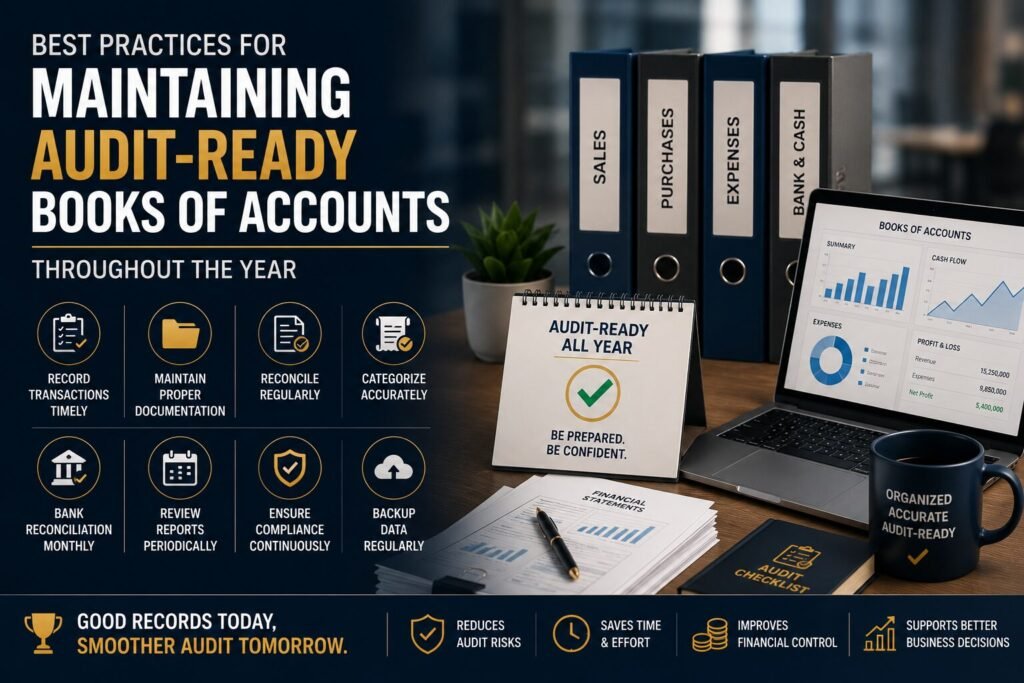
TL;DR Businesses that maintain audit-ready books throughout the year face fewer compliance risks, smoother audits, better GST accuracy, and improved financial decision-making. Key practices include regular bookkeeping, GST reconciliations, document management, internal controls, and periodic financial reviews with experienced chartered accountants. Why Audit-Ready Accounting Matters More Than Ever In today’s regulatory environment, businesses cannot afford weak accounting practices. Income tax scrutiny, GST notices, statutory audits, and investor due diligence have become increasingly data-driven and documentation-focused. For many businesses in Mumbai, audit stress does not come from the audit itself. It comes from: Missing records Incomplete bookkeeping GST mismatches Unreconciled bank entries Improper expense classification Last-minute accounting corrections When books of accounts are maintained properly throughout the year, audits become significantly smoother and less disruptive. Well-maintained accounts also help businesses: Improve cash flow visibility Detect financial leakages early Build investor confidence Reduce compliance penalties Strengthen operational control What Are Audit-Ready Books of Accounts? Audit-ready books of accounts are financial records that are: Accurate Updated regularly Properly categorized Supported by documentation GST-compliant Easily verifiable during audit or scrutiny These records should allow an auditor to verify transactions without delays, confusion, or missing evidence. Audit-ready accounting is not a year-end activity. It is a continuous financial discipline. Essential Financial Records Every Business Must Maintain Businesses should consistently maintain the following: Financial Record Purpose Sales invoices Revenue verification Purchase invoices Expense validation Bank statements Cash flow tracking GST returns Tax compliance Vendor ledgers Liability tracking Customer ledgers Receivable management Payroll records Salary compliance Expense vouchers Audit support Fixed asset register Depreciation tracking TDS records Tax deduction compliance Missing even a few of these documents can delay audits and create unnecessary scrutiny. Common Accounting Mistakes That Create Audit Problems Many businesses unknowingly create audit risks through poor accounting habits. 1. Delayed Bookkeeping Entering transactions months later leads to inaccuracies and missing data. 2. GST Mismatches Differences between GSTR-1, GSTR-3B, and vendor filings often trigger notices. 3. Improper Expense Classification Personal and business expenses mixed together create compliance complications. 4. Missing Supporting Documents Invoices without proper backup documentation weaken audit credibility. 5. No Bank Reconciliation Unmatched bank entries raise red flags during audits. 6. Weak Internal Controls Lack of approval systems increases fraud and accounting errors. Best Practices for Maintaining Audit-Ready Books 1. Record Transactions Daily Daily bookkeeping prevents backlog accumulation and improves accuracy. Businesses should: Record invoices immediately Update expense entries daily Maintain payment references Track receivables and payables consistently Real-time accounting also improves financial visibility for management decisions. 2. Maintain Proper Invoice Management Invoices are among the most important audit documents. Ensure: Sequential invoice numbering Proper GST details Vendor verification Digital copies of invoices Easy retrieval systems A centralized invoice management process reduces audit delays significantly. 3. Perform Monthly Bank Reconciliations Bank reconciliation ensures accounting records match actual banking activity. Monthly reconciliation helps identify: Duplicate entries Missed transactions Unauthorized payments Banking errors Outstanding cheques Businesses that delay reconciliation often face year-end accounting confusion. 4. Reconcile GST Data Regularly GST reconciliation is critical for audit preparedness. Businesses should reconcile: GSTR-1 vs sales register GSTR-3B vs books GSTR-2B vs purchase register Input tax credit claims Frequent GST reconciliation reduces the risk of: ITC reversals GST notices Penalties Vendor mismatch issues 5. Separate Personal and Business Expenses One of the most common audit issues in SMEs is mixing personal expenses with business accounts. Maintain: Separate bank accounts Dedicated business cards Clear expense policies Proper authorization procedures This improves accounting transparency and compliance credibility. 6. Maintain Vendor & Customer Ledgers Clean ledgers help businesses track: Outstanding receivables Vendor dues Advance payments Credit periods Disputed balances Periodic ledger confirmation also improves audit accuracy. 7. Implement Internal Financial Controls Internal controls reduce operational and financial risks. Examples include: Approval workflows Expense authorization limits Dual verification systems Restricted accounting access Inventory controls Strong internal controls strengthen both audit readiness and fraud prevention. 8. Use Cloud Accounting Systems Modern accounting software improves: Data accessibility Financial reporting Backup security Multi-user collaboration Compliance tracking Cloud systems also simplify audit sharing with accountants and auditors. 9. Conduct Quarterly Internal Reviews Quarterly reviews help identify issues before year-end. Internal reviews should evaluate: GST reconciliations TDS compliance Outstanding liabilities Revenue recognition Expense categorization Documentation gaps This proactive approach prevents last-minute panic. 10. Maintain Proper Documentation Backup Businesses should maintain: Digital backups Cloud storage Organized folders Vendor contracts Tax filings Signed agreements Proper documentation protects businesses during audits, litigation, or tax scrutiny. Monthly Audit-Readiness Checklist Task Frequency Update bookkeeping Daily Bank reconciliation Monthly GST reconciliation Monthly Vendor ledger review Monthly Customer outstanding review Monthly Expense verification Monthly Payroll reconciliation Monthly TDS compliance review Quarterly Internal audit review Quarterly Financial statement review Quarterly Role of Professional Chartered Accountants in Audit Preparedness Professional chartered accountants help businesses: Maintain compliant accounting systems Improve financial accuracy Detect accounting weaknesses Reduce audit risks Strengthen internal controls Handle GST and tax reconciliations Prepare for statutory and tax audits For growing businesses in Mumbai, professional accounting support often becomes essential as transaction complexity increases. Suggested internal linking opportunities: “GST compliance services” “Tax audit support” “Business accounting solutions” “Internal audit services” “Startup compliance advisory” How Audit-Ready Accounting Improves Business Growth Businesses often see accounting only as a compliance requirement. In reality, accurate accounting directly supports growth. Audit-ready books improve: Financial forecasting Loan eligibility Investor confidence Cash flow management Budget planning Tax efficiency Decision-making speed When financial records are reliable, business owners can make strategic decisions with confidence. Final Thoughts Maintaining audit-ready books of accounts throughout the year is no longer optional for businesses operating in India’s increasingly regulated environment. Businesses that adopt disciplined accounting practices experience: Smoother audits Better compliance Reduced penalties Stronger operational control Faster business decision-making Instead of treating audits as year-end emergencies, companies should build a year-round accounting system focused on accuracy, transparency, and compliance. Working with experienced professionals like CA Arihant Lodha can help businesses establish reliable accounting processes, strengthen financial controls, and stay consistently audit-ready. FAQ SECTION What are audit-ready books of accounts? Audit-ready books of accounts are organized, accurate,
Hidden Financial Mistakes That Hurt Business Growth More Than High Taxes

TL;DR Many businesses assume taxes are the biggest obstacle to profitability. In reality, weak HIdden Financial systems, poor bookkeeping, cash flow mismanagement, delayed compliance, and lack of financial visibility often damage growth far more than taxes. Businesses in Mumbai that improve financial discipline usually scale faster, reduce operational stress, and make better strategic decisions. Why Most Businesses Focus on Taxes Instead of Financial Systems Most entrepreneurs actively look for ways to reduce taxes. While tax planning matters, it is rarely the main reason businesses struggle financially. A business can survive taxes. What usually hurts growth is: Poor cash flow Uncontrolled expenses Weak accounting systems Compliance delays Financial decision-making without data Lack of profitability analysis Many growing businesses in Mumbai generate strong sales but still face liquidity problems, vendor pressure, tax notices, and unstable profits because their internal financial systems are weak. This problem is especially common among: Startups Ecommerce businesses Agencies Traders Small manufacturers Service-based companies The real issue is not always taxation. It is financial visibility. The Real Cost of Financial Mismanagement Financial mistakes rarely create immediate disasters. They silently reduce efficiency and profitability over time. Here is how poor financial management affects businesses: Financial Mistake Business Impact Delayed bookkeeping Wrong financial decisions Poor cash flow management Payment crises Missed compliance deadlines Penalties and notices No forecasting Sudden cash shortages Untracked expenses Reduced profitability Weak reporting Slow growth decisions Inventory mismanagement Capital blockage No financial planning Unstable scaling Businesses that fail financially are often not lacking revenue. They lack financial structure. Hidden Financial Mistakes That Damage Business Growth 1. Ignoring Cash Flow While Tracking Only Revenue Many businesses celebrate high monthly sales without checking actual cash movement. Revenue does not guarantee liquidity. A business may appear profitable on paper while struggling to: Pay salaries Clear vendor dues Handle GST payments Manage loan obligations Common causes include: Excessive credit sales Slow customer collections High operational overhead Poor receivables tracking Why this hurts growth Without proper cash flow management: Expansion plans get delayed Vendor relationships weaken Emergency borrowing increases Working capital pressure rises Best practice Maintain: Weekly cash flow tracking Receivables ageing reports Expense forecasting Emergency reserve planning 2. Poor Bookkeeping and Delayed Accounting One of the most damaging mistakes is treating bookkeeping as a low-priority administrative task. Many businesses update accounts: Quarterly At year-end Only during tax filing season This creates inaccurate financial visibility. Problems caused by delayed bookkeeping Incorrect GST filings Expense leakage Wrong profit calculations Tax mismatches Missed deductions Weak audit readiness Smart businesses do this instead Maintain real-time accounting Reconcile bank statements monthly Review ledgers regularly Track outstanding liabilities Accurate books help management make faster and safer decisions. 3. Mixing Personal and Business Expenses This is extremely common among startups and family-run businesses. Business owners often use: Business accounts for personal spending Personal cards for company expenses Informal cash withdrawals Why this creates problems It leads to: Accounting confusion Tax complications Compliance risks Distorted profitability reports It also becomes difficult to: Secure funding Prepare audits Track true business performance Recommended approach Maintain: Separate bank accounts Defined salary or drawings Expense approval systems Documented reimbursements 4. No Budgeting or Financial Forecasting Many businesses operate reactively instead of strategically. Without budgeting: Costs rise unnoticed Hiring becomes inefficient Marketing spends become inconsistent Expansion decisions lack financial backing Financial forecasting helps businesses: Plan growth Manage operational risks Predict working capital needs Avoid sudden financial stress Important forecasting areas Revenue projections Monthly expenses GST liabilities Payroll planning Seasonal demand trends Businesses that forecast financially usually respond faster to market changes. 5. Delaying GST, ROC, and Tax Compliance Compliance delays are one of the fastest ways to create avoidable business stress. Many businesses ignore filings until: Notices arrive Deadlines approach Penalties accumulate Common compliance mistakes Incorrect GST reconciliation Late ROC filings TDS mismatches Wrong expense classification Ignoring notices Consequences Penalties Interest liabilities Department scrutiny Reduced credibility Funding complications 6. Not Reviewing Financial Reports Regularly Many entrepreneurs only review financials during: Tax season Audits Loan applications This is risky. Financial reports businesses should review monthly Profit & Loss Statement Balance Sheet Cash Flow Statement GST reconciliation Receivables report Expense trends Why regular review matters It helps identify: Falling profit margins Unnecessary expenses Slow-paying clients Operational inefficiencies Tax exposure risks Data-driven businesses usually scale faster because they identify issues early. 7. Weak Inventory and Expense Controls Businesses often lose money through operational inefficiency rather than taxation. Common issues Overstocking Inventory shrinkage Duplicate vendor payments Untracked expenses Informal purchasing Impact on profitability Capital gets blocked Margins reduce Cash flow weakens Operational waste increases Solution Implement: Inventory audits Vendor controls Expense approval systems Monthly cost analysis 8. Overdependence on One Revenue Source Many businesses become financially vulnerable because they rely heavily on: One major client One product category One seasonal demand cycle Risk involved If that revenue source slows: Cash flow collapses Payroll becomes difficult Growth plans stop Smart strategy Diversify: Customer segments Revenue channels Geographic markets Product/service mix 9. Hiring Finance Staff Without Strategic Oversight Having an accountant is not the same as having financial strategy. Many businesses record transactions but fail to analyze: Business performance Financial trends Profitability ratios Compliance risks Strategic financial oversight helps with Tax planning Business structuring Compliance management Financial forecasting Growth planning This is where experienced chartered accountants add long-term value. 10. Ignoring Technology and Automation Manual accounting systems increase: Errors Delays Compliance risks Reporting inefficiencies Businesses should adopt Cloud accounting Automated invoicing GST reconciliation tools Digital expense tracking MIS reporting systems Automation improves: Accuracy Speed Decision-making quality Warning Signs Your Business Has Financial Blind Spots Your business may have financial management issues if: Sales are increasing but profits remain low GST filings feel stressful every month Cash shortages happen frequently Financial reports are outdated You rely heavily on one client Vendor payments keep getting delayed You do not know monthly profitability accurately Tax notices are becoming common These signs usually indicate structural financial weaknesses. How Professional Financial Management Improves Business Growth Businesses with strong financial systems generally experience: Better
How Mumbai Startups Can Stay ROC, GST & Income Tax Compliant Without Last-Minute Stress
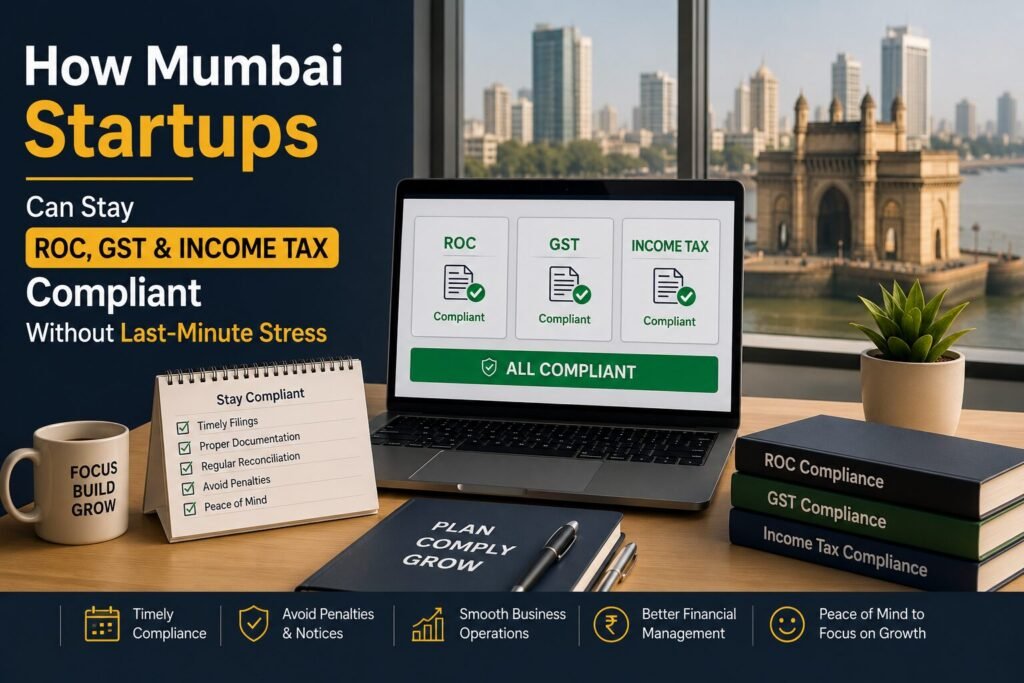
TL;DR Mumbai Startup often struggle with ROC filings, GST returns, bookkeeping gaps, and tax deadlines because compliance is treated as a year-end activity instead of an ongoing business process. To avoid penalties, notices, director disqualification risks, and operational stress in 2026, startups should: Maintain monthly bookkeeping Track ROC and GST deadlines Reconcile GST regularly Maintain clean financial records Conduct periodic compliance reviews Work with experienced chartered accountants A proactive compliance strategy saves time, improves investor confidence, and protects business continuity. Why Startup Compliance Is Becoming More Important in 2026 India’s compliance ecosystem is becoming increasingly data-driven. Government departments now use automated matching systems, AI-assisted scrutiny, PAN-GST integration, TDS analytics, and MCA cross-verification to identify inconsistencies quickly. For startups operating in Mumbai, this means compliance errors are no longer easy to ignore. Even small issues such as: Delayed GST filing Incorrect input tax credit claims ROC filing delays Mismatch between turnover and income tax returns Missing invoices can trigger: Notices Penalties Interest liabilities Funding complications Vendor trust issues In 2026, compliance is not just a legal requirement. It directly impacts: Investor due diligence Banking relationships GST credibility Tender eligibility Business reputation Understanding the Three Major Compliance Areas ROC Compliance ROC (Registrar of Companies) compliance applies primarily to: Private Limited Companies LLPs OPCs It includes: Annual filings Director disclosures Financial statement submission Board meeting documentation MCA updates Failure to comply can result in: Heavy late filing penalties Director disqualification Company status issues GST Compliance GST compliance involves: GST registration Monthly or quarterly returns Invoice management ITC reconciliation E-invoicing (where applicable) GST authorities increasingly track: Invoice mismatches Fake ITC claims Return delays Supplier compliance gaps Income Tax Compliance Income tax compliance includes: Accurate bookkeeping Advance tax payments TDS compliance Income tax return filing Audit requirements Incorrect filings can lead to: Scrutiny notices Penalties Cash flow disruptions Common Compliance Mistakes Mumbai Startup Make 1. Treating Compliance as a Year-End Task Many startups ignore bookkeeping and reconciliations for months and attempt to complete everything near filing deadlines. This creates: Data inconsistencies Missing invoices GST mismatches Filing errors 2. Poor Documentation Practices Startups often fail to maintain: Vendor invoices Expense proofs Board resolutions Employee payroll records Incomplete records create major problems during: GST assessments Income tax scrutiny Investor due diligence 3. Mixing Personal and Business Transactions Founders frequently use: Personal bank accounts Personal credit cards Informal expense reimbursements This complicates: Tax calculations Expense claims Audit trails 4. Ignoring ROC Filings Many startups focus only on GST and income tax while ignoring MCA compliance. Late ROC filings can accumulate substantial penalties over time. 5. Inconsistent GST Reconciliation Failure to reconcile: GSTR-1 GSTR-3B Purchase records Vendor filings can create ITC disputes and notices. ROC Compliance Checklist for Startups Compliance Area Frequency Importance Board Meetings Periodic Governance compliance Annual ROC Filing Annual Mandatory under Companies Act Director KYC Annual Director validation Financial Statement Filing Annual MCA reporting Statutory Registers Ongoing Audit readiness Best Practice Maintain a digital compliance tracker instead of relying on manual reminders. GST Compliance Checklist for Startups Maintain Proper GST Invoicing Ensure invoices contain: GSTIN Invoice number HSN/SAC codes Tax breakup Reconcile GST Monthly Monthly reconciliation helps identify: Vendor filing mismatches Missing ITC Duplicate entries Wrong tax calculations File Returns Consistently Avoid irregular filing patterns even during low-revenue periods. Nil returns are also mandatory where applicable. Monitor Vendor Compliance Your ITC eligibility may be affected if vendors fail to file returns properly. Income Tax Compliance Checklist Maintain Updated Books of Accounts Monthly bookkeeping prevents: Profit calculation errors Tax estimation problems Cash flow confusion Track Advance Tax Obligations Businesses with tax liability beyond prescribed thresholds should monitor advance tax obligations carefully. Maintain Expense Documentation Keep organized records for: Rent Salaries Professional fees Marketing expenses Software subscriptions Conduct Quarterly Financial Reviews Quarterly reviews help startups: Detect compliance risks early Estimate taxes accurately Improve financial planning Compliance Calendar Every Mumbai Startup Should Maintain A structured compliance calendar significantly reduces last-minute pressure. Recommended Tracking Areas GST filing deadlines ROC filing due dates TDS payment schedules Advance tax dates Payroll compliance Audit preparation timelines Using cloud-based accounting systems can automate reminders and improve visibility. How Poor Bookkeeping Creates Compliance Problems Many compliance failures originate from weak bookkeeping systems. Poor accounting creates: Wrong GST returns Inaccurate tax filings Vendor disputes Cash flow confusion Audit complications Common bookkeeping issues: Delayed entries Missing invoices Duplicate transactions Incorrect expense classification Warning Signs Your Startup Is Falling Behind You may already have compliance risks if: GST returns are filed late regularly Bank reconciliation is incomplete Directors are unaware of ROC deadlines Vendor ledgers are inconsistent TDS compliance is irregular Financial statements are delayed Ignoring these indicators increases future scrutiny risk. How Professional CA Support Reduces Compliance Risk An experienced chartered accountant firm helps startups: Build compliance systems Maintain accurate books Reduce filing errors Improve audit preparedness Handle notices professionally Maintain investor-ready records For startups in Mumbai, working with specialists familiar with startup ecosystems and regulatory frameworks provides operational clarity and long-term compliance stability. Best Practices to Stay Compliant Year-Round Automate Accounting Processes Use cloud accounting software integrated with GST systems. Separate Personal and Business Finances Maintain dedicated business banking and expense management. Conduct Monthly Compliance Reviews Monthly reviews are easier and safer than annual panic corrections. Maintain a Compliance Folder Store: GST returns ROC acknowledgements Tax filings Audit reports Financial statements digitally and securely. Work Proactively — Not Reactively Most compliance penalties are preventable with proper planning. Final Thoughts Startups that treat compliance as an operational discipline gain a major advantage in 2026. Strong ROC, GST, and income tax compliance: Improves business credibility Supports fundraising Reduces regulatory risks Improves financial clarity Prevents last-minute stress For growing startups in Mumbai, proactive compliance management is no longer optional. It is a core business requirement. A structured compliance framework supported by experienced chartered accountants can help startups focus on growth while remaining fully aligned with regulatory requirements. FAQ SECTION What compliances are mandatory for startups in India? Startups generally need ROC, GST, income tax, TDS, and bookkeeping compliance
ax Audit in India Explained: Who Needs It, Penalties, Due Dates & Compliance Tips

TL;DR A tax audit under Section 44AB of the Income Tax Act is mandatory for eligible businesses and professionals crossing prescribed turnover or income thresholds. Non-compliance can result in penalties, scrutiny notices, and financial reporting issues. Businesses that maintain accurate bookkeeping, GST reconciliation, and organized documentation throughout the year significantly reduce audit risks. What Is a Tax Audit? A tax audit is an examination of a taxpayer’s financial records conducted by a Chartered Accountant to verify whether income, deductions, expenses, and compliance records are correctly maintained according to the Income Tax Act. The objective of a tax audit is to: Ensure accurate income reporting Verify tax compliance Reduce tax evasion Improve financial transparency Standardize reporting practices For businesses in India, tax audits have become increasingly important due to: GST data integration AIS and TIS reporting systems Digital payment tracking Advanced income tax analytics Automated discrepancy detection Today, mismatches between GST returns, bank transactions, and income tax filings can quickly trigger notices or scrutiny. What Is Section 44AB of the Income Tax Act? Section 44AB: Mandatory Tax Audit for Eligible Businesses and Professionals\text{Section 44AB: Mandatory Tax Audit for Eligible Businesses and Professionals}Section 44AB: Mandatory Tax Audit for Eligible Businesses and Professionals Section 44AB governs tax audit applicability in India. It mandates certain businesses and professionals to get their accounts audited by a Chartered Accountant and submit the audit report before the prescribed due date. The audit report is typically filed using: Form 3CA / 3CB Form 3CD These forms contain detailed disclosures related to: Turnover Expenses GST compliance Related-party transactions TDS compliance Depreciation Cash transactions Who Needs a Tax Audit in India? 🔍 1. Businesses Businesses are generally required to undergo tax audit if turnover exceeds prescribed limits under Section 44AB. 2. Professionals Professionals such as: Doctors Architects Consultants Chartered Accountants Freelancers Lawyers may require tax audit based on gross receipts thresholds. 3. Presumptive Taxation Cases Businesses or professionals opting for presumptive taxation under: Section 44AD Section 44ADA Section 44AE may also become liable for audit under specific circumstances, especially when declaring lower profits than prescribed norms. This is one of the most misunderstood areas among small businesses and freelancers. Tax Audit Turnover Limits for FY 2025–26 📊 Category Tax Audit Applicability Business Applicable if turnover crosses prescribed limits under Section 44AB Professionals Applicable based on gross receipt threshold Presumptive Taxation Audit applicable under certain lower-profit declarations Businesses should always consult a qualified Chartered Accountant because applicability can vary based on: Digital transaction percentage Nature of business Presumptive taxation selection Profit reporting structure Important Tax Audit Due Dates 🗓️ Missing due dates is one of the biggest compliance mistakes businesses make. Typically, businesses requiring tax audit must: Complete books of accounts Finalize financial statements Conduct audit File audit report Submit income tax return well before statutory deadlines. Late preparation creates: Reporting errors Reconciliation mismatches Documentation gaps Filing pressure Businesses operating in Mumbai often face additional operational complexity due to high transaction volumes and multi-state GST activity. Documents Required for Tax Audit 📂 Maintaining organized documentation simplifies the audit process significantly. Common Documents Include: Sales invoices Purchase records Bank statements GST returns TDS returns Expense vouchers Payroll records Loan statements Fixed asset register Previous audit reports Additional Supporting Records E-invoices Vendor reconciliations Inventory reports Cash book Profit and loss statements Balance sheet schedules Poor documentation is one of the leading causes of audit delays. Common Mistakes Businesses Make During Tax Audit 1. GST Reconciliation Errors Many businesses fail to reconcile: GSTR-1 GSTR-3B E-way bills Books of accounts This creates discrepancies that may attract notices from both GST and Income Tax departments. 2. Improper Expense Claims Businesses often claim: Unsupported expenses Personal expenses as business expenses Incorrect depreciation Unverified vendor payments These claims increase audit exposure significantly. 3. Cash Transaction Violations High-value cash transactions remain a major compliance risk. Improper handling of: Cash receipts Cash expenses Related-party cash dealings can trigger scrutiny under multiple provisions of the Income Tax Act. 4. Ignoring TDS Compliance Mismatch in TDS deduction or delayed filing creates cascading compliance issues. Businesses must reconcile: TDS returns Vendor payments Form 26AS AIS reporting regularly throughout the financial year. 5. Last-Minute Accounting One of the biggest operational mistakes is postponing bookkeeping until year-end. This usually results in: Incomplete records Missed entries Incorrect reconciliations Filing stress Continuous accounting discipline reduces audit complications dramatically. Penalties for Non-Compliance Failure to comply with tax audit requirements may result in penalties under the Income Tax Act. Consequences may include: Monetary penalties Increased scrutiny risk Delayed refunds Compliance notices Disallowance of expenses Litigation exposure Businesses should avoid treating tax audit as a last-minute compliance exercise. Practical Tax Audit Compliance Tips ✅ Maintain Monthly Bookkeeping Regular accounting reduces year-end pressure and improves reporting accuracy. Reconcile GST Every Month Monthly GST reconciliation helps detect mismatches early. Separate Personal and Business Transactions Mixing transactions creates audit complications and weakens financial transparency. Digitize Financial Records Cloud-based accounting systems improve: Record accessibility Audit readiness Reporting accuracy Compliance tracking Work With a Professional CA Firm A structured Chartered Accountant firm can help businesses: Maintain proper records Ensure statutory compliance Reduce tax exposure Respond to notices Improve audit preparedness How CA Arihant Lodha Helps Businesses Stay Audit-Ready CA Arihant Lodha assists startups, SMEs, professionals, and established businesses with: Tax audit support Accounting and bookkeeping GST reconciliation Income tax compliance Financial reporting Audit preparedness Business compliance management The firm focuses on proactive compliance systems that help businesses reduce risks and maintain accurate financial records throughout the year. Final Thoughts Tax audit compliance is no longer just a statutory requirement. It is now a critical part of financial governance and business credibility. Businesses that maintain clean books, timely reconciliations, and structured compliance systems: reduce scrutiny risks, improve operational clarity, strengthen financial reporting, and avoid unnecessary penalties. As regulatory systems become increasingly data-driven in 2026, businesses must move from reactive compliance to proactive audit readiness. Partnering with an experienced Chartered Accountant firm can make that transition significantly easier and more reliable. FAQ SECTION 1. Who needs a tax audit in India? Businesses and professionals crossing prescribed turnover or receipt limits under Section 44AB may
Why Small Businesses in Mumbai Are Switching to Outsourced Accounting & Bookkeeping Services 1
TL;DR Mumbai small businesses are outsourcing accounting to improve compliance and operational efficiency Outsourced bookkeeping reduces errors and improves reporting accuracy Mumbai businesses gain access to professional accounting expertise without building large internal teams GST, TDS, and tax compliance management become more streamlined Cloud accounting tools are driving the outsourcing trend in 2026 Introduction Mumbai small business ecosystem is evolving rapidly. From startups and agencies to retailers and e-commerce brands, businesses today operate in an environment where: Compliance requirements are stricter GST scrutiny is increasing Financial reporting expectations are higher Operational efficiency directly affects profitability Many business owners initially attempt to manage accounting internally. But as operations grow, they face recurring problems: Delayed bookkeeping GST mismatches Incomplete financial records Poor cash flow tracking Filing errors This is one of the biggest reasons why businesses across Mumbai are increasingly shifting toward outsourced accounting and bookkeeping services. In 2026, outsourced finance support is no longer viewed as an optional convenience. For many SMEs, it has become a strategic business decision. Why Traditional Accounting Models Are Failing SMEs Small businesses often rely on: One internal accountant Manual spreadsheets Delayed reconciliation processes This creates several operational risks. Common problems include: Inconsistent bookkeeping entries GST return mismatches Vendor reconciliation issues Missing invoices Poor audit preparedness Lack of monthly reporting discipline As transaction volumes increase, these problems multiply quickly. Most SMEs realize the issue only when: ❌ Tax notices arrive ❌ Cash flow problems appear ❌ Investors ask for clean financial statements ❌ GST scrutiny begins What Are Outsourced Accounting & Bookkeeping Services? Outsourced accounting means delegating financial management activities to professional accounting experts outside the company. These services may include: Bookkeeping GST accounting Bank reconciliation Financial reporting TDS management Payroll accounting Tax filing support MIS reporting Instead of building a large in-house finance team, businesses work with specialized professionals using digital accounting systems. Top Reasons Mumbai Businesses Are Outsourcing Accounting 1. Better Compliance Management One of the biggest reasons businesses outsource accounting is compliance accuracy. In 2026, businesses must handle: GST returns TDS filings ROC compliance Income tax documentation E-invoicing requirements Even small errors can trigger: Notices Penalties Input tax credit issues Professional accounting firms maintain structured compliance workflows that reduce these risks significantly. 2. Access to Experienced Financial Expertise Hiring experienced finance professionals internally is difficult for many SMEs. Outsourced accounting gives businesses access to: ✔ Qualified accountants ✔ GST specialists ✔ Tax professionals ✔ Financial reporting expertise This improves: Reporting quality Tax accuracy Financial planning 3. Improved Financial Visibility Many small businesses struggle because owners lack real-time financial visibility. Outsourced bookkeeping helps businesses monitor: Cash flow Receivables Payables Tax liabilities Profitability trends Better visibility leads to better business decisions. 4. More Focus on Core Business Operations Business owners should focus on: Sales Growth Customer acquisition Operations Not chasing invoice entries or correcting reconciliation mistakes. Outsourcing accounting reduces administrative burden and allows founders to focus on scaling the business. 5. Scalability & Operational Flexibility As businesses grow: Transaction volumes increase Compliance becomes more complex Financial reporting expectations rise Outsourced accounting systems scale more efficiently compared to fragmented internal processes. This becomes especially important for: E-commerce businesses Agencies Multi-location businesses Growing startups Common Accounting Problems SMEs Face Problem Business Impact Delayed bookkeeping Poor financial visibility GST mismatches Input tax credit loss Missing invoices Audit complications Incorrect reconciliation Cash flow confusion Weak reporting Poor decision-making Manual accounting Increased human errors What Services Are Usually Outsourced? Most businesses outsource a combination of: Bookkeeping Daily transaction recording and ledger maintenance. GST Compliance GST returns, reconciliation, and ITC tracking. Payroll Accounting Salary processing and statutory deductions. MIS Reporting Monthly business performance reporting. Bank Reconciliation Matching transactions and identifying discrepancies. Vendor & Receivable Tracking Managing payment cycles efficiently. Cloud Accounting & Digital Transformation in 2026 Cloud accounting platforms have accelerated accounting outsourcing across India. Businesses now use: Real-time dashboards Automated invoicing Cloud document sharing Digital reconciliation systems Benefits include: ✔ Faster reporting ✔ Remote accessibility ✔ Reduced paperwork ✔ Better collaboration Digital accounting ecosystems are now standard for modern SMEs. How Outsourced Bookkeeping Helps with GST & Tax Compliance GST compliance has become increasingly data-driven. Authorities now monitor: Invoice matching Return consistency Vendor compliance E-way bill reconciliation Outsourced accounting teams help businesses: Maintain clean records Avoid filing mismatches Track GST liabilities properly Improve audit readiness This significantly reduces compliance risks. Industries Benefiting Most from Outsourced Accounting E-commerce Businesses High transaction volumes require structured bookkeeping. Agencies & Service Firms Project-based billing needs organized accounting systems. Retail Businesses Inventory-linked accounting becomes easier with professional systems. Startups Investor reporting and compliance become more manageable. Professional Services Consultants and service firms benefit from structured financial tracking. Mistakes Businesses Make While Choosing Accounting Partners 1. Choosing Only Based on Low Cost Low-quality bookkeeping often creates expensive compliance problems later. 2. Ignoring Industry Experience Different industries require different accounting workflows. 3. Lack of Reporting Systems Many providers record transactions but fail to deliver actionable insights. 4. Weak Communication Processes Delayed responses create compliance bottlenecks. Why Professional CA Support Matters Accounting is no longer just data entry. Modern businesses need: Compliance expertise Financial reporting clarity Tax planning support Scalable accounting systems Professional CA firms provide strategic financial support that goes beyond bookkeeping. How CA Arihant Lodha Supports Mumbai Businesses CA Arihant Lodha assists SMEs and startups with: Accounting & bookkeeping support GST compliance management Financial reporting Tax advisory Business compliance assistance Startup financial structuring Conclusion Mumbai businesses are shifting toward outsourced accounting because modern compliance and financial management require specialized expertise. The transition is driven by: Increasing GST complexity Demand for accurate reporting Need for operational efficiency Digital accounting adoption Businesses that maintain organized accounting systems gain: ✔ Better compliance ✔ Stronger financial control ✔ Improved scalability ✔ Faster decision-making In 2026, outsourced accounting is not just an operational support function — it is a competitive advantage. CTA Need professional accounting and bookkeeping support for your business in Mumbai? Consult CA Arihant Lodha for structured accounting, GST compliance, and financial management solutions tailored for startups and
LLP vs Private Limited Company in India: Which Business Structure Is Better in 2026?

TL;DR LLPs are simpler and cheaper to maintain Private Limited Companies are better for funding and scalability Startups seeking investors usually prefer Pvt Ltd structures LLPs work well for professionals, agencies, and family businesses Compliance, taxation, and long-term business goals should guide the decision Introduction Choosing the right business structure is one of the most important decisions entrepreneurs make. And in 2026, the decision matters even more because: Compliance systems are becoming stricter Investors expect structured governance Tax scrutiny has increased Startup ecosystems are more competitive Two of the most popular business structures in India are: Limited Liability Partnership (LLP) Private Limited Company (Pvt Ltd) Both provide limited liability protection, but they differ significantly in: Compliance Taxation Fundraising capability Ownership flexibility Scalability This guide explains the practical differences so founders and SMEs can choose the right structure strategically. What is an LLP? A Limited Liability Partnership (LLP) combines features of: Partnerships Corporate entities An LLP offers: ✔ Limited liability protection✔ Lower compliance burden✔ Operational flexibility LLPs are governed under the Limited Liability Partnership Act, 2008. LLPs are commonly preferred by: Consultants CA firms Agencies Service providers Family-run businesses What is a Private Limited Company? A Private Limited Company is a separate legal entity governed under the Companies Act, 2013. It offers: ✔ Separate corporate identity✔ Shareholding structure✔ Better investor confidence✔ Easier fundraising opportunities Private Limited Companies are highly preferred by: Tech startups Venture-backed businesses Fast-scaling companies E-commerce brands LLP vs Private Limited Company: Key Differences Factor LLP Private Limited Company Governing Law LLP Act Companies Act Ownership Partners Shareholders Liability Limited Limited Compliance Lower Higher Audit Requirement Conditional Mandatory in many cases Funding Capability Limited High ESOPs Not Available Available Investor Preference Low High Scalability Moderate High Annual Compliance Cost Lower Higher 1. Ownership Structure LLP Managed by partners Flexible operational structure Partnership agreement defines roles Private Limited Managed by directors Ownership divided into shares Stronger governance framework Best for: LLP → Closely managed businesses Pvt Ltd → Structured scaling businesses 2. Compliance Requirements This is where most founders underestimate the difference. LLP Compliance Typically includes: Annual Return Statement of Accounts Income Tax Return Private Limited Compliance Includes: Board meetings ROC filings Financial statements Annual return filings Statutory audit requirements Important: Private Limited Companies generally have: ❌ Higher compliance burden❌ Higher professional costs But they also offer: ✔ Better credibility✔ Investor readiness 3. Taxation Comparison LLP Taxation Flat income tax rate Dividend distribution flexibility No dividend tax implications like companies Private Limited Taxation Corporate tax applies Dividend distribution rules applicable Better tax structuring possibilities for scaling businesses In practice: LLPs often work better for: Moderate-profit service firms Private Limited Companies work better for: Reinvestment-heavy growth businesses 4. Funding & Investment Potential This is one of the biggest differentiators. LLP Challenges: Cannot issue shares Limited investor flexibility Venture capital firms rarely prefer LLPs Private Limited Company Advantages: ✔ Equity issuance possible✔ ESOPs possible✔ Preferred by VCs and angel investors If your goal is fundraising: 👉 Private Limited Company is usually the stronger option. 5. Scalability & Expansion LLP Suitable for: Stable businesses Professional practices Regional operations Private Limited Suitable for: National expansion Investor-backed growth Multi-founder scaling International business expansion 6. Credibility & Brand Perception Many vendors, investors, and enterprise clients perceive: Private Limited Companies as more structured and scalable LLPs as more suitable for smaller professional businesses This perception affects: Funding Partnerships Enterprise contracts Which Structure is Better for Startups? Choose LLP if: ✔ You want lower compliance✔ You run a professional service business✔ External funding is not a priority✔ You want operational flexibility Choose Private Limited if: ✔ You plan to raise investment✔ You want rapid scaling✔ You need ESOPs✔ You expect multiple shareholders Which Structure is Better for Small Businesses? For many SMEs and local businesses: 👉 LLP can be more cost-effective. For growth-focused businesses: 👉 Private Limited often becomes the smarter long-term structure. Compliance Cost Comparison in 2026 Expense Area LLP Pvt Ltd Registration Cost Lower Higher Annual Filing Lower Higher Audit Cost Conditional More Frequent Secretarial Compliance Minimal Significant Common Mistakes Entrepreneurs Make 1. Choosing Structure Only Based on Cost Cheap registration today can create scaling limitations later. 2. Ignoring Future Funding Goals Businesses planning investment should avoid structural limitations early. 3. Underestimating Compliance Many founders fail to budget for ongoing ROC and tax compliance. 4. Copying Competitors Blindly Your business structure should match: Revenue model Growth goals Investor expectations Tax planning strategy How to Choose the Right Business Structure Ask these questions: Will you raise funding? How fast do you plan to scale? Do you need ESOPs? How much compliance can you manage? Is tax efficiency your priority? The answers usually clarify the right structure. Why Professional CA Guidance Matters Business registration decisions affect: Tax planning Investor readiness Compliance burden Future restructuring costs Professional CA firms help entrepreneurs: ✔ Choose the correct structure✔ Handle registration smoothly✔ Maintain ROC & GST compliance✔ Avoid costly legal mistakes Why CA Arihant Lodha is a Strong Business Registration Partner CA Arihant Lodha assists startups and SMEs with: LLP registration Private Limited Company incorporation GST registration ROC compliance Startup advisory Tax planning Conclusion There is no universally “best” business structure. The right choice depends on: Your growth vision Funding plans Compliance capacity Tax strategy In general: ✅ LLP → Better for operational simplicity✅ Private Limited → Better for aggressive scaling and investment Choosing correctly in the beginning prevents expensive restructuring later. CTA Need help deciding between LLP and Private Limited Company registration? Consult CA Arihant Lodha for expert startup registration, GST, and compliance advisory in Mumbai. FAQ SECTION 1. Which is better LLP or Private Limited Company? It depends on your goals. LLPs are simpler and cost-effective, while Private Limited Companies are better for scaling and investment. 2. Can LLP raise funding from investors? LLPs face limitations in raising equity funding because they cannot issue shares like companies. 3. Is LLP good for startups? Yes, especially for bootstrapped service businesses with lower compliance needs. 4. Which structure has lower compliance
GST Registration vs GST Compliance: What Mumbai Businesses Often Get Wrong
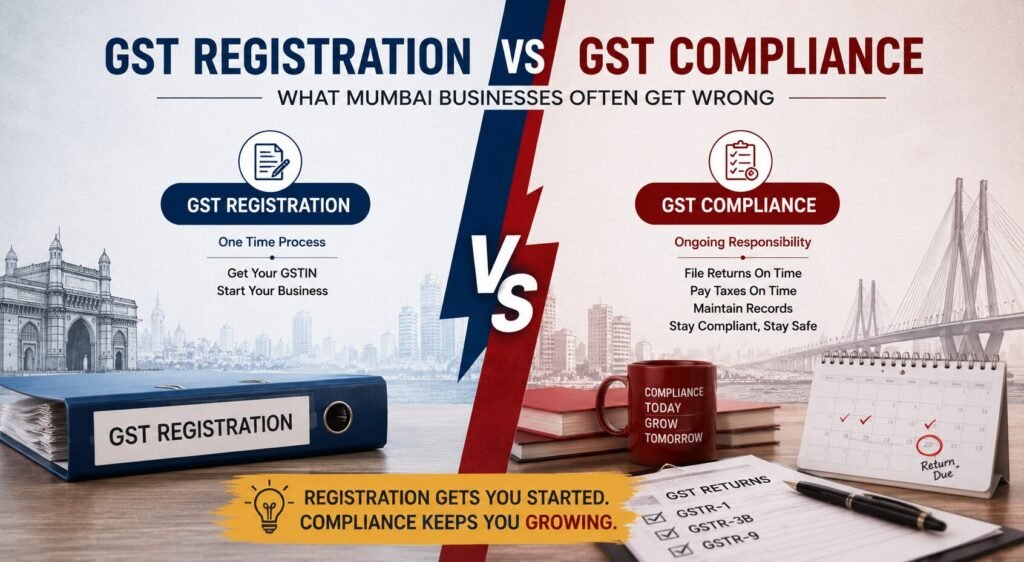
TL;DR gst registration is only the first step—not full compliance Many Mumbai businesses mistakenly believe registration alone is sufficient GST compliance includes filing, reconciliation, invoicing, and reporting Errors can trigger notices, penalties, and audits Professional GST management significantly reduces compliance risks Introduction Many businesses celebrate after receiving their GST number. But that’s where the real work actually begins. One of the biggest misconceptions among startups and SMEs in Mumbai is believing that gst registration equals GST compliance. It doesn’t. In 2026, GST systems are more automated, interconnected, and scrutiny-driven than ever before. Businesses that fail to maintain ongoing compliance face: Penalties Input Tax Credit (ITC) reversals GST notices Departmental scrutiny This guide explains the crucial difference between GST registration and GST compliance—and the mistakes businesses must avoid. Understanding GST Registration GST registration is the process of obtaining a GST Identification Number (GSTIN) from the government. Businesses typically require registration if: Turnover exceeds threshold limits They sell interstate They operate through e-commerce platforms They fall under mandatory GST categories Registration legally enables businesses to: ✔ Collect GST✔ Claim Input Tax Credit✔ Issue GST invoices However: Registration alone does not mean you are compliant. What is GST Compliance? GST compliance refers to the ongoing responsibilities businesses must fulfill after registration. This includes: Filing GST returns Paying GST on time Reconciling invoices Maintaining proper records Following e-invoicing rules Reporting accurate turnover GST compliance is continuous—not one-time. GST Registration vs GST Compliance: Key Differences Factor GST Registration GST Compliance Nature One-time process Ongoing process Purpose Obtain GSTIN Maintain legal compliance Timeline Initial setup Monthly/Quarterly/Annual Includes Filing? No Yes Includes Reconciliation? No Yes Risk if Ignored Cannot legally collect GST Penalties & notices Common GST Mistakes Mumbai Businesses Make 1. Assuming Registration is Enough Many businesses register under GST and then: Skip return filing Ignore reconciliations Delay tax payments This quickly creates compliance issues. 2. Ignoring Monthly & Quarterly Filings Businesses often miss: GSTR-1 GSTR-3B Annual returns Late filing results in: Interest Late fees Compliance risk scores 3. Incorrect ITC Claims Input Tax Credit errors are among the top reasons for GST notices. Common problems include: Claiming ineligible ITC Vendor non-compliance Duplicate claims 4. GST Reconciliation Failures Mismatch between: Books of accounts GST returns E-way bills E-invoices …can trigger automated scrutiny. 5. E-Invoicing Non-Compliance Businesses crossing prescribed turnover thresholds must comply with e-invoicing regulations. Non-compliance can result in: Invalid invoices ITC denial Penalties Penalties & Risks of GST Non-Compliance Compliance Failure Possible Consequence Late filing Interest + penalties Incorrect ITC ITC reversal Under-reporting turnover GST notice E-invoice errors Compliance action Persistent non-compliance GST registration suspension GST Compliance Checklist for 2026 Monthly Tasks File GSTR-1 File GSTR-3B Reconcile ITC claims Quarterly Tasks Review vendor compliance Validate turnover reconciliation Annual Tasks Annual GST return filing Financial audit support Why Businesses Need Professional GST Support GST regulations continue evolving rapidly. Professional GST consultants help businesses: ✔ Reduce notice risks✔ Maintain filing accuracy✔ Optimize Input Tax Credit✔ Ensure audit readiness✔ Improve compliance efficiency This becomes especially important for: Startups SMEs Multi-state businesses E-commerce sellers Why CA Arihant Lodha is a Strong Compliance Partner CA Arihant Lodha offers: GST registration assistance End-to-end GST compliance support GST reconciliation & audit preparation Startup and SME-focused advisory Conclusion GST registration gets your business into the system. GST compliance keeps your business safe inside it. In 2026, the difference between these two concepts is no longer minor—it directly impacts: ✔ Financial stability✔ Tax efficiency✔ Compliance risk✔ Business reputation Businesses that treat GST strategically avoid unnecessary penalties and operational stress. CTA Need help with GST compliance, return filing, or GST notices? Consult CA Arihant Lodha for professional GST advisory and compliance services in Mumbai. FAQ SECTION 1. What is the difference between GST registration and GST compliance? GST registration is obtaining a GSTIN, while GST compliance involves ongoing filing, reconciliation, and reporting obligations. 2. Is GST registration enough for businesses? No. Businesses must continue complying through regular filings and tax payments. 3. What happens if GST returns are not filed? Late filing can lead to penalties, interest, notices, and even suspension of GST registration. 4. Why do businesses receive GST notices? Common reasons include mismatches, incorrect ITC claims, and delayed filings. 5. What is GST reconciliation? It is the process of matching invoices, GST returns, and financial records for accuracy. 6. Can GST non-compliance affect Input Tax Credit? Yes. Incorrect or non-compliant filings can result in ITC reversal or denial. Blog By : CA Arihant Lodha
Virtual CFO Services in Mumbai: Cost, Benefits & When Your Business Actually Needs One

A Virtual CFO provides strategic financial leadership without full-time cost Ideal for startups and SMEs scaling beyond basic accounting Costs range from ₹15,000 to ₹1,00,000+/month depending on scope Helps with cash flow, fundraising, compliance, and growth strategy Hiring at the right stage prevents financial chaos Introduction Most businesses don’t fail because of bad products—they fail because of poor financial decisions. In Mumbai’s competitive business environment, founders often rely on accountants for compliance—but lack strategic financial direction. That’s where Virtual CFO services come in. In 2026, businesses are increasingly shifting to outsourced CFO models to access high-level financial expertise without hiring a full-time executive. What is a Virtual CFO? 🤔 A Virtual CFO (Chief Financial Officer) is a financial expert who provides: Strategic financial planning Cash flow management Business forecasting Compliance oversight 👉 Unlike accountants, a CFO focuses on future growth, not just past records. What Does a Virtual CFO Actually Do? A Virtual CFO handles: Strategic Functions Financial planning & budgeting Business growth strategy Fundraising support Operational Functions Cash flow monitoring Expense optimization Profitability analysis Compliance & Risk Tax planning Regulatory compliance Financial reporting Key Benefits of Virtual CFO Services 🚀 1. Cost Efficiency No full-time salary burden Pay only for required expertise 2. Strategic Decision-Making Data-driven insights Growth-focused planning 3. Improved Cash Flow Management Predictive cash flow tracking Reduced financial stress 4. Investor & Funding Readiness Financial projections Due diligence preparation 5. Risk Reduction Compliance monitoring Early error detection Cost of Virtual CFO Services in Mumbai 💰 Service Level Monthly Cost Basic Advisory ₹15,000 – ₹30,000 Growth Stage Support ₹30,000 – ₹75,000 Advanced Strategic CFO ₹75,000 – ₹1,50,000+ 💡 Cost depends on: Business size Complexity Frequency of engagement Virtual CFO vs Full-Time CFO Factor Virtual CFO Full-Time CFO Cost Low Very High Flexibility High Low Expertise Access Wide Limited to one person Scalability Easy Difficult 👉 For startups & SMEs, Virtual CFO is the smarter choice. When Does Your Business Need a Virtual CFO? ⚠️ You should consider one if: Revenue crosses ₹50 lakh – ₹5 crore Cash flow issues are frequent You’re planning to raise funds Financial decisions feel unclear Compliance complexity increases Industries That Benefit the Most Startups & SaaS companies E-commerce brands Manufacturing SMEs Professional services firms Common Mistakes Without CFO Support Scaling without financial planning Poor cash flow management Overpaying taxes Lack of profitability insights Financial misreporting How to Choose the Right Virtual CFO in Mumbai Look for: ✅ Industry experience ✅ Strategic thinking ability ✅ Strong compliance knowledge ✅ Tech-driven reporting systems ✅ Transparent pricing Why CA Arihant Lodha is a Strong Choice Deep expertise in startups & SMEs End-to-end financial advisory Strong compliance + strategy integration Mumbai-focused business understanding Conclusion Financial clarity is no longer optional—it’s a competitive advantage. A Virtual CFO doesn’t just manage numbers—they shape business outcomes. In 2026, businesses that invest in financial strategy: ✔ Scale faster✔ Avoid costly mistakes✔ Attract investors CTA 🚀 Ready to scale your business with clarity?Consult CA Arihant Lodha for expert Virtual CFO services in Mumbai. FAQ SECTION 1. What does a virtual CFO do? Provides financial strategy, planning, and business insights. 2. How much does a virtual CFO cost in India? Typically ₹15,000 to ₹1,50,000+ per month. 3. When should a startup hire a CFO? When financial complexity increases or funding is planned. 4. Is a virtual CFO worth it? Yes, especially for growing businesses needing strategic insights. 5. What is the difference between CFO and accountant? Accountants manage records; CFOs manage strategy. Blog by : CA Arihant Lodha