
Income Tax Filing Mistakes Business Owners in Mumbai Must Avoid This Financial Year
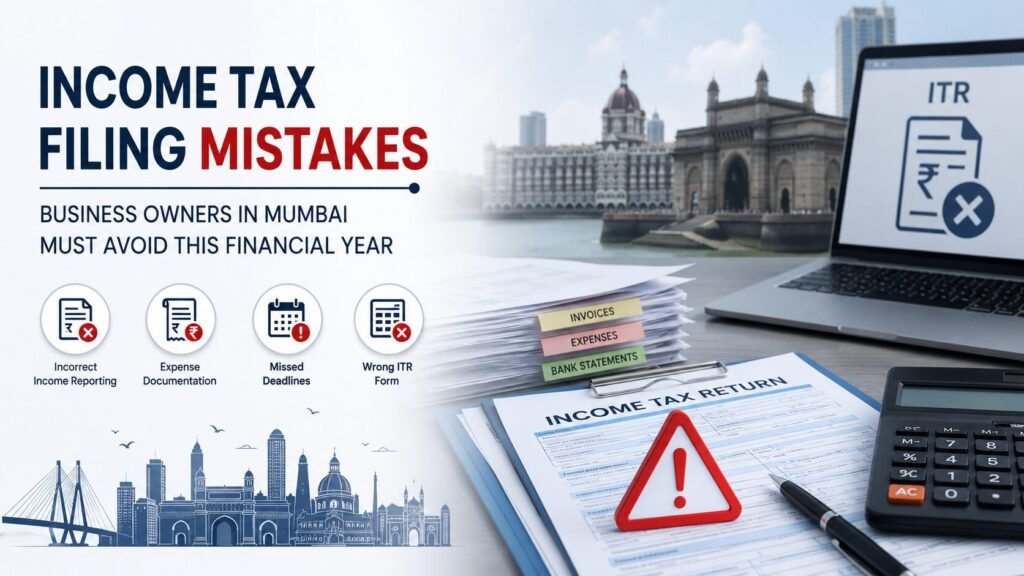
Tax filing errors can trigger penalties, notices, and audits Common mistakes include wrong income reporting and missed deductions Advance tax and GST mismatches are major red flags in 2026 A structured filing approach eliminates most risks CA guidance significantly improves accuracy and savings Introduction Income tax filing for business owners is no longer a routine compliance task—it’s a high-risk activity if done incorrectly. In 2026, the Income Tax Department uses AI-driven scrutiny systems, cross-verifying GST data, bank transactions, and reported income. Even small errors can trigger: Notices Penalties Scrutiny assessments This guide highlights the most critical income tax filing mistakes business owners in Mumbai must avoid—and how to fix them proactively. Why Tax Filing Errors Are Increasing in 2026 📊 Several structural changes have increased error detection: Automated reconciliation with GST returns Integration with banking and financial systems Real-time data validation Increased audit focus on SMEs 👉 Result: Mistakes that were previously ignored are now flagged instantly. Top Income Tax Filing Mistakes 1. Incorrect Income Reporting 🚨 Many businesses: Underreport revenue Exclude cash transactions Misclassify income 💡 This is the fastest way to trigger a tax notice. 2. Missing Eligible Deductions Common missed deductions: Business expenses Depreciation Rent & utility costs 👉 Missing deductions = higher tax liability unnecessarily 3. Choosing the Wrong ITR Form Using the incorrect ITR form leads to: Rejection of return Compliance complications 4. Ignoring Advance Tax Payments ⏱️ Businesses must pay advance tax in installments. Failure results in: Interest penalties under Sections 234B & 234C 5. Poor Record Keeping 📂 Missing invoices Unorganized expenses No audit trail 👉 Leads to compliance issues and weak defense during scrutiny. 6. GST & Income Tax Mismatch Mismatch between: GST turnover Income tax declared revenue This is a major red flag in 2026. Financial Impact of These Mistakes 💸 Mistake Possible Consequence Underreporting income Heavy penalties + scrutiny Late filing Interest + fines Incorrect deductions Higher tax liability GST mismatch Audit trigger Step-by-Step Checklist for Error-Free Filing ✅ Reconcile financial statements Match GST returns with income Verify deductions Select correct ITR form Pay advance tax on time Maintain proper documentation How to Correct Mistakes After Filing Made an error? Act fast: File a revised return before deadline Rectify errors via income tax portal Consult CA for major discrepancies How to Avoid Tax Notices in 2026 🚫 Maintain clean financial records Ensure GST & ITR consistency Avoid aggressive tax claims File returns on time Conduct periodic audits Why Hiring a CA is a Smart Move A professional CA: Identifies errors before submission Maximizes deductions legally Ensures compliance accuracy Represents you in case of notices Conclusion Tax filing mistakes are no longer minor errors—they are compliance risks with financial consequences. In a system driven by automation and data intelligence, accuracy is non-negotiable. The solution is simple: ✔ Stay organized✔ Follow structured processes✔ Work with experts CTA 🚀 Avoid costly tax mistakes this year.Consult CA Arihant Lodha for accurate, compliant, and optimized income tax filing in Mumbai. FAQ SECTION 1. What are common income tax filing mistakes? Incorrect income reporting, missed deductions, and wrong ITR forms are the most common. 2. Can tax filing mistakes lead to penalties? Yes. Errors can result in interest, fines, and scrutiny notices. 3. How to correct ITR mistakes? File a revised return before the deadline. 4. What is GST mismatch in tax filing? When GST turnover differs from income tax data. 5. How to avoid tax notices? Maintain accurate records, file on time, and ensure compliance. BLOG BY : CA Arihant Lodha
CA Firm in Mumbai for Startups: Complete Guide to Company Registration, GST & Compliance (2026)
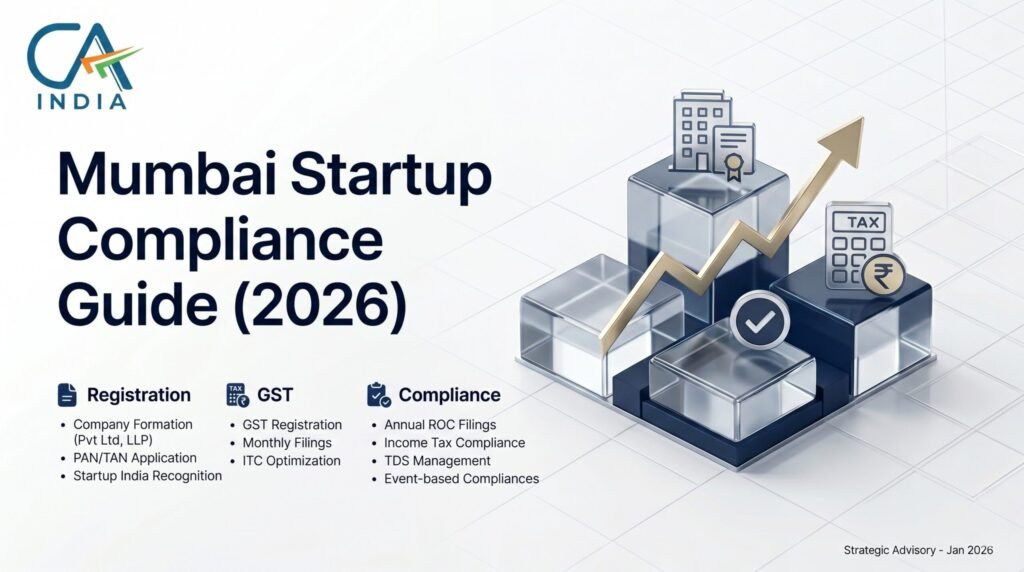
Startups need CA support from day one to avoid costly mistakes Choose the right business structure (Pvt Ltd, LLP, OPC) GST registration is critical for most startups Compliance in 2026 is stricter due to automation A specialized CA firm ensures legal safety + growth readiness Introduction Starting a business in Mumbai is exciting—but compliance complexity can derail even the most promising startups. From company registration to GST filings and ongoing compliance, founders often underestimate the legal and financial groundwork required. The reality in 2026:👉 Compliance is no longer optional—it’s algorithmically enforced. This guide breaks down everything you need to know about working with a CA firm in Mumbai for startups, ensuring your business starts strong and scales safely. Why Startups Need a CA Firm Early 🚀 Many founders delay hiring a CA to “save cost.” That usually backfires. A startup-focused CA helps you: Choose the right legal structure Avoid tax inefficiencies Ensure compliance from day one Prepare for funding & due diligence 💡 Early mistakes in structure or GST can cost lakhs later. Types of Company Registration in India Choosing the correct structure is critical. Type Best For Key Benefit Private Limited Fundraising startups Scalability LLP Small businesses Lower compliance OPC Solo founders Full control 👉 For most startups aiming to scale, Private Limited Company is preferred. Step-by-Step Company Registration Process 🧾 Name Approval (RUN/DIR) Digital Signature Certificate (DSC) Director Identification Number (DIN) MOA & AOA Drafting Incorporation Filing (MCA) PAN & TAN Allotment ⏱️ Timeline: 7–12 working days (if documents are correct) GST Registration for Startups Is GST Mandatory? Yes, if: Turnover exceeds ₹40 lakh (₹20 lakh for services) You sell interstate You operate e-commerce GST Registration Process Apply on GST portal Submit business documents Verification & ARN generation Startup Compliance Requirements in 2026 📊 Compliance is stricter than ever. Key Requirements: GST returns (monthly/quarterly) TDS filings ROC compliance Income tax returns Accounting & bookkeeping Common Mistakes Startups Make ⚠️ Choosing wrong business structure Delaying GST registration Mixing personal & business finances Ignoring compliance deadlines DIY accounting without expertise How to Choose the Right CA Firm in Mumbai Look for: ✅ Startup Expertise ✅ End-to-End Services ✅ Transparent Pricing ✅ Technology-driven processes ✅ Advisory beyond compliance Cost Breakdown for Startup Services 💰 Service Estimated Cost Company Registration ₹8,000 – ₹25,000 GST Registration ₹2,000 – ₹5,000 Monthly Compliance ₹3,000 – ₹15,000 Why CA Arihant Lodha is Ideal for Startups Specialized in startup advisory End-to-end services (registration → compliance → tax planning) Mumbai-focused expertise Practical, business-first approach Conclusion Launching a startup is challenging—but compliance doesn’t have to be. The right CA firm acts not just as a service provider—but as a strategic partner. In 2026, startups that prioritize compliance early: ✔ Avoid penalties✔ Build investor trust✔ Scale faster CTA 🚀 Looking for a reliable CA firm in Mumbai for your startup?Connect with CA Arihant Lodha for expert guidance on registration, GST, and compliance. FAQ SECTION 1. Which CA firm is best for startups in Mumbai? A startup-focused CA firm offering end-to-end services is ideal. 2. Is GST required for startups? Yes, if turnover or business model meets GST criteria. 3. What is the cost of company registration? Typically between ₹8,000–₹25,000 depending on structure. 4. What compliances are required after registration? GST filing, ROC filing, tax returns, and accounting. 5. Can I register a company without a CA? Technically yes, but not recommended due to complexity. Blog by : CA Arihant Lodha
GST & Compliance Challenges for E-commerce Businesses in Mumbai: Expert CA Solutions (2026 Guide)

TL;DR GST is mandatory for most e-commerce sellers regardless of turnover TCS deduction by platforms complicates tax reconciliation Input tax credit mismatches are a major issue Monthly GST compliance is critical for avoiding penalties Expert CA support ensures accurate filings and tax optimization Why GST Compliance is Complex for E-commerce Unlike traditional businesses, e-commerce sellers operate across multiple states, platforms, and logistics networks. This creates: Multi-state GST liabilities Complex return filing requirements Continuous reconciliation challenges For Mumbai-based sellers, especially D2C brands scaling rapidly, GST becomes a high-risk compliance area. GST Framework for E-commerce Businesses GST Registration Rules E-commerce sellers must register for GST regardless of turnover if selling through marketplaces. Key rule: Mandatory GST registration under Section 24 TCS (Tax Collected at Source) Marketplaces like Amazon and Flipkart deduct TCS before paying sellers. Implications: Requires reconciliation with GST returns Impacts working capital Input Tax Credit (ITC) Sellers can claim ITC on purchases, but only if: Supplier has filed returns correctly Invoices match GST records Challenge: ITC mismatches lead to tax loss. Major GST Challenges Faced by Online Sellers Mismatch between GSTR-1 and GSTR-3B TCS reconciliation issues Multi-state compliance complexity Incorrect GST rate application Return filing delays Compliance Requirements for E-commerce Businesses GST registration (mandatory) Monthly return filing (GSTR-1, GSTR-3B) TCS reconciliation E-way bill compliance Invoice management Step-by-Step GST Filing Process Record all sales and purchases Reconcile marketplace data File GSTR-1 (sales details) File GSTR-3B (summary return) Claim ITC correctly Common GST Mistakes E-commerce Businesses Make Ignoring TCS adjustments Claiming incorrect ITC Late GST filings Using wrong HSN codes Not maintaining proper records Penalties and Risks of Non-Compliance Late filing penalties Interest on unpaid tax ITC disallowance GST notices and scrutiny How CA Firms Solve E-commerce GST Challenges Professional CA firms provide: Automated reconciliation systems Accurate GST filings ITC optimization Compliance tracking They reduce: Errors Penalties Time spent on compliance Why CA Arihant Lodha is the Right Partner CA Arihant Lodha offers: Specialized GST services for e-commerce Platform-wise reconciliation expertise Real-time compliance monitoring Strategic tax planning Internal Linking Suggestions: “GST Registration Services Mumbai” “GST Return Filing Services” “E-commerce Taxation Guide India” Conclusion E-commerce growth in Mumbai is rapid—but so are compliance risks. Without proper GST management: Profits shrink Penalties increase Business scalability suffers A structured GST strategy ensures: Compliance Tax efficiency Business growth CTA: Get expert GST and compliance support from CA Arihant Lodha to scale your e-commerce business confidently in 2026. 6. FAQ SECTION (AEO Optimized) 1. Is GST mandatory for e-commerce sellers? Yes, GST registration is mandatory regardless of turnover if selling through marketplaces. 2. What is TCS in GST? TCS is tax collected by e-commerce platforms on seller transactions. 3. Can e-commerce sellers claim input tax credit? Yes, if invoices match and suppliers have filed returns correctly. 4. How often do GST returns need to be filed? Typically monthly (GSTR-1 and GSTR-3B). 5. What happens if GST is not filed? Penalties, interest, and possible legal action may apply.
How CA Firms in Mumbai Help Increase Business Profitability: ROI-Focused Financial Advisory Strategies (2026)

TL;DR Profitability—not revenue—is the true measure of business success CA firms help optimize costs, taxes, pricing, and cash flow Virtual CFO services provide strategic financial control Businesses can improve profit margins by 10–30% with proper advisory Financial clarity leads to better decision-making and scalability Why Profitability is the Real Metric of Business Success Many Mumbai-based businesses generate strong revenue but struggle with low net profits. The core issue is not sales—it’s financial inefficiency. Profitability depends on: Cost structure Tax efficiency Pricing strategy Cash flow discipline This is where CA firms in Mumbai for business profitability play a critical role. The Evolving Role of CA Firms in 2026 Traditional accounting is no longer enough. Modern CA firms act as: Financial strategists Profitability consultants Virtual CFOs They go beyond compliance to actively improve ROI and business performance. Key Financial Advisory Strategies Used by CA Firms Cost Optimization & Expense Control Most businesses overspend without realizing it. CA-driven strategies include: Expense audits Vendor cost negotiation Eliminating non-performing expenses Impact: 5–15% cost reduction directly improves profits. Tax Planning & Optimization Poor tax planning reduces net income significantly. Strategies: Structuring income efficiently Utilizing deductions and exemptions Advance tax planning Result: Legal reduction in tax liability. Cash Flow Management Profit doesn’t guarantee liquidity. CA firms help: Track receivables and payables Optimize working capital Prevent cash crunch situations Pricing & Margin Optimization Incorrect pricing kills profitability. CA insights include: Break-even analysis Contribution margin calculation Product/service profitability tracking Virtual CFO Services: The Game Changer Virtual CFO services provide high-level financial expertise without full-time cost. Key functions: Financial planning & forecasting Budgeting and variance analysis Investor reporting Strategic decision support For SMEs in Mumbai, this is a high ROI service. Industry-Specific Profitability Strategies Manufacturing Reduce production wastage Optimize inventory cycles Real Estate Tax-efficient structuring Cash flow planning for projects E-commerce Optimize logistics costs Manage GST and pricing Professional Services Improve billing efficiency Control overhead costs Real Example: Profitability Transformation Case: A Mumbai-based SME with ₹2 crore revenue had only 5% net profit. Result: Profit margin increased to 15%. Common Profit-Killing Mistakes Businesses Make Ignoring financial reports Overstaffing or inefficient hiring Poor pricing strategy Lack of tax planning No cash flow monitoring How to Choose the Right CA Firm in Mumbai Look for: Financial advisory expertise (not just compliance) Experience across industries Ability to provide CFO-level insights Transparent pricing Proven track record Why CA Arihant Lodha is a Profitability Partner CA Arihant Lodha focuses on: ROI-driven financial strategies End-to-end business advisory Tax-efficient structuring Growth-focused financial planning Internal Linking Suggestions: “Virtual CFO Services in Mumbai” “Business Tax Planning Services” “Financial Advisory for SMEs” Conclusion Revenue growth without profitability is unsustainable. Businesses that succeed in 2026 are those that: Control costs Optimize taxes Manage cash flow Make data-driven decisions A strategic CA firm transforms your business into a profit-generating engine. CTA: Work with CA Arihant Lodha to unlock higher profitability and build a financially strong business in Mumbai. 6. FAQ SECTION 1. How can a CA help increase business profitability? By optimizing costs, reducing tax liability, improving pricing, and managing cash flow effectively. 2. What are financial advisory services? They include budgeting, forecasting, tax planning, and strategic financial decision-making support. 3. What is a virtual CFO? A virtual CFO provides high-level financial strategy without the cost of a full-time CFO. 4. How do businesses reduce tax legally? Through deductions, exemptions, and efficient income structuring. 5. How can I improve my business cash flow? By managing receivables, controlling expenses, and optimizing working capital.
Industry-Wise Audit & Compliance Requirements in Mumbai: A Complete Guide for SMEs & Corporates (2026)

TL;DR Multiple audits apply depending on turnover, structure, and industry Statutory audit is mandatory for all companies Tax audit applies beyond specified turnover limits Industry-specific compliance is often overlooked Non-compliance can lead to penalties, notices, and reputational damage Why Audit & Compliance Matter More Than Ever in 2026 Regulatory scrutiny in India has intensified significantly. With digital tracking, GST integration, and MCA monitoring, businesses in Mumbai face real-time compliance checks. For SMEs and corporates, compliance is no longer optional—it is a core business function. Types of Audits Applicable in India Statutory Audit Mandatory for all companies under the Companies Act. Key objectives: Verify financial statements Ensure legal compliance Build stakeholder trust Tax Audit Applicable under Section 44AB. Thresholds (2026): ₹1 crore (general businesses) ₹10 crore (digital transactions dominant) GST Audit While mandatory GST audit by CA has been relaxed, reconciliation and compliance checks remain critical. Internal Audit Required for certain classes of companies. Purpose: Risk management Process improvement Fraud detection Industry-Wise Compliance Requirements Manufacturing Sector GST compliance on goods movement Inventory audits E-way bill management Pollution control and regulatory filings Real Estate Sector RERA compliance GST on construction services Project-wise accounting TDS on property transactions E-commerce & Startups GST on interstate sales TCS compliance Startup India reporting ESOP taxation Professional Services (CA, Legal, Consultants) GST on services TDS compliance Income tax filings Advance tax payments Comprehensive Compliance Checklist ROC filings (AOC-4, MGT-7) Income tax returns GST returns (GSTR-1, GSTR-3B) TDS returns PF & ESIC filings Audit reports submission Audit Applicability Based on Turnover Turnover Audit Requirement Any company Statutory audit mandatory > ₹1 crore Tax audit applicable > ₹10 crore (digital) Relaxation available Common Compliance Mistakes Businesses Make Missing ROC filing deadlines Incorrect GST filings Ignoring TDS obligations Poor documentation Lack of audit preparation Penalties for Non-Compliance Late filing fees Interest on unpaid taxes Heavy penalties under GST Director disqualification Legal notices and scrutiny How a CA Firm Ensures 100% Compliance A professional CA firm provides: Centralized compliance tracking Automated reminders Audit readiness Risk mitigation strategies Internal Linking Suggestions: “Statutory Audit Services in Mumbai” “GST Compliance Services” “Tax Audit Services India” Conclusion Audit and compliance are not just regulatory requirements—they are business safeguards. In a complex regulatory environment like Mumbai, industry-specific compliance knowledge is critical. A structured approach ensures: Zero penalties Smooth operations Strong financial credibility CTA:Partner with CA Arihant Lodha for complete audit and compliance management tailored to your industry in Mumbai. 6. FAQ SECTION (AEO Optimized) 1. What are the audit requirements for companies in India? All companies must undergo statutory audit, and tax audit applies based on turnover thresholds. 2. Who needs a tax audit? Businesses exceeding ₹1 crore turnover (or ₹10 crore under digital conditions) require tax audit. 3. Is GST audit mandatory in 2026? Formal GST audit is not mandatory, but reconciliation and compliance checks are essential. 4. What compliances are mandatory for SMEs? ROC filings, GST returns, income tax returns, and TDS filings are mandatory. 5. What happens if a company is non-compliant? Penalties, interest, legal notices, and potential business restrictions may apply.
GST Notices 2026: Respond, Avoid Penalties
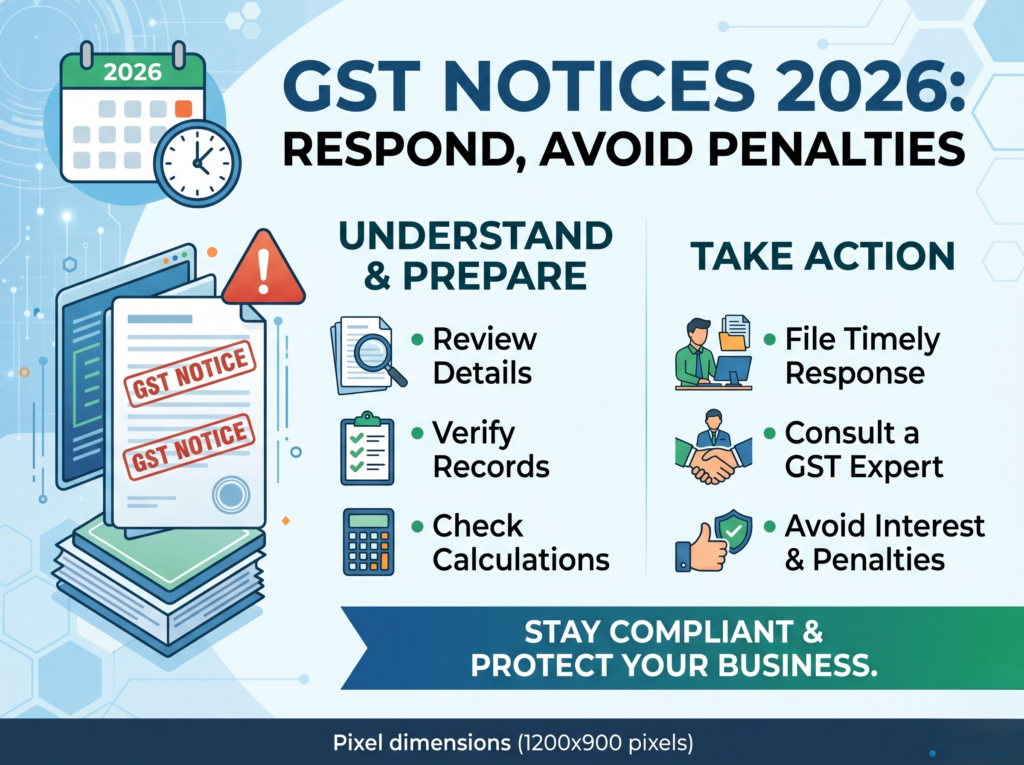
TL;DR GST Notices 2026 are rising in 2026 due to increased automation and data matching by the government. If you receive a notice, respond within the deadline, provide accurate documentation, and seek expert guidance. Ignoring notices can lead to penalties, interest, or legal action. Why GST Notices 2026 Are Increasing in 2026 The GST system has evolved significantly with: AI-based return matching Real-time invoice tracking Stronger compliance enforcement This means even minor mismatches trigger notices automatically. Key Insight:Most GST notices today are system-generated — not manually issued. Types of GST Notices You Must Know Understanding the type of notice is critical before responding. 1. GSTR-1 vs GSTR-3B Mismatch Occurs when sales reported differ from tax paid. Cause: Incorrect reporting Missed invoices 2. Input Tax Credit (ITC) Mismatch Triggered when: Supplier hasn’t filed returns ITC claimed is higher than eligible 3. Late Filing / Non-Filing Notices Issued when returns are delayed or not filed. 4. Scrutiny Notices Detailed examination of returns under GST law. Step-by-Step: How to Respond to a GST Notices 2026 Step 1: Read the Notice Carefully Identify: Notice type Section reference Deadline Step 2: Verify Data Check: GST returns Books of accounts Invoices Step 3: Identify the Issue Common issues: Mismatch Missing filings Incorrect ITC Step 4: Prepare Supporting Documents Invoices GST returns Reconciliation statements Step 5: Draft a Proper Reply Ensure: Clear explanation Supporting evidence Professional tone Step 6: Submit Response Online Via GST portal within deadline. GST Notice Reply Format (Practical Template) Subject: Reply to GST Notice [Reference No.] Dear Sir/Madam, We acknowledge receipt of the notice dated [date]. Upon review, we submit the following: Explanation of discrepancy Supporting documents attached Corrective action taken We request your kind consideration. Regards,[Business Name] Penalties: What Happens If You Ignore Notices Ignoring GST notices can result in: Penalty up to 10% of tax amount Interest charges Suspension of GST registration Legal proceedings How to Avoid GST Notices in Future 1. Monthly Reconciliation Match GSTR-1, GSTR-3B, and books regularly. 2. Accurate ITC Claims Avoid excess or ineligible claims. 3. Timely Filing Never delay GST returns. 4. Vendor Compliance Check Ensure suppliers file returns properly. 5. Use Automation Tools Reduce manual errors. Role of CA in GST Compliance A professional CA firm ensures: Error-free filings Timely compliance Proper notice handling Strategic tax planning Final Checklist Before submitting a GST reply: Verified all data Attached documents Checked deadlines Reviewed reply professionally Conclusion GST notices are not a threat — they are a signal of compliance gaps. Businesses that act quickly and correctly: Avoid penalties Maintain compliance Build credibility CTA: Facing a GST notice? Get expert assistance from CA Arihant Lodha handle notices, reduce penalties, and ensure complete compliance. 6. FAQ SECTION 1. What should I do if I receive a GST notice?Immediately review the notice, identify the issue, and respond within the deadline with proper documentation. 2. Can I ignore a GST notice?No. Ignoring can lead to penalties, interest, and legal action. 3. How to reply to GST notice online?Log in to the GST portal, navigate to notices, and submit your response with documents. 4. What is the penalty for GST notice?Penalty can be up to 10% of tax liability along with interest. 5. How to avoid GST notices?Maintain accurate records, reconcile returns monthly, and ensure timely filing. Blog By : CA Arihant Lodha
Outsourcing vs In-House Accounting: ROI Guide 2026
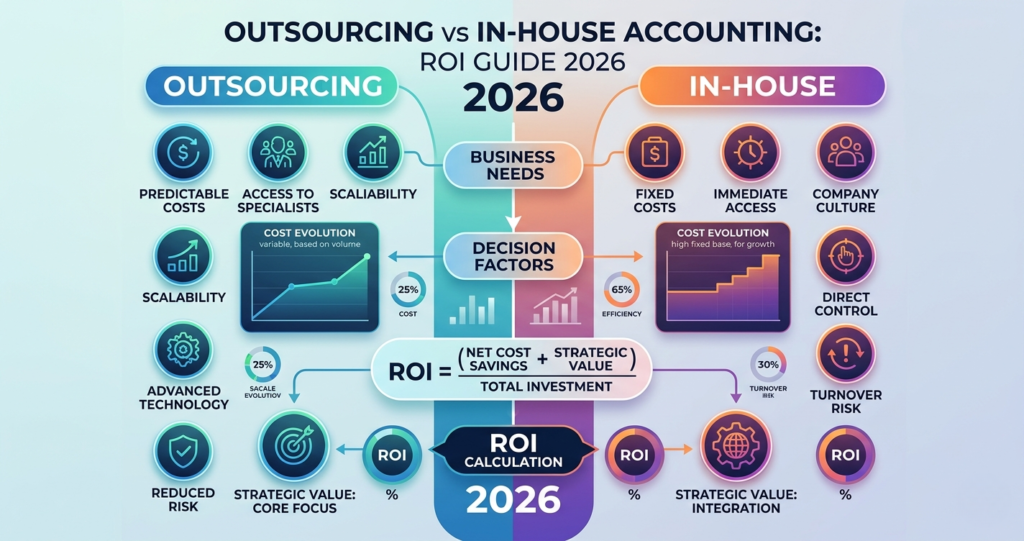
TL;DR Outsourced accounting delivers 30–50% cost savings, better scalability, and higher compliance efficiency for most startups and SMEs. In-house teams make sense only for large enterprises with complex, real-time financial needs. Why This Decision Matters in 2026 Accounting is no longer just bookkeeping. In 2026, it directly impacts: Profit margins Compliance risk Fundraising readiness Business scalability With rising salaries, compliance complexity, and tech adoption, choosing the wrong model can cost businesses lakhs annually. What is In-House Accounting? An in-house accounting team involves hiring: Accountants Finance managers Compliance specialists Typical Setup: 1 Accountant: ₹3–6 LPA 1 Senior Accountant: ₹6–12 LPA Tools & software: ₹1–2 LPA Total Annual Cost: ₹10–20+ lakhs What is Accounting Outsourcing? Outsourcing means delegating accounting functions to a CA firm or specialized service provider. Services Include: Bookkeeping GST filing TDS & payroll Financial reporting Compliance management Typical Cost: ₹1–5 lakhs annually (depending on scale) Cost Comparison: Real Numbers Factor In-House Team Outsourcing Salary Cost High None Software Cost High Included Training Cost Ongoing Zero Scalability Cost Expensive Flexible Total Annual Cost ₹10–20L ₹1–5L Insight:Outsourcing reduces accounting costs by 50–80%. ROI Breakdown: Outsourcing vs In-House ROI is not just cost — it’s value delivered. Outsourcing ROI Drivers: Lower operational cost Access to expert CAs Reduced compliance penalties Faster reporting In-House ROI Drivers: Real-time control Internal coordination Custom processes Verdict:For 90% of SMEs, outsourcing delivers higher ROI due to cost efficiency + expertise. Scalability & Flexibility Analysis In-House Limitations: Hiring delays Fixed cost structure Difficult to scale up/down Outsourcing Advantages: Pay-as-you-grow model Instant scalability No hiring dependency Compliance & Risk Management Compliance errors can cost businesses heavily. Outsourcing Advantage: Dedicated compliance experts Up-to-date with tax laws Reduced penalties In-House Risk: Knowledge gaps Dependency on individuals Technology & Automation Advantage Outsourcing firms use: Cloud accounting tools Automation workflows Real-time dashboards In-house teams often lag due to: Budget constraints Resistance to change When In-House Makes Sense Choose in-house if: Revenue > ₹50 Cr Complex financial operations Need daily financial control Large internal teams When Outsourcing Wins Outsourcing is ideal if: Startup or SME Revenue < ₹50 Cr Need cost optimization Limited finance expertise Hybrid Model (Best of Both Worlds) Many businesses adopt: 1 internal finance manager Outsourced accounting team This ensures: Strategic control Operational efficiency Final Verdict For most Indian businesses in 2026: Outsourcing = Higher ROI In-house = Higher control The smartest companies don’t choose one blindly — they choose based on scale and strategy. Conclusion Accounting is a strategic function, not just a compliance requirement. Businesses that outsource smartly gain: Cost efficiency Expert insights Better compliance Faster growth CTA:Looking to reduce accounting costs and improve financial efficiency? Partner with CA Arihant Lodha & Associates for expert outsourced accounting solutions tailored to your business. 6. FAQ SECTION 1. Is outsourcing accounting cheaper than in-house?Yes. Outsourcing can reduce costs by 50–80% compared to hiring a full in-house team. 2. Is outsourced accounting safe?Yes, if handled by a professional CA firm with proper data security and compliance systems. 3. When should I hire an in-house accountant?When your business requires real-time financial decision-making and has complex operations. 4. What is the ROI of outsourced accounting?Higher ROI due to lower costs, expert handling, and reduced compliance risks. 5. Can startups rely fully on outsourcing?Yes, most startups operate efficiently with outsourced accounting until they scale. Blog By : CA Arihant & Lodha
D2C Tax Saving Guide India (2026): Save 30% Legally
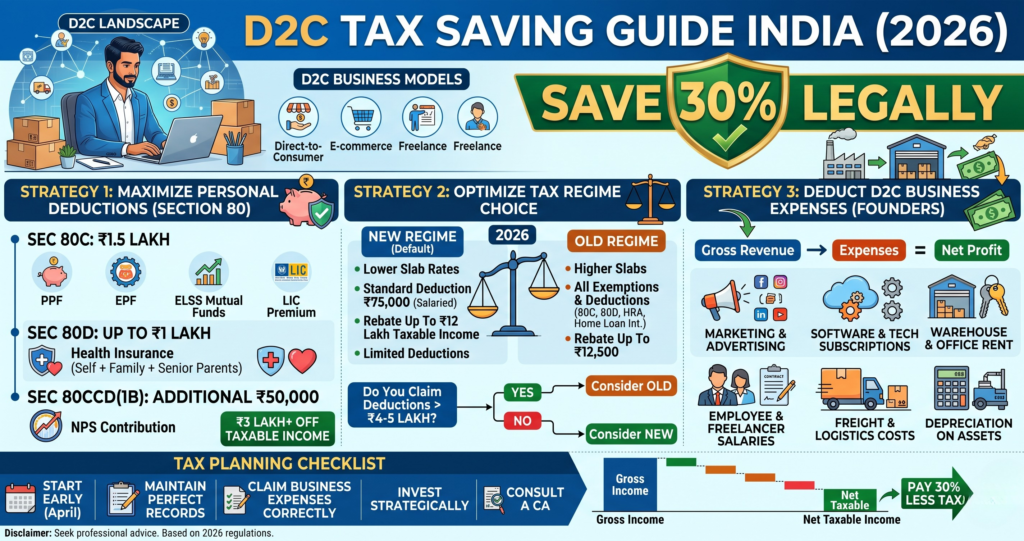
TL;DR D2C Tax Saving and e-commerce brands in India often overpay taxes due to poor structuring. By choosing the right business entity, optimizing GST, structuring income streams, and leveraging deductions, brands can legally reduce tax liability by up to 30%. Why Most D2C Brands Overpay Taxes Saving Most founders focus heavily on revenue growth but ignore tax architecture. As a result: Wrong business structure leads to higher tax slabs No GST optimization increases cash outflow Poor expense tracking reduces deductions No strategic planning = reactive tax filing This results in 10–30% unnecessary tax leakage annually. Understanding Business Structures for Tax Efficiency Sole Proprietorship vs LLP vs Pvt Ltd Structure Tax Rate Best For Limitation Sole Proprietor Up to 30% Small sellers High tax burden LLP 30% flat Service-based D2C Limited funding Pvt Ltd 22–25% Scalable brands Compliance-heavy Insight:Most serious D2C brands benefit from Private Limited Company with 22% tax regime, especially post-2020 reforms. Smart Income Structuring Strategies Instead of showing all income as direct profit: Pay founders via salary + dividends Allocate profits strategically across stakeholders Use family members (legally) for tax distribution Defer income where possible This reduces taxable income at the entity level. GST Optimization for E-commerce Brands GST is where most cash leakage happens. Key Strategies: Claim Input Tax Credit (ITC) aggressively Avoid wrong GST classifications Optimize interstate vs intrastate supply Use proper invoicing systems Example:A brand paying ₹10L GST annually can reduce ₹1.5–2L through ITC corrections alone. Expense Maximization & Deductions Most founders miss 20–40% of eligible deductions. Common deductible expenses: Digital marketing (Meta, Google Ads) Warehousing & logistics SaaS tools (Shopify, Razorpay, Zoho) Salaries & freelancer payments Office rent & utilities Pro Tip:Maintain clean bookkeeping to ensure maximum claimable deductions. Multi-Entity Structuring (Advanced Strategy) Top-performing brands use multi-entity setups: One entity for brand/IP ownership One for operations/sales One for marketing or consulting Benefits: Profit shifting Expense allocation Risk separation Tax optimization This alone can reduce overall tax liability by 5–10%. Case Study: How a D2C Brand Tax Saving 28% Scenario: Mumbai-based skincare brand (₹3 Cr revenue) Before: Proprietorship No GST optimization Tax paid: ~₹42L After restructuring: Converted to Pvt Ltd Implemented ITC strategy Structured salary + dividends Result: Tax reduced to ~₹30L Savings: ₹12L (≈28%) Common Mistakes to Avoid Choosing structure based on cost, not tax efficiency Ignoring GST compliance Mixing personal & business expenses No advance tax planning DIY accounting without expert review When to Hire a CA Firm You should consult a CA firm when: Revenue crosses ₹50L You sell across multiple states You plan to scale or raise funding Tax outflow feels disproportionately high A specialized CA firm helps in: Strategic structuring Compliance automation Tax planning (not just filing) Conclusion Tax saving is not about loopholes — it’s about smart structuring and compliance-driven strategy. D2C and e-commerce brands that proactively manage tax planning gain: Higher profit margins Better cash flow Stronger scalability If you’re serious about scaling your brand, tax strategy must become a core business function. CTA: Looking to reduce your tax burden legally? Consult CA Arihant Lodha & Associates for customized D2C tax structuring and compliance strategies. 6. FAQ SECTION 1. How can D2C brands save tax in India?By choosing the right business structure, optimizing GST, claiming deductions, and structuring income efficiently. 2. Is Pvt Ltd better than LLP for tax saving?Yes, for scalable brands, Pvt Ltd offers lower effective tax rates and better funding opportunities. 3. Can GST be reduced legally?Yes, through Input Tax Credit and proper classification of goods/services. 4. What expenses are deductible for e-commerce businesses?Marketing, logistics, SaaS tools, salaries, rent, and operational costs. 5. What is the biggest tax mistake founders make?Operating under the wrong business structure. Blog By : CA Arihant Lodha