
TL;DR
Outsourced accounting delivers 30–50% cost savings, better scalability, and higher compliance efficiency for most startups and SMEs. In-house teams make sense only for large enterprises with complex, real-time financial needs.
Why This Decision Matters in 2026
Accounting is no longer just bookkeeping. In 2026, it directly impacts:
- Profit margins
- Compliance risk
- Fundraising readiness
- Business scalability
With rising salaries, compliance complexity, and tech adoption, choosing the wrong model can cost businesses lakhs annually.
What is In-House Accounting?
An in-house accounting team involves hiring:
- Accountants
- Finance managers
- Compliance specialists
Typical Setup:
- 1 Accountant: ₹3–6 LPA
- 1 Senior Accountant: ₹6–12 LPA
- Tools & software: ₹1–2 LPA
Total Annual Cost: ₹10–20+ lakhs
What is Accounting Outsourcing?
Outsourcing means delegating accounting functions to a CA firm or specialized service provider.
Services Include:
- Bookkeeping
- GST filing
- TDS & payroll
- Financial reporting
- Compliance management
Typical Cost:
₹1–5 lakhs annually (depending on scale)
Cost Comparison: Real Numbers
| Factor | In-House Team | Outsourcing |
|---|---|---|
| Salary Cost | High | None |
| Software Cost | High | Included |
| Training Cost | Ongoing | Zero |
| Scalability Cost | Expensive | Flexible |
| Total Annual Cost | ₹10–20L | ₹1–5L |
Insight:
Outsourcing reduces accounting costs by 50–80%.
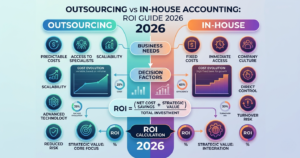
ROI Breakdown: Outsourcing vs In-House
ROI is not just cost — it’s value delivered.
Outsourcing ROI Drivers:
- Lower operational cost
- Access to expert CAs
- Reduced compliance penalties
- Faster reporting
In-House ROI Drivers:
- Real-time control
- Internal coordination
- Custom processes
Verdict:
For 90% of SMEs, outsourcing delivers higher ROI due to cost efficiency + expertise.
Scalability & Flexibility Analysis
In-House Limitations:
- Hiring delays
- Fixed cost structure
- Difficult to scale up/down
Outsourcing Advantages:
- Pay-as-you-grow model
- Instant scalability
- No hiring dependency
Compliance & Risk Management
Compliance errors can cost businesses heavily.
Outsourcing Advantage:
- Dedicated compliance experts
- Up-to-date with tax laws
- Reduced penalties
In-House Risk:
- Knowledge gaps
- Dependency on individuals
Technology & Automation Advantage
Outsourcing firms use:
- Cloud accounting tools
- Automation workflows
- Real-time dashboards
In-house teams often lag due to:
- Budget constraints
- Resistance to change
When In-House Makes Sense
Choose in-house if:
- Revenue > ₹50 Cr
- Complex financial operations
- Need daily financial control
- Large internal teams
When Outsourcing Wins
Outsourcing is ideal if:
- Startup or SME
- Revenue < ₹50 Cr
- Need cost optimization
- Limited finance expertise
Hybrid Model (Best of Both Worlds)
Many businesses adopt:
- 1 internal finance manager
- Outsourced accounting team
This ensures:
- Strategic control
- Operational efficiency
Final Verdict
For most Indian businesses in 2026:
- Outsourcing = Higher ROI
- In-house = Higher control
The smartest companies don’t choose one blindly — they choose based on scale and strategy.
Conclusion
Accounting is a strategic function, not just a compliance requirement.
Businesses that outsource smartly gain:
- Cost efficiency
- Expert insights
- Better compliance
- Faster growth
CTA:
Looking to reduce accounting costs and improve financial efficiency? Partner with CA Arihant Lodha & Associates for expert outsourced accounting solutions tailored to your business.
6. FAQ SECTION
1. Is outsourcing accounting cheaper than in-house?
Yes. Outsourcing can reduce costs by 50–80% compared to hiring a full in-house team.
2. Is outsourced accounting safe?
Yes, if handled by a professional CA firm with proper data security and compliance systems.
3. When should I hire an in-house accountant?
When your business requires real-time financial decision-making and has complex operations.
4. What is the ROI of outsourced accounting?
Higher ROI due to lower costs, expert handling, and reduced compliance risks.
5. Can startups rely fully on outsourcing?
Yes, most startups operate efficiently with outsourced accounting until they scale.
Blog By : CA Arihant & Lodha