
TL;DR
Choosing between an LLP and a Private Limited Company depends on your business model, funding plans, compliance capacity, ownership structure, and long-term growth vision.
An LLP is generally suitable for professionals, consultants, service businesses, and closely held ventures that want limited liability with relatively simpler compliance.
A Private Limited Company is better suited for startups, scalable businesses, investor-backed ventures, and companies planning to raise funds, issue shares, build ESOPs, or expand aggressively.
For most entrepreneurs, the right question is not “Which structure is cheaper?” The better question is: Which structure supports your business goals for the next 3–5 years?
Why Choosing the Right Business Structure Matters
Business registration is one of the first major decisions an entrepreneur makes. It affects taxation, compliance, investor confidence, ownership rights, liability, fundraising, governance, and future expansion.
Many founders choose an entity based only on reg
istration cost. That is a mistake.
A structure that looks affordable today may become restrictive lat
er. For example, an LLP may work well for a consulting firm, but it may not be ideal for a startup planning to raise venture capital. Similarly, a Private Limited Company may
offer strong credibility but also comes with higher compliance responsibilities.
Entrepreneurs should choose the structure based on:
- Business model
- Number of founders
- Funding plans
- Expected revenue scale
- Compliance capacity
- Tax planning
- Exit strategy
- Investor expectations
- Long-term expansion goals
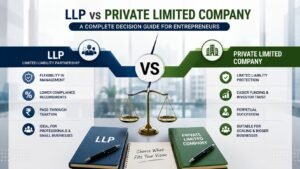
This guide explains the difference between LLP vs Private Limited Company in practical terms.
What Is an LLP?
LLP stands for Limited Liability Partnership.
It combines features of a partnership firm and a company. Partners can manage the business directly while enjoying limited liability protection.
In an LLP, the liability of partners is generally limited to their agreed contribution. This means personal assets are usually protected against business liabilities, subject to fraud, negligence, or personal guarantees.
LLPs are commonly preferred by:
- Consultants
- Chartered accountants
- Lawyers
- Architects
- Small service businesses
- Family-run ventures
- Professional firms
- Agencies
- Closely held businesses
An LLP is flexible, relatively easier to manage, and suitable where external equity funding is not a major goal.
What Is a Private Limited Company?
A Private Limited Company is a separate legal entity registered under the Companies Act, 2013.
It has shareholders, directors, share capital, board governance, statutory records, and formal compliance requirements.
Private Limited Companies are commonly preferred by:
- Startups
- Technology companies
- D2C brands
- SaaS businesses
- Manufacturing companies
- Fundraising-focused ventures
- Scalable service businesses
- Companies planning ESOPs
- Businesses targeting institutional investors
A Private Limited Company is usually seen as more structured, scalable, and investor-friendly.
LLP vs Private Limited Company: Quick Comparison
| Factor | LLP | Private Limited Company |
|---|---|---|
| Governing Law | LLP Act, 2008 | Companies Act, 2013 |
| Owners | Partners | Shareholders |
| Management | Designated Partners | Directors |
| Liability | Limited | Limited |
| Compliance | Moderate | Higher |
| Investor Funding | Limited suitability | Highly suitable |
| ESOPs | Not ideal | Suitable |
| Ownership Transfer | Less flexible | More flexible |
| Credibility | Good | Stronger for scaling |
| Best For | Professionals, consultants, SMEs | Startups, scalable companies, investor-backed ventures |
Key Differences Entrepreneurs Should Understand
1. Ownership Structure
In an LLP, ownership rests with partners. Their rights, profit-sharing ratio, capital contribution, and responsibilities are governed by the LLP agreement.
In a Private Limited Company, ownership is represented through shares. Shareholders own the company, while directors manage operations.
This difference becomes important when:
- New investors enter
- Founders exit
- Ownership changes
- ESOPs are issued
- Shares are transferred
- Valuation is negotiated
A Private Limited Company offers a clearer ownership structure for investor-backed businesses.
2. Liability Protection
Both LLP and Private Limited Company provide limited liability protection.
However, limited liability does not mean unlimited protection.
Founders or partners may still become personally liable in cases involving:
- Fraud
- Misrepresentation
- Personal guarantees
- Non-compliance
- Wrongful conduct
- Statutory defaults
For normal business risks, both structures protect personal assets better than a traditional partnership or proprietorship.
3. Compliance Burden
Compliance is one of the biggest practical differences.
An LLP generally has fewer annual compliance requirements compared to a Private Limited Company.
Typical LLP compliances include:
- Annual return filing
- Statement of accounts and solvency
- Income tax return
- Audit, if applicable
- Partner-related filings when changes occur
A Private Limited Company generally requires:
- Annual ROC filings
- Board meetings
- Shareholder meetings
- Statutory registers
- Director KYC
- Financial statements
- Auditor appointment
- Income tax filing
- GST and TDS compliance, if applicable
- Event-based MCA filings
If simplicity is the main priority, LLP may be better.
If scalability and investor readiness matter more, Private Limited Company is usually stronger.
4. Taxation
Taxation should not be viewed only from the rate perspective. The overall tax impact depends on profits, withdrawals, remuneration, dividends, business model, and future plans.
An LLP is taxed as a firm. Partners may receive remuneration or profit share depending on the LLP agreement and tax provisions.
A Private Limited Company pays corporate tax, and distribution of profits to shareholders may have additional tax implications depending on the method of extraction.
Entrepreneurs should review:
- Expected profits
- Founder remuneration
- Dividend plans
- Reinvestment requirements
- Investor entry
- Tax audit applicability
- GST and TDS obligations
A CA should evaluate the tax impact before finalising the structure.
5. Funding and Investment
This is where Private Limited Company usually has a clear advantage.
Most angel investors, venture capital firms, private equity investors, and institutional investors prefer Private Limited Companies because shares can be issued, transferred, valued, and documented more easily.
A Private Limited Company is better suited for:
- Angel funding
- Venture capital
- ESOPs
- Convertible instruments
- Share transfers
- Strategic investment
- Future acquisition
An LLP is not the preferred structure for equity fundraising.
If your business plans to raise funds, issue ESOPs, or bring in investors, Private Limited Company is usually the better choice.
6. Scalability
A Private Limited Company generally offers better scalability because it has a formal governance structure.
It is suitable for businesses planning:
- Multiple founders
- Senior leadership hiring
- Investor reporting
- Large contracts
- Expansion to multiple states
- Bank funding
- Institutional partnerships
- Employee stock options
- Merger or acquisition opportunities
LLPs can also grow, but they are usually better suited for businesses where ownership remains closely held.
7. Credibility
A Private Limited Company often carries stronger credibility with investors, banks, large clients, and enterprise customers.
This does not mean LLP lacks credibility. Many successful professional firms operate as LLPs.
However, for high-growth businesses, a company structure may appear more formal and funding-ready.
Credibility matters when dealing with:
- Large corporates
- Investors
- Banks
- Government tenders
- International clients
- Enterprise contracts
8. Conversion Flexibility
Some entrepreneurs begin with LLP and later convert into a Private Limited Company when they plan to raise funds.
This is possible, but conversion requires planning, documentation, approvals, and compliance review.
Founders should avoid assuming that conversion is always quick or simple. Tax, capital structure, partner rights, assets, contracts, and registrations must be reviewed carefully.
If fundraising is already part of the near-term plan, starting with a Private Limited Company may avoid future restructuring work.
When Should You Choose LLP?
An LLP may be suitable if:
- You are starting a consulting or professional service business
- You do not plan to raise equity funding
- Ownership will remain closely held
- You want flexible internal management
- Compliance simplicity matters
- You want limited liability protection
- You are running an agency, advisory firm, or service business
- Partners will directly manage operations
- You do not need ESOPs
- You want lower governance complexity
Best Examples for LLP
- CA firm
- Law firm
- Consulting practice
- Architecture firm
- Boutique agency
- Small IT services firm
- Family-owned service business
- Professional partnership
When Should You Choose Private Limited Company?
A Private Limited Company may be suitable if:
- You are building a startup
- You plan to raise investor funding
- You want to issue ESOPs
- You have multiple co-founders
- You want clear shareholding
- You plan to scale aggressively
- You may raise bank loans or institutional funding
- You want stronger market credibility
- You expect future acquisition or merger
- You need formal governance
Best Examples for Private Limited Company
- Tech startup
- SaaS company
- D2C brand
- Fintech venture
- Manufacturing business
- Fundraising-focused startup
- Scalable e-commerce company
- Venture-backed business
Common Mistakes Entrepreneurs Make
Mistake 1: Choosing Only Based on Cost
Low registration cost should not decide your business structure.
The wrong entity may create future tax, funding, or compliance challenges.
Mistake 2: Ignoring Funding Plans
If you plan to raise funds, choose a structure investors understand and prefer.
Mistake 3: Not Drafting Proper Agreements
LLP agreements and shareholder agreements should clearly define ownership, responsibilities, exits, profit sharing, and decision-making.
Mistake 4: Delaying Compliance
Even simple structures require compliance. Late filings can lead to penalties and reputational issues.
Mistake 5: Not Taking Tax Advice
Tax treatment differs across structures. Always evaluate tax impact before registration.
Decision Framework: LLP or Private Limited Company?
Use this simple framework:
| Business Goal | Recommended Structure |
|---|---|
| Professional services | LLP |
| Consulting practice | LLP |
| Family-run business | LLP |
| Startup with funding plans | Private Limited Company |
| D2C or SaaS business | Private Limited Company |
| ESOP plans | Private Limited Company |
| Low compliance preference | LLP |
| Investor readiness | Private Limited Company |
| Closely held ownership | LLP |
| High-growth expansion | Private Limited Company |
How CA Arihant Lodha Can Help
Choosing the right business structure requires more than filling registration forms.
CA Arihant Lodha can support entrepreneurs with:
- Entity structure advisory
- LLP registration
- Private Limited Company registration
- Tax planning
- GST registration
- ROC compliance
- Accounting setup
- Founder documentation review
- Business advisory
- Compliance planning
A properly selected structure helps entrepreneurs avoid avoidable restructuring, tax friction, compliance gaps, and investor concerns.
Conclusion
There is no single best structure for every entrepreneur.
An LLP is practical for professional firms, consultants, service businesses, and closely held ventures that want flexibility with limited liability.
A Private Limited Company is better for startups, scalable businesses, investor-backed ventures, ESOP planning, and long-term expansion.
The right decision depends on your business model, funding goals, tax position, ownership plan, and compliance capacity.
Before registering your business, take professional advice and choose a structure that supports your future, not just your starting point.
FAQ SECTION
1. Which is better, LLP or Private Limited Company?
It depends on business goals. LLP is better for professional and closely held businesses. Private Limited Company is better for startups, fundraising, ESOPs, and scalable ventures.
2. Is LLP good for startups?
LLP can work for small or service-based startups, but it is usually not ideal for startups planning to raise angel or venture capital funding.
3. Is Private Limited Company better for funding?
Yes. Investors generally prefer Private Limited Companies because shares can be issued, transferred, valued, and documented more easily.
4. Which has less compliance, LLP or Private Limited Company?
LLP generally has lower compliance compared to a Private Limited Company. However, both structures require annual filings and proper records.
5. Can LLP be converted into Private Limited Company?
Yes, an LLP can be converted into a Private Limited Company, subject to legal, tax, documentation, and compliance requirements.
6. Which structure is better for consultants?
LLP is often suitable for consultants, professionals, agencies, and advisory firms because it offers flexibility and limited liability.
7. Which structure is better for a tech startup?
A Private Limited Company is usually better for tech startups, especially if they plan to raise funds, issue ESOPs, or scale rapidly.