
Energy shock from Middle East war may lift US inflation to 4.2% this year; OECD warns of weaker global growth

The escalation of the Middle East conflict could push US inflation to 4.2% this year–the highest among G7 economies– while also slowing global growth, the Organisation for Economic Cooperation and Development (OECD) has said, underlining the widening economic costs of the US-Israel war with Iran, the Financial Times reported.In its interim economic outlook, the Paris-based body cautioned that rising oil and gas prices triggered by disruptions to energy exports are likely to increase inflation across major economies and create “significant downside risks” to global expansion if the conflict intensifies.The OECD expects US inflation to climb sharply from 2.6% in 2025, with countries such as China, South Korea and India also facing stronger price pressures due to the energy shock. “The breadth and duration of the conflict are very uncertain, but a prolonged period of higher energy prices will add markedly to business costs and raise consumer price inflation, with adverse consequences for growth,” it said.The report projected that higher living costs could weigh on US household spending and slow economic momentum. US growth is forecast to ease to 2% this year and further to 1.7% in 2027.Globally, economic activity is also expected to moderate. The OECD said world GDP growth could slow from 3.3% last year to 2.9% in 2026, before recovering slightly to 3% in 2027.Earlier in the year, the global outlook had appeared more resilient, supported by strong investment in artificial intelligence and buoyant equity markets. However, the conflict that began with US and Israeli strikes on Iran in late February has pushed up energy prices and triggered ripple effects across commodities including metals and fertilisers.The organisation noted that the resilience of the global economy is now being tested, particularly because of the strategic role of the Strait of Hormuz, which typically handles about one-quarter of global seaborne oil trade and one-fifth of liquefied natural gas shipments.Supply-chain risks have also increased. Gulf countries account for 34% of global urea exports and roughly half of sulphur exports, while the Middle East produces more than one-third of global helium and two-thirds of bromine, both vital for industrial uses including semiconductor manufacturing.“A prolonged period of disruption could also result in the emergence of significant energy shortages that would lower growth further,” the OECD warned.The outlook indicates that earlier improvements in global growth projections have been reversed. Indicators at the start of the year had pointed to a 0.3 percentage point upward revision in global GDP forecasts, but the conflict has effectively erased that boost.Inflation projections have also been revised higher. The OECD now expects headline inflation in the G20 to reach 4% in 2026, an increase of 1.2 percentage points compared with its December forecast, and 2.7% in the following year.Growth prospects in Europe remain subdued, with the eurozone economy projected to expand by 0.8% this year before improving to 1.2% next year.In the US, the organisation said weakening household demand could reduce growth momentum heading into 2026. Despite the inflation risks, it expects the Federal Reserve to keep interest rates unchanged, while the European Central Bank may implement a single rate increase.Members of the US Federal Open Market Committee (FOMC) still anticipate rate cuts this year, although Federal Reserve chair Jay Powell has acknowledged that forecasts have become more uncertain because of geopolitical tensions.The FOMC recently raised its projections slightly, saying headline and core personal consumption expenditures inflation may end the year at 2.7%, compared with earlier estimates of 2.4% and 2.5%. It also lifted its US growth forecast for this year to 2.4% from 2.3%, citing productivity gains.The OECD’s inflation outlook is significantly higher than that of the Federal Reserve and many private forecasters, reflecting expectations of a more persistent energy price shock and continued effects from earlier US tariff increases. It also suggested that the US economy may already be operating under capacity constraints linked to lower immigration.In a downside scenario where oil prices average around $135 per barrel in the second quarter, the OECD estimates global output could be 0.5 percentage points lower than its baseline forecast, while consumer prices could be nearly 1 percentage point higher.While some countries are considering emergency support for households facing higher energy bills, the OECD said such measures should be “well-targeted” towards the most vulnerable households and financially viable firms.
US-Iran war impact: India’s crude imports from Russia near all time highs; will such high numbers continue?
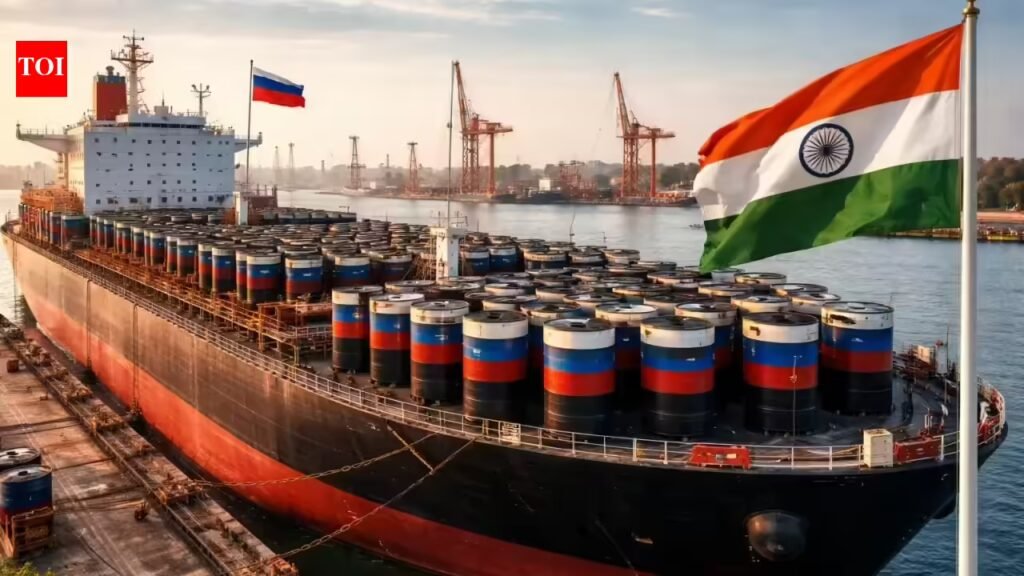
Historically, India’s highest monthly purchases of Russian crude have been around 2.0-2.1 Mbd since the Russia-Ukraine war began in 2022. (AI image) Russian crude has emerged as a major player amid the US-Iran war – global crude oil supply is badly affected via the Strait of Hormuz, Middle East countries are finding it difficult to export oil and global crude oil prices have risen dramatically. The situation has had major implications for India – a country that imports almost 90% of its crude oil.There was a time after the Russia-Ukraine war began in 2022 that Russia had begun to contribute approximately 35-40% of India’s crude oil imports. Come early 2026, sanctions forced India’s procurement of Russian crude to drop. But March 2026 presents a very different picture. Watch Amid Hormuz Disruption, India Locks 60 Million Barrels Of Russian Oil To Secure Energy Supply The inflows of Russian crude oil have risen sharply since the US-Iran war began and imports via the Strait of Hormuz were disrupted. In fact, crude imports from Russia are now nearing lifetime monthly highs!The Donald Trump administration has given a 30-day waiver for purchase of Russian crude to keep global oil prices stable. It’s important to note that India has never stopped buying crude oil from Russia, however imports dropped drastically after sanctions on Russian oil majors. “We source crude from wherever supplies are available, competitively priced and deliverable, and we will continue to do so,” a government source told TOI earlier this month. The source also said that the declaration of a 30-day waiver by the US appears to be for the consumption of their domestic audience. When India Became A Big Importer of Russian Oil For decades, India has mainly imported crude oil from the Middle East, especially from countries like Iraq, Saudi Arabia and the UAE. The decision has been driven by proximity, long‑term contracts and stable shipping routes.After the Russia–Ukraine war began in 2022, Western sanctions pushed Russian oil out of European markets. This is when India started importing large volumes of Russian crude – and a big factor driving this decision was the availability of crude that suited Indian refineries at such steep discounts.This helped India reduce its oil import costs and diversify its supply network. However, in late 2025 and early 2026, India scaled back Russian oil purchases amid US trade negotiations and pressure linked to tariffs and sanctions compliance. In August 2025, the Donald Trump administration imposed a 25% penalty tariff on India for its crude oil buys from Russia. The US called these imports an indirect financing of the war against Ukraine. Within months two Russian crude oil majors, Lukoil and Rosneft, were sanctioned making it difficult for Indian refiners to buy Russian crude, leading to a gradual decline in imports. But that has changed now. The Re-emergence Of Russian Oil An analysis by Kpler, a global real-time data and analytics provider suggests that India has so far purchased around 45–50 million barrels of Russian crude since the start of the Middle East conflict. The figure may even be higher, given that April figures are not confirmed as yet. The trendline suggests March procurement is likely to reach around 1.8–2.0 Mbd, which would make it one of the strongest months for Russian crude intake since India began ramping up purchases after the start of the Russia-Ukraine war. This compares with a pre-conflict run rate closer to around 1.0 Mbd, Sumit Ritolia, Lead Research Analyst, Refining and Modelling at Kpler tells TOI.Historically, India’s highest monthly purchases of Russian crude have been around 2.0-2.1 Mbd since the Russia-Ukraine war began in 2022.Hence, the biggest takeaway is that the current spurt in purchases of Russian crude oil is now nearing peak monthly trends seen before India started dialling down on Moscow’s crude. For Sumit Ritolia, what stands out is the speed of the rebound: as Middle Eastern supplies via Hormuz dried up, Indian refiners were able to lift Russian purchases by close to around 0.8–1.0 Mbd, helping cushion the disruption without materially affecting refinery runs so far.Sourav Mitra, Partner – Oil & Gas at Grant Thornton Bharat points out that India bought the most Russian crude in a single month in May 2023, when imports reached about 66 million barrels, 2.1 million bpd. “The recent rise in March 2026 is expected to be as high, at around 60 million barrels. This implies that the ongoing conflict in West Asia has pushed India’s purchase of Russian crude oil closer to its previous all-time high,” Mitra tells TOI. India vs China: The Russian Crude Factor Experts note that since China has more reserves, it is structurally less exposed to the Strait of Hormuz oil supply shock.Kpler data and analysis suggests that compared with China, India is currently buying similar to slightly higher absolute volumes of Russian crude in March, depending on the month, but Russia’s role in India’s crude slate has become much more critical in the current environment. China continues to take substantial Russian volumes as well, supported by both seaborne crude and pipeline imports, while India’s recent increase has been more directly linked to replacing lost Middle Eastern barrels. “In other words, India and China remain the larger structural buyers of Russian crude overall, but India’s current surge is more pronounced from a substitution and energy-security standpoint,” says Sumit Ritolia.India usually imports 5-5.5 million bpd of crude oil vis-à-vis China’s import of about 11 million bpd.Sourav Mitra says that in 2025, China ramped up crude oil imports to 11.5 million bpd to augment its stockpiles. Russia accounted for 18% of total Chinese crude oil imports in 2025. China’s import of Russian seaborne crude oil surged to almost 2 million bpd in February as India scaled back the import of Russian Urals in February. In the first two months of 2026 alone, Russia’s shipments of crude to China rose about 40 % y-o-y.“Since oil prices are high and China has enough inventory, it’s likely to cut its oil purchases. Shifting of
US stock markets today (March 26, 2026): Wall Street opens lower as oil jumps above $100; Middle East tensions weigh on sentiment

Wall Street’s key indices opened lower on Thursday after gains in the previous session, as investors turned cautious over evolving developments in the Middle East and weighed the prospects of any de-escalation in the conflict.At the opening bell, the Dow Jones Industrial Average slipped 84.8 points, or 0.18%, to 46,344.64. The S&P 500 declined 36 points, or 0.55%, to 6,555.86, while the Nasdaq Composite dropped 236.7 points, or 1.08%, to 21,693.17.US equities tracked weakness in global markets as crude oil prices climbed back above the $100-a-barrel mark amid fading hopes of a ceasefire in the Iran war. Futures for the S&P 500 and Dow Jones Industrial Average had fallen about 0.7% before the opening bell, while Nasdaq futures were down 0.8%.Brent crude, the international benchmark, rose 3.4% to $100.61 per barrel after trading below $95 on Wednesday. US benchmark crude gained 3.2% to $93.25 a barrel. The rise in oil prices lent modest support to energy stocks, with shares of ConocoPhillips and Valero Energy rising about 1%.US President Donald Trump said a deal to end the war was near, even as Tehran dismissed his proposed 15-point ceasefire plan. Iran outlined its own conditions via state television, including a halt to the killing of its officials, guarantees against future conflict, reparations and recognition of its sovereignty over the Strait of Hormuz.Iran also moved to formalise its control over the strategic waterway, through which around 20% of globally traded oil and natural gas moves in normal times. A Gulf Arab bloc official said Iran had begun charging fees for ships to safely transit the strait, while Washington prepared for the deployment of additional US troops to the region.European markets were also trading lower by midday. Britain’s FTSE 100 fell 1.3%, France’s CAC 40 dropped 0.7% and Germany’s DAX declined 1.2%.In Asia, Japan’s Nikkei 225 closed 0.3% lower at 53,603.65, while South Korea’s Kospi plunged 3.2% to 5,460.46. Hong Kong’s Hang Seng slipped 1.9% to 24,856.43 and the Shanghai Composite fell 1.1% to 3,889.08. Australia’s S&P/ASX 200 edged down 0.1%, and Taiwan’s Taiex was trading 0.3% lower.In commodities trade, gold prices dropped 2.3% to $4,446 per ounce, while silver declined 6.2% to $68 an ounce. The fall in precious metals weighed on mining stocks, with companies such as Newmont Corp. and Freeport-McMoRan slipping about 3%, AP reported.(With input from agencies)
US unemployment data: Jobless claims edge up to 210,000; labour market still shows resilience

Applications for unemployment benefits in the United States rose slightly last week, signalling continued labour market resilience even as hiring momentum has slowed over the past year.New filings for jobless aid increased by 5,000 to 210,000 for the week ended March 21, up from 205,000 in the previous week, the US Labour Department said on Thursday, according to AP. The figure was in line with expectations of analysts surveyed by FactSet.Weekly jobless claims are widely viewed as a near real-time gauge of layoffs. Though layoffs have largely remained within a historically healthy range of 200,000–250,000 in recent years, several major companies — including Morgan Stanley, Block, UPS and Amazon — have recently announced job cuts.Earlier this month, the Labour Department reported that US employers unexpectedly shed 92,000 jobs in February. Payroll data for December and January were also revised lower by a combined 69,000 jobs, pushing the unemployment rate up to 4.4%.The weaker employment picture has added to economic uncertainty amid the ongoing conflict involving Iran, which has driven oil prices more than 40% higher and increased cost pressures for businesses and households. Inflation was already elevated before the conflict, with the Commerce Department noting that the Federal Reserve’s preferred price gauge rose 2.8% year-on-year in January, above the central bank’s 2% target.Against this backdrop, the Federal Reserve left its benchmark lending rate unchanged at its latest policy meeting. Policymakers had earlier voted to raise rates three times towards the end of 2025, citing concerns about a softening job market.Economists say the labour market remains in a “low-hire, low-fire” phase — keeping unemployment historically low but making it harder for jobseekers to find new work.The report also showed that the four-week moving average of jobless claims dipped by 250 to 210,500. Meanwhile, the number of Americans continuing to receive unemployment benefits for the week ended March 14 declined by 32,000 to 1.82 million.
OECD pegs India GDP growth at 7.6% in FY26, sees moderation next fiscal

India’s economy is projected to expand by 7.6% in the current fiscal before moderating to 6.1% in 2026-27, the Organisation for Economic Cooperation and Development (OECD) said in its interim Economic Outlook report, PTI reported.The multilateral body said the evolving conflict in the Middle East has “human and economic costs” for countries directly involved and could test the resilience of the global economy by disrupting energy supplies and raising commodity prices.“The decline in (US) tariffs should support growth in India, though gas rationing will disrupt some production activities and fiscal support is expected to fade, with growth easing from 7.6 per cent in fiscal year (FY) 2025-26 to 6.1 per cent in FY 2026-27 and 6.4 per cent in FY 2027-28,” the OECD said.According to the report, disruption of shipments through the Strait of Hormuz and damage to energy infrastructure have triggered a surge in energy prices and affected the global supply of commodities, including fertilisers.The OECD also warned that inflationary pressures could rise as the deflationary effects of earlier food and energy price shocks recede. It projected inflation to increase from 2% in FY 2025-26 to 5.1% in FY 2026-27 before easing to 4.1% in FY 2027-28.Among emerging-market economies, India may need to raise policy rates temporarily in the second quarter of 2026 to counter stronger inflationary pressures, the report said.The OECD noted that US bilateral tariff rates have declined following a US Supreme Court ruling against levies imposed under the International Emergency Economic Powers Act. While this has resulted in significant tariff reductions for several emerging-market economies, including India, the overall US effective tariff rate remains higher than levels seen before 2025.Globally, growth is expected to soften to 2.9% in 2026 before improving slightly to 3% in 2027.“The energy price surge and the unpredictable nature of the evolving conflict in the Middle East will raise costs and lower demand, offsetting the tailwinds from strong technology-related investment and production, lower effective tariff rates and the momentum carried over from 2025,” the OECD said.
India’s voluntary carbon market gains ground as net-zero goals drive ecosystem buildup

NEW DELHI: With Climate action gaining momentum as part of India’s net-zero commitment by 2070, the country’s carbon market is beginning to take shape and gain momentum. Homegrown institutions such as the Carbon Registry of India (CRI) are emerging as important enablers for the voluntary carbon market offering platforms to register and track carbon projects, even as corporates and developers scale up efforts around offsets, credits, and trading in line with evolving global frameworks. While the regulatory framework is still in the development stage across many industries, India is leading the development of platforms for listing of voluntary carbon projects in South Asia, creating implementation partners, enabling trading of credits and audit process — all to to align the processes with international standards having an end-to-end setup. “The carbon market today is split into two clear paths,” says Priya Bahirwani, co-founder of Terrablu Climate Technologies, a carbon project developer with proprietary carbon accounting, offsetting and trading platform. “The compliance market is regulation-led and has different levers and framework within which it operates. But the voluntary carbon market is where intent shows up, where companies invest for credibility, brand and long-term responsibility.” It is this voluntary market that is now steering the path and driving the momentum in India for a climate-driven economy. This market is driven by corporates looking to go beyond compliance and are committed to demonstrating real climate impact and social impact – Indian Carbon for Global Markets. CRI (a public-private registry) and other such reputed organisations are building the ecosystem in a sustainable manner. Especially companies like Varaha, Terrablu, NextNow Green (NNG), and other entities are slowly but steadily building the momentum for a climate resilient economy in India. From large conglomerates to mid-sized firms, companies are increasingly investing in carbon credits not just to meet regulatory norms, but to build long-term brand credibility and stakeholder trust. The is the just the beginning of new wave of building a climate resilient economy. CRI helps companies register and formalise their carbon projects in a standardised format. For India, this shift represents a strategic move — from being a supply-side participant to shaping the rules of the market itself. “Carbon markets will only scale on the foundation of trust, transparency, and traceability. With its depth in innovation and resilience, India is well placed to lead this evolution.,” says Richard Bright, CEO of CRI. CRI, he adds, is focused on building a credible domestic bridge between Indian climate projects and global demand, while leveraging digital frameworks to improve transparency, traceability and access. Companies listed on the CRI for carbon projects include Sahyadri Farms, Piplantri FPO, L&T Metro and others are in the pipeline, says Bright. Terrablu’s Bahirwani says India should not just generate carbon credits, but also own the platforms that certify them. “CRI is creating that opportunity, and we are already seeing increasing interest from corporates in sourcing credits listed on such platforms.” Companies such as NNG, which is a carbon consultancy and ecosystem implementation partner, believes that as India moves from a voluntary to a rules- and penalties-based setup in carbon, companies will increasingly work on carbon and climate strategies to strengthen their play in the area. “We are already seeing efforts in this regard. There are enquiries about how to go about carbon projects, how to carry out assessment and audit of current work, and how to work out credits and even offset them, or trade them, across diverse sectors including agriculture and industrial decarbonisation,” says NNG’s Archana Raha. This push is also being reinforced by ecosystem players such as legal frameworks to project developers. They see value in strengthening India’s own carbon market architecture. “Global registries will continue to play a role, but India needs trusted domestic platforms as well,” says Vishnu Sudarsan, senior partner at law firm JSA. “Platforms like CRI provide visibility and credibility within the Indian ecosystem, which is critical as the market matures, supported by robust, dual-layer governance structures that reinforce transparency and accountability,” Sudarsan adds. On the ground, this shift is already taking shape through projects that are choosing to align with India’s emerging carbon infrastructure. Take Piplantri as an example. It is a model that goes beyond carbon to integrate afforestation, water conservation and community livelihoods. By listing on CRI, stakeholders are signalling a clear intent to prioritise transparency, traceability and alignment with India’s evolving climate ecosystem. The market is gradually maturing as reputed and credible market players with sophistication and focus are shaping the ecosystem . The decision reflects a broader trend. Project developers and intermediaries are increasingly working with platforms like CRI and CCTS, supported by ecosystem players such as Terrablu and implementation partners like NNG. Alongside them, credible validation and verification bodies — including KBS certification, 4K Earth Science, VKU Certification and others — are empanelled with CRI, strengthening the integrity and credibility of the overall ecosystem, and helping create a more locally anchored yet globally credible carbon market framework. Experts say that India’s emerging carbon ecosystem is beginning to offer answers through creation of stronger platforms, better verification, and tighter integration across the value chain. “The direction is clear: India is not just participating in the global carbon market but it is leading the market for other emerging economies,” says Sudarsan. It is believed that with the foundation for the climate economy coming in place, India is well poised to become a hub for high-integrity carbon solutions.
Nayara Energy hikes petrol prices by Rs 5, diesel by Rs 3 amid Middle East crisis
NEW DELHI: India’s largest private fuel retailer Nayara Energy on Thursday raised its prices by Rs 5 per litre and diesel by Rs 3 a litre amid the ongoing Middle East crisis. Nayara Energy, which operates 6,967 of India’s 102,075 petrol pumps, has decided to pass on part of the increase in input costs to consumers, said PTI sources.The majority-owned by Russia’s Rosneft, has raised the prices but the actual increase varies across states due to differences in local levies such as VAT, with petrol prices in certain regions rising by as much as Rs 5.30 per litre.Fuel marketing companies in India are under increasing financial pressure, as retail petrol and diesel prices have been kept unchanged even though global oil prices have climbed nearly 50 per cent since February 28, when US–Israel strikes on Iran sparked a wider conflict and retaliation from Tehran.Private and state-run fuel retailers in India are taking divergent approaches as pressure mounts from elevated global crude prices and a prolonged freeze in retail rates.Jio-bp, the fuel retail joint venture between Reliance Industries and BP Plc, which operates over 2,100 outlets nationwide, has so far held petrol and diesel prices steady despite absorbing significant losses. In contrast, state-owned oil marketing companies—dominating roughly 90 per cent of the market—have also maintained a price freeze on standard fuels, continuing a strategy in place since April 2022.State-run companies—Indian Oil Corporation (IOC), Bharat Petroleum Corporation Ltd (BPCL), and Hindustan Petroleum Corporation Ltd (HPCL)—have been absorbing losses during periods of high crude prices and recovering margins when prices soften. While retail prices for regular petrol and diesel remain unchanged, these companies recently increased the price of premium-grade petrol by Rs 2 per litre and sharply raised bulk diesel rates sold to industrial consumers by about Rs 22 per litre.In Delhi, the price of premium 95-octane petrol now stands at Rs 101.89 per litre, up from Rs 99.89, while bulk diesel rates have jumped to Rs 109.59 per litre from Rs 87.67. Meanwhile, standard petrol and diesel prices remain frozen at Rs 94.77 and Rs 87.67 per litre, respectively.The divergence reflects differences in fuel grades: regular petrol, typically rated at 91–92 octane, caters to standard engines, whereas premium petrol with higher octane levels (95–98) is designed for high-performance vehicles.Globally, crude oil prices surged to as high as $119 per barrel earlier this month amid escalating tensions involving Iran, before easing to around $100 per barrel. India, which imports nearly 88 per cent of its crude oil and about half of its natural gas requirements, remains highly exposed to such volatility—particularly as a significant portion of supplies passes through the strategically sensitive Strait of Hormuz. Recent threats from Iran following US and Israeli strikes, coupled with insurance withdrawals, have disrupted tanker movements through the route.The government has reiterated that petrol and diesel pricing is deregulated and determined by oil marketing companies.Historically, oil firms have navigated sharp price cycles. Crude had previously touched $119 per barrel in June 2022 after Russia’s invasion of Ukraine. While that year saw limited profitability, state-run companies posted record profits of Rs 81,000 crore in FY24, offsetting earlier margin pressures. In the current financial year, the three firms together reported profits of Rs 23,743 crore in the December quarter alone.
Oil & energy price shock: Goldman Sachs sees India’s macro outlook worsening; cuts Nifty target

Strategists at Goldman Sachs now project Brent crude to average about $105 in March and rise to $115 in April. (AI image) As a direct fallout of the US-Iran war and rising crude oil prices, Goldman Sachs has adopted a more cautious view on Indian equities, revising its rating to “marketweight,. The global brokerage has also lowered its target for the Nifty, and cautioned that an earnings downgrade cycle driven by an energy shock is likely to emerge. The bank has reduced its 12-month Nifty target, for end-March 2027, to 25,900 from an earlier 29,300. This suggests expected returns of about 13% in rupee terms and 12% in dollar terms over the next year, which is lower than the 19% upside projected for the MXAPJ index. It expects these returns to be supported partly by earnings growth of 8% and 13% in calendar years 2026 and 2027, respectively, along with a modest re-rating in valuations to a lower fair value multiple of 19.5 times, compared with its earlier estimate of 20.8 times, as earnings downgrades take effect.The firm said persistently high oil prices amid tensions around the Strait of Hormuz have weakened India’s macroeconomic outlook and are expected to lead to downward revisions in profit estimates over the coming quarters, according to an ET report.Earlier this week, Bernstein also trimmed its year-end Nifty target to 26,000 and warned that, in a worst-case scenario, the benchmark index could fall to as low as 19,000.Goldman Sachs further noted that returns are likely to be skewed toward the latter part of the period. “We see risks tilted to the downside in the next 3 to 6 months as we think the market may not be pricing in the full extent of the earnings downgrades, and low earnings visibility in the near-term could demand a higher risk premium,” it said.The firm added that, historically, forward returns tend to remain subdued when valuations are in the 18–20 times range during an earnings downgrade phase. However, it pointed out that equities have typically recovered once earnings stabilise after about two to three quarters, as has been seen during past energy-related shocks.Strategists at Goldman Sachs now project Brent crude to average about $105 in March and rise to $115 in April, before gradually easing to $80 in the fourth quarter and stabilising at that level through 2027. The report highlights that, within Asia, India is particularly exposed to potential energy supply risks due to its relatively lower per capita income and heavy reliance on energy imports.The change in global energy dynamics has led the firm to significantly revise its outlook for India’s macroeconomic indicators. Since the onset of the Iran conflict, Goldman has cut its 2026 GDP growth forecast for India by 1.1 percentage points to 5.9%, increased its inflation projection by 70 basis points, widened the current account deficit estimate to 2% of GDP, lowered its outlook for the rupee, and factored in an additional 50 basis points of rate hikes in 2026.Its latest internal estimates for calendar year 2026 now assume real GDP growth of 5.9%, average CPI inflation of 4.6%, a current account deficit of 2% of GDP, a fiscal deficit of 4.7% of GDP, a year-end repo rate of 5.75%, and an average Brent crude price of $85 per barrel.Goldman also expects the weaker macro environment to eventually reflect in corporate earnings. Its VAR-based analysis indicates that if oil prices remain about $45 per barrel higher on average for three months, India’s full-year earnings growth could decline by roughly 9%, which is a larger impact compared to the estimated 6% hit to earnings for the MXAPJ index.
DGCA seeks corrective action from Air India over wrong plane on Delhi-Vancouver route

In a regulatory intervention following an operational lapse, aviation watchdog Directorate General of Civil Aviation (DGCA) has asked Air India to take corrective measures after the airline operated a Delhi–Vancouver flight with an aircraft that was not approved for the route, a senior official said on Thursday.Action has also been initiated against an airline official over the incident, the official at DGCA told PTI.The Air India Boeing 777-200 LR aircraft, which took off for Vancouver on March 19, was recalled to Delhi after remaining airborne for over seven hours when it was found that the flight was cleared only for operation by a Boeing 777-300 ER.The regulator subsequently sought a report from the airline and has now directed it to put in place safeguards to prevent a recurrence of such lapses. Specific details of the action taken could not be immediately ascertained.There was no immediate response from Air India, as reported PTI.Sources had earlier indicated on March 20 that an apparent lapse in updating operational requirement lists for Canada-bound services may have led to the deployment of the incorrect aircraft.In a statement issued the same day, the airline said, “Air India flight AI185, operating from Delhi to Vancouver on 19 March, returned to Delhi due to an operational issue and in line with established standard operating procedures. The aircraft landed safely, and all passengers and crew had disembarked.”
Government assures strong fuel security: No LPG shortage, crude reserves secured, PNG transition underway

The government, on Thursday, moved to reassure citizens that the country’s fuel supply situation remains fully stable. The ministry of petroleum and natural gas said India’s petroleum and LPG systems are secure and under firm control, with no shortage of petrol, diesel or LPG anywhere in the country. It also warned against what it called a coordinated misinformation campaign intended to create unnecessary panic.This follows the Centre’s earlier clarification dismissing reports that LPG refill booking timelines had been changed. It said the claims were incorrect and misleading, and reaffirmed that the existing timelines “remain unchanged and continue to” operate under the current time limit.Here’s what the government said: ‘Oasis of energy security’: Fuel supply stable across India The ministry reiterated India’s fuel security, saying that the country continues to function as an “oasis of energy security.” In a press release, the government pointed out that “India is the world’s 4th largest refiner and 5th largest exporter of petroleum products, supplying refined fuel to over 150 countries.”Commenting on petrol and diesel availability, the Centre assured that, being a net exporter, India’s petrol and diesel availability is “structurally assured.” It confirmed that all 1 lakh-plus retail fuel outlets across India are operating normally and dispensing petrol and diesel without interruption.The ministry said no outlet has been instructed to ration fuel. It also highlighted that, unlike several countries facing rationing, price shocks, odd-even vehicle restrictions and even station closures, with some declaring a “National Energy Emergency,” India has no requirement for such measures.According to the ministry, reports of shortages at select locations were driven by panic buying triggered by misinformation circulating on social media. It said that despite temporary surges in demand, fuel continued to be supplied to all customers, while oil company depots operated round-the-clock to strengthen distribution. Oil companies have also extended credit limits to petrol pumps to more than three days, up from one day earlier, to ensure smooth working capital flow and uninterrupted supply. Crude tanks — already covered Addressing concerns over global supply routes, the ministry stated that even with disruptions at the Strait of Hormuz, India is currently receiving higher crude volumes from over 41 international suppliers than what previously came through the strait.It added that increased availability in global markets, particularly from the western hemisphere, has fully offset any disruption. All Indian refineries, it said, are operating at over 100% capacity utilisation.The ministry further stated that crude oil requirements for the next 60 days have already been secured, and there is no supply gap in the system. “Crude oil supplies for next 60 days have already been tied up by Indian Oil companies.” LPG Commenting on LPG supply, a major concern for consumers amid the Middle East crisis, the ministry said that there is no shortage anywhere in the country and production has been significantly ramped up following the LPG Control Order.Domestic refinery output has increased by 40 per cent, reaching 50 TMT per day, more than 60 per cent of the country’s total daily requirement of around 80 TMT. As a result, the net import requirement has been reduced to 30 TMT per day.It said 800 TMT of LPG cargoes have already been secured and are currently en route from countries including the United States, Russia and Australia. These supplies are arriving across 22 LPG import terminals, compared to 11 in 2014.The ministry said about one month of LPG supply is fully secured, with further procurement ongoing. Oil companies are currently distributing over 50 lakh cylinders daily. It noted that demand had briefly surged to 89 lakh cylinders due to panic buying but has since returned to normal levels. Commercial cylinder allocation has been increased to 50% in consultation with state governments to prevent hoarding and black marketing. A PNG transition The ministry once again highlighted the push for piped natural gas expansion, stating that it is part of a planned and ongoing transition towards cleaner, cheaper and safer household energy, being implemented in coordination with state governments. It further clarified that this expansion is not linked to any shortage situation and rejected claims that PNG is being pushed due to LPG scarcity. It said LPG supply remains fully secure.India produces 92 MMSCMD of natural gas domestically against a total requirement of 191 MMSCMD, making gas relatively less import-dependent than LPG.Till now, city gas distribution networks have expanded from 57 geographical areas in 2014 to more than 300 at present. Domestic PNG connections have grown from 25 lakh to over 1.5 crore. Strategic reserves — A bigger picture The ministry also dismissed claims circulating online that India has only six days of fuel stock, saying the country has a total reserve capacity of 74 days, with current stock cover at around 60 days.This includes crude stocks, product inventories and strategic storage in underground caverns. The ministry noted that this is the position even as the country is on the 27th day of the ongoing Middle East crisis.It said that almost two months of steady supply is already secured, with additional crude procurement for the next two months also tied up. It asserted that India remains fully secure for the coming months, and stressed that claims of depleted reserves are false. “Nearly two months of steady supply is available for every Indian citizen regardless of what happens globally. Next 2 months of crude procurement has also been secured. India is completely secure for next many months and the quantity in strategic cavern storage becomes secondary in such a supply situation.” Government’s warning Expressing serious concern, the ministry said misleading videos and social media posts are circulating that misuse images of queues, foreign rationing situations and fabricated claims about fuel emergencies in India.It also said certain posts have misinterpreted routine administrative orders such as the Natural Gas Control Order and LPG Control Order as emergency declarations, when they are standard supply management measures.The Ministry said these false narratives are being spread by miscreants and amplified by motivated elements, causing avoidable public anxiety. It urged citizens to