
Income Tax Scrutiny India 2026: Avoid Notices
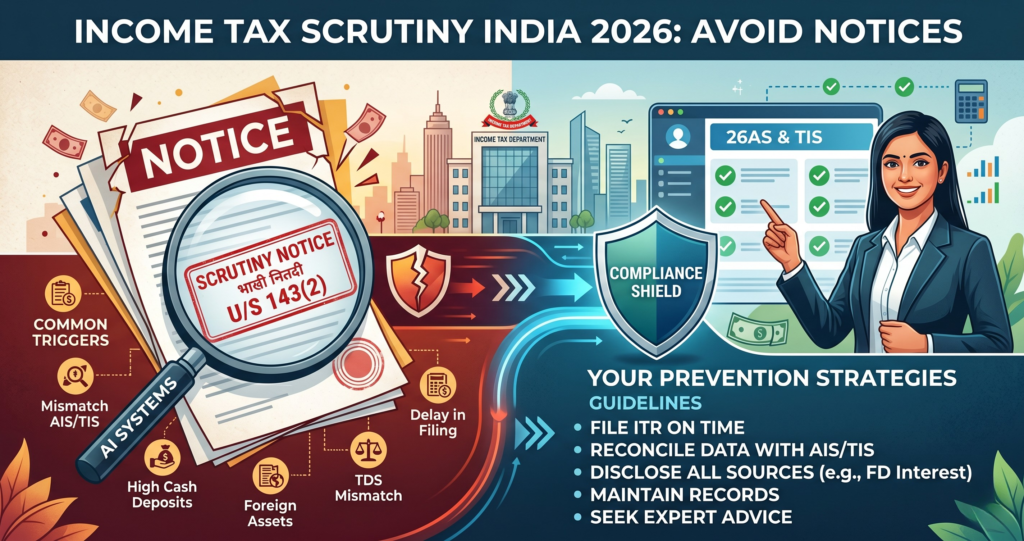
TL;DR Income tax scrutiny in India is triggered by mismatches, high-value transactions, or suspicious filings. Businesses can avoid notices and penalties by maintaining accurate records, ensuring compliance, and using expert tax advisory. Proactive planning is the key to staying audit-proof. What is Income Tax Scrutiny? Income tax scrutiny is a detailed examination of a taxpayer’s financial records by the Income Tax Department to verify: Income accuracy Tax payments Deductions claimed It ensures that businesses are not underreporting income or evading taxes. Types of Scrutiny Cases 1. Limited Scrutiny Focuses on specific issues like: High-value transactions Mismatched data 2. Complete Scrutiny Full examination of financial records. 3. Manual Scrutiny Selected based on risk parameters or red flags. Why Businesses Receive Tax Notices Tax notices are not random. They are triggered due to: Data mismatches Unusual financial activity Non-compliance Common Triggers for Scrutiny 1. Mismatch in Returns Differences between: GST filings Income tax returns TDS records 2. High-Value Transactions Large cash deposits Property purchases Foreign transactions 3. Abnormal Profit Margins Extremely low or high profits compared to industry 4. Frequent Loss Reporting Repeated losses raise suspicion. 5. Incorrect Deductions Claiming ineligible tax benefits. Step-by-Step Scrutiny Process Notice issued under Income Tax Act Submission of documents Clarification and hearings Assessment order issued Penalties & Consequences If discrepancies are found: Tax demand raised Penalty (50%–200% of tax) Interest charges Legal proceedings in severe cases How to Respond to a Tax Notice Step 1: Understand the Notice Identify: Section Issue raised Step 2: Gather Documents Financial statements Bank records Invoices Step 3: File Response Online Via income tax portal. Step 4: Consult a CA Avoid errors in response. How to Avoid Scrutiny Legally 1. Maintain Accurate Records Proper bookkeeping Updated financial data 2. Ensure Data Consistency Match: GST TDS incometax filings 3. Avoid Cash Transactions Prefer digital transactions. 4. Claim Deductions Carefully Only valid and documented claims. 5. Conduct Regular Tax Reviews Quarterly financial audits reduce risk. Compliance Checklist for 2026 Timely ITR filing GST reconciliation TDS compliance Proper invoicing Audit readiness Common Mistakes to Avoid Ignoring notices Late responses Poor documentation Incorrect filings DIY tax handling without expertise Final Thoughts Income tax scrutiny is not a problem if your compliance is strong. Businesses that proactively manage their finances: Reduce risk Avoid penalties Build credibility Conclusion In 2026, tax compliance is becoming more data-driven and strict. The best strategy is not reacting to notices—but preventing them. CTA: Work with CA Arihant Lodha to ensure complete tax compliance, avoid scrutiny risks, and safeguard your business from penalties. 6. FAQ SECTION 1. What triggers income tax scrutiny in India? Mismatched data, high-value transactions, and abnormal financial patterns. 2. How do I respond to an income tax notice? Understand the issue, gather documents, and respond via the income tax portal. 3. Can scrutiny lead to penalties? Yes, penalties can range from 50% to 200% of tax due. 4. How to avoid income tax notices legally? Maintain accurate records, ensure compliance, and file correct returns. 5. What happens in tax scrutiny cases? Authorities review financial records and verify tax accuracy. Blog By – CA Arihant Lodha
Increase Profit Margins with CFO Services (2026)

TL;DR Businesses that adopt financial advisory and virtual CFO services can increase profit margins by 15–25% by optimizing costs, improving pricing strategies, and making data-driven decisions. The shift is from reactive accounting to proactive financial strategy. Why Most Businesses Struggle with Profit Margins in CFO Services Many businesses generate revenue—but fail to retain profit. Common Reasons: Uncontrolled expenses Poor pricing strategies Lack of financial visibility Inefficient operations No strategic planning Reality: Without financial insights, profit leakage is inevitable. What Are Financial Advisory & CFO Services? Financial advisory and CFO services go beyond bookkeeping. They focus on: Strategic financial planning Profitability analysis Cash flow management Cost optimization Business growth strategy Virtual CFO = Strategy + Execution Unlike traditional accountants, CFO services help businesses make decisions, not just maintain records. Key Drivers of Profitability To increase profit margins, businesses must optimize: Revenue streams Cost structures Operational efficiency Pricing models CFO services align all four. How CFO Services Increase Profit Margins 1. Cost Optimization CFOs identify: Unnecessary expenses Vendor inefficiencies High operational costs Impact: 10–20% cost reduction possible 2. Revenue Enhancement Strategies include: Pricing optimization Product profitability analysis Upselling & cross-selling insights 3. Cash Flow Management Avoid working capital issues Improve liquidity Reduce borrowing costs 4. Data-Driven Decisions CFO dashboards provide: Real-time financial insights Predictive analytics Scenario planning Result: Faster and smarter business decisions Real ROI Impact Area Impact Cost Reduction 10–20% Revenue Growth 5–15% Profit Margin Increase 15–25% Insight: Profit growth is not accidental—it is engineered. Case Scenarios Scenario 1: E-commerce Brand Reduced logistics costs by 18% Improved pricing → +12% margin Scenario 2: Service Business Eliminated unnecessary subscriptions Optimized team cost Scenario 3: Startup Controlled burn rate Improved investor reporting When Should You Hire a CFO? You need CFO services if: Revenue is growing but profits aren’t You lack financial clarity You are planning to scale You want better decision-making Step-by-Step Profit Optimization Framework Step 1: Financial Audit Analyze revenue & cost structure Step 2: Identify Leakages Pinpoint inefficiencies Step 3: Implement Cost Controls Reduce unnecessary spending Step 4: Optimize Pricing Adjust based on data Step 5: Monitor KPIs Track margins, cash flow, ROI Common Mistakes to Avoid Focusing only on revenue Ignoring financial data Delaying expert advice Poor cost tracking Not using financial tools Final Thoughts Profitability is not just about earning more—it’s about managing money smarter. Businesses that leverage financial advisory and CFO services gain: Higher margins Better control Faster growth Conclusion In 2026, businesses that rely only on traditional accounting will struggle to compete. The winners will be those who: Use financial data strategically Optimize every cost Make informed decisions CTA:Partner with CA Arihant Lodha to implement CFO-driven financial strategies and increase your profit margins sustainably. 6. FAQ SECTION 1. How can CFO services improve profitability? By optimizing costs, improving pricing, and providing strategic financial insights. 2. What does a financial advisor do for businesses? They analyze finances, plan strategies, and help improve profitability. 3. Is hiring a virtual CFO worth it? Yes, especially for growing businesses needing strategic financial guidance. 4. How to increase profit margins in business? Reduce costs, improve pricing, and use data-driven decisions. 5. What are financial advisory services? Services focused on financial planning, analysis, and business growth strategies. Blog By – CA Arihant Lodha
Mumbai Startup Tax Saving Guide 2026 (Save 30%)

TL;DR Most startups overpay taxes due to poor planning, not high rates Legal strategies can reduce tax liability by 20–30% Key levers: structure, exemptions, GST optimization, and expense planning Early CA involvement = maximum savings Why Most Mumbai Startups Overpay Taxes Mumbai’s startup ecosystem is booming—but many founders unknowingly bleed money through taxes. Common reasons: No structured tax planning Missing eligible deductions Poor salary vs profit distribution decisions Ignoring government schemes Result? Startups often pay 10–30% more tax than necessary. Understanding Startup Taxation in India (2026 Update) Startups in India are primarily taxed under: Corporate tax (22–25%) GST (if applicable) TDS compliance Dividend taxation However, the government offers multiple benefits under: Startup India recognition Section 80 IAC R&D incentives The difference between average and optimized tax? Strategy. 7 Smart CA Strategies to Save Up to 30% Tax 1. Choose the Right Business Structure Your structure directly impacts taxation. Structure Tax Impact Best For Proprietorship Individual slab Freelancers LLP Lower compliance Small teams Pvt Ltd Corporate tax benefits Scalable startups Insight: Most scalable startups benefit from Private Limited structure due to funding and tax advantages. 2. Leverage Section 80 IAC Benefits Eligible startups can claim: 100% tax exemption for 3 consecutive years Conditions: DPIIT recognition Incorporated after April 2016 Turnover under ₹100 crore Missing this = massive loss. 3. Optimize Salary vs Dividend Strategy Founders often make this mistake: Taking excessive salary → higher personal tax Smart approach: Balanced mix of: Salary (for expenses) Dividends (tax-efficient distribution) 4. Claim All Eligible Business Expenses Most startups under-claim expenses. Common deductible expenses: Office rent Software subscriptions Marketing costs Salaries Travel Pro tip: Maintain proper documentation to avoid scrutiny. 5. GST Input Credit Optimization If your startup is GST-registered, you can claim: Input tax credit on purchases Example: Paid GST on software/tools → claim credit → reduce liability Poor GST handling = direct cash loss. 6. R&D Deductions and Innovation Benefits Tech startups can claim: Weighted deductions on R&D expenses Especially useful for: SaaS startups Product-based companies 7. Smart Loss Carry Forward Planning Losses in early years? Good news. Startups can: Carry forward losses for up to 8 years This helps offset future profits → reducing tax significantly. Real Example: Tax Saving Breakdown Startup Type: SaaS company in MumbaiAnnual Profit: ₹50 lakh Strategy Applied Savings 80 IAC Exemption ₹12–15 lakh Expense Optimization ₹3–5 lakh GST Credit ₹2–3 lakh Salary Structuring ₹2–4 lakh Total Savings: ₹15–20 lakh (~30%) Common Mistakes That Kill Tax Savings Avoid these at all costs: Filing taxes without planning Ignoring compliance deadlines Mixing personal & business expenses Not consulting a CA early Poor bookkeeping When Should a Startup Hire a CA? Answer: Immediately after incorporation. Why? Setup right structure from day one Avoid costly mistakes Plan tax-saving roadmap early Why Professional CA Strategy Beats DIY Tax Filing DIY tools are fine for individuals—not startups. A professional CA helps with: Strategic tax planning Compliance management Audit readiness Fundraising support For Mumbai startups, working with experts like CA Arihant Lodha (SAKG & Associates) ensures: Tailored strategies Updated compliance Maximum legal savings Conclusion: Stop Overpaying, Start Planning Tax saving isn’t about loopholes—it’s about smart planning. Mumbai startups that treat tax as a strategy—not a liability—gain: Better cash flow Faster growth Investor confidence 6. FAQ Section 1. How can startups reduce tax in India? Startups can reduce tax through exemptions (like 80 IAC), expense deductions, GST credits, and smart structuring. Professional planning is key. 2. What is Section 80 IAC? It allows eligible startups to claim 100% tax exemption for 3 consecutive years under Startup India. 3. Is GST optimization legal? Yes, claiming input tax credit and structuring GST properly is fully legal and recommended. 4. Should startups hire a CA early? Yes, early involvement helps avoid mistakes and maximize savings from day one. 5. What expenses can startups claim? Rent, salaries, marketing, software, travel, and operational costs are typically deductible. 6. Can startups carry forward losses? Yes, losses can be carried forward for up to 8 years to offset future profits. Blog by – CA Arihant Lodha (SAKG & Associates)