
GST Reconciliation Best Practices for Businesses
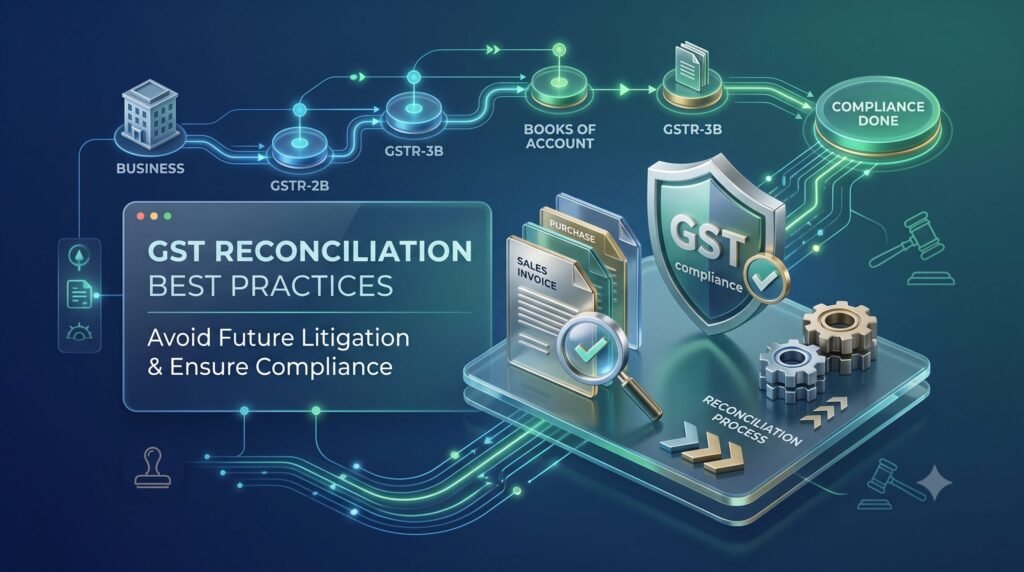
TL;DR GST reconciliation is the process of matching GST returns, books of accounts, purchase records, sales records, GSTR-2B, GSTR-1, GSTR-3B, e-invoices, and vendor filings to ensure that tax reporting is accurate. Businesses that do not reconcile GST data regularly may face input tax credit mismatches, tax notices, interest, penalties, blocked credits, vendor disputes, and future litigation. The best approach is simple: reconcile GST every month, document every difference, follow up with vendors, correct errors early, and maintain a clear audit trail. Why GST Reconciliation Matters in 2026 GST compliance has become more data-driven and system-led. The GST portal, e-invoicing system, GSTR-2B, GSTR-1, GSTR-3B, e-way bills, and accounting records are now closely connected. If one record does not match another, the mismatch can create future tax risk. Earlier, many businesses treated GST reconciliation as a year-end exercise. That approach is no longer safe. A small mismatch today can become: ITC reversal Interest liability GST notice Department scrutiny Vendor dispute Cash flow blockage Audit objection Litigation risk For growing businesses, GST reconciliation is not just a compliance task. It is a financial control process. What Is GST Reconciliation? GST reconciliation means comparing GST data across different records to confirm that sales, purchases, tax liability, input tax credit, debit notes, credit notes, reverse charge, and tax payments are correctly reported. In simple terms, GST reconciliation answers four questions: Have all sales been reported correctly? Has the correct tax liability been paid? Is input tax credit claimed only where eligible? Do GST returns match books of accounts? If the answer to any of these is unclear, the business has a compliance risk. Key GST Records Businesses Must Reconcile 1. GSTR-1 GSTR-1 contains invoice-level details of outward supplies. Businesses should reconcile GSTR-1 with: Sales register E-invoices Credit notes Debit notes Export invoices B2B and B2C sales records Mistakes in GSTR-1 can affect the buyer’s ITC and create disputes with customers. 2. GSTR-3B GSTR-3B is the summary return showing tax liability, input tax credit, reversals, and tax payment. Businesses should compare GSTR-3B with: GSTR-1 Sales register Purchase register GSTR-2B Tax payment challans Accounting records Mismatch between GSTR-1 and GSTR-3B is one of the most common GST risk areas. 3. GSTR-2B GSTR-2B is a static auto-drafted input tax credit statement. It shows ITC available based on supplier filings. Businesses should reconcile GSTR-2B with: Purchase register Vendor invoices Goods received records Expense invoices Debit notes Credit notes Claiming ITC without checking GSTR-2B can lead to mismatch and future dispute. 4. Purchase Register The purchase register is the internal record of all purchases and expenses. It should be checked for: Correct GSTIN Invoice number Invoice date Taxable value GST rate CGST, SGST, IGST Reverse charge applicability Vendor filing status ITC eligibility A clean purchase register is essential for accurate ITC claims. 5. Sales Register The sales register should match outward supplies reported in GSTR-1 and books. Review: Invoice values GST rates HSN/SAC codes Place of supply B2B/B2C classification Export invoices Credit notes Debit notes Incorrect sales reporting can lead to tax liability mismatch. 6. E-Invoices and E-Way Bills Businesses covered under e-invoicing or e-way bill requirements must ensure that portal data matches accounting records. Mismatch may arise due to: Cancelled invoices Duplicate invoices Wrong invoice values Incorrect GSTIN Delayed accounting entries Incorrect movement details These differences should be reviewed before return filing. Common GST Mismatches That Lead to Notices Mismatch Type Possible Risk GSTR-1 vs GSTR-3B mismatch Tax demand or scrutiny GSTR-2B vs purchase register mismatch ITC reversal Books vs GST returns mismatch Audit objection E-invoice vs GSTR-1 mismatch Reporting issue GST vs income tax turnover mismatch Cross-tax scrutiny Vendor not filing returns ITC dispute Incorrect GST rate Tax short payment Wrong place of supply CGST/SGST/IGST error Duplicate ITC claim Penalty risk Missing credit notes Excess or short reporting GST Reconciliation Best Practices 1. Reconcile GST Monthly, Not Annually GST reconciliation should be done every month. Annual reconciliation often identifies problems too late. Monthly reconciliation helps businesses: Correct errors early Follow up with vendors Avoid ITC loss Reduce interest exposure Prevent return mismatches Maintain audit-ready records 2. Match GSTR-1 with Sales Register Before Filing Before filing GSTR-1, compare it with internal sales data. Check: Invoice numbers Invoice dates Customer GSTIN Taxable value GST rate Tax amount Credit notes Debit notes Export details This reduces customer disputes and return mismatch risk. 3. Match GSTR-3B with GSTR-1 GSTR-3B should not be filed casually. Before filing, check whether outward supply and tax liability match GSTR-1. If differences exist, document the reason. Common reasons may include: Amendments Credit notes Timing differences Advances Exempt supplies Rounding differences Every difference should be explainable. 4. Reconcile GSTR-2B with Purchase Register This is one of the most important GST controls. Compare GSTR-2B with purchase records to identify: Invoices present in books but missing in GSTR-2B Invoices present in GSTR-2B but missing in books Value mismatch GSTIN mismatch Duplicate invoices Ineligible ITC Blocked credits Vendor filing delays Do not blindly claim ITC only because an invoice is in the books. 5. Track Vendor Compliance Your ITC depends heavily on vendor compliance. Businesses should monitor whether vendors: File GSTR-1 on time Report invoices correctly Use correct GSTIN Mention correct invoice value Correct mismatches promptly Issue valid tax invoices Create a vendor compliance scorecard for major suppliers. 6. Maintain an ITC Eligibility Review Not every GST invoice gives eligible ITC. Review blocked and ineligible credits carefully. Common areas include: Personal expenses Motor vehicle-related restrictions Food and beverages Club memberships Employee benefits Construction-related restrictions Expenses not used for business Claiming ineligible ITC can lead to reversal, interest, and litigation. 7. Document Every Difference Not every mismatch is an error. Some differences are due to timing. However, every difference must be documented. Maintain a reconciliation sheet with: Invoice number Vendor/customer name GSTIN Difference amount Reason for mismatch Action required Responsible person Closure date This creates a strong audit trail. 8. Review Credit Notes and Debit Notes Carefully Credit notes and debit notes often create GST mismatches. Check whether: Credit notes are