
Outsourced Accounting vs In-House Finance Team: Cost Comparison for Indian Businesses
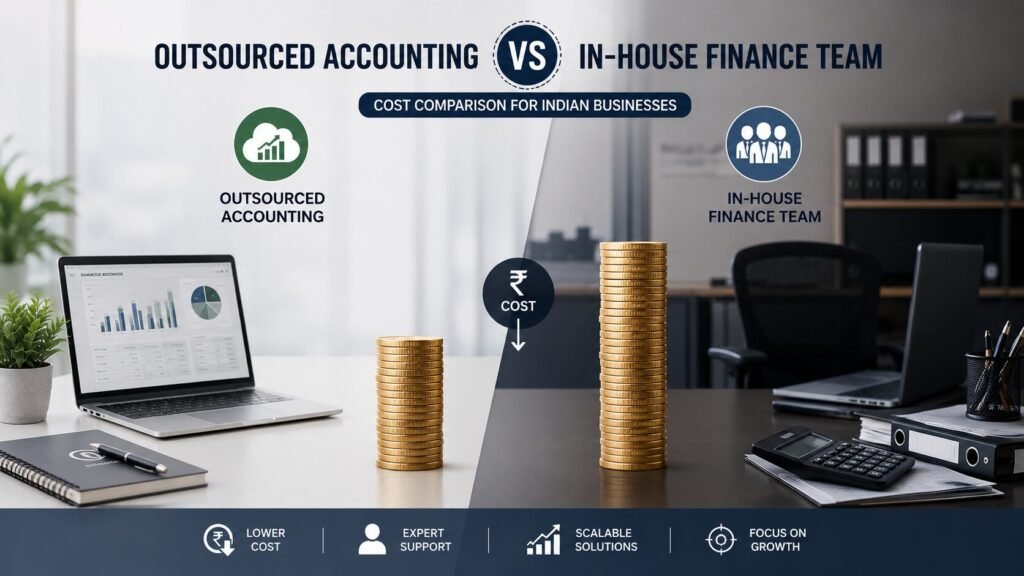
TL;DR Outsourced Accounting is often more cost-effective for Indian SMEs, startups, consultants, service businesses, and growing companies that need reliable bookkeeping, GST compliance, TDS support, tax coordination, MIS reporting, and financial review without hiring a full finance team. An in-house finance team gives stronger daily control but comes with salary, recruitment, training, software, supervision, compliance, and employee overhead costs. For many Indian businesses, the best model is not purely outsourced or fully in-house. A hybrid model works better: internal operational support plus outsourced CA-led accounting, compliance, reporting, and advisory review. Why This Decision Matters for Indian Businesses Every business needs accurate accounting. But not every business needs a full in-house finance department from day one. As businesses grow, financial work becomes more complex. Owners must manage: Sales entries Purchase records Bank reconciliation GST returns TDS compliance Payroll entries Vendor payments Customer collections Cash flow reporting Financial statements Audit support Income tax planning Management reports At this point, many business owners ask a practical question: Should we outsource accounting or hire an in-house finance team? The right answer depends on size, transaction volume, compliance complexity, management control, budget, and growth stage. This guide explains the real cost difference between outsourced accounting and in-house finance teams for Indian businesses. What Is Outsourced Accounting? Outsourced Accounting means hiring an external professional firm or accounting team to manage your accounting, bookkeeping, compliance, reporting, and related finance functions. Depending on the scope, outsourced accounting may include: Bookkeeping Bank reconciliation Accounts payable Accounts receivable GST data preparation TDS coordination Payroll accounting MIS reports Financial statements Audit support Tax filing support Compliance tracking Virtual CFO-style review For SMEs, outsourced accounting gives access to accounting expertise without building a full internal department. What Is an In-House Finance Team? An in-house finance team means hiring employees within the business to manage accounting and finance work. A basic in-house setup may include: Junior accountant Senior accountant Accounts manager Finance manager Tax/compliance executive CFO or controller, for larger companies This model offers daily internal access and stronger operational control. However, it also comes with fixed monthly costs and supervision responsibility. Cost Comparison: Outsourced Accounting vs In-House Finance 1. Salary Cost Salary is the most visible cost of an in-house finance team. A small business may begin with one accountant. But as compliance and reporting needs increase, one person may not be enough. Typical In-House Cost Components Role Approximate Annual Cost Range Junior Accountant ₹3 lakh – ₹5 lakh Senior Accountant ₹5 lakh – ₹9 lakh Accounts Manager ₹8 lakh – ₹15 lakh Finance Manager ₹12 lakh – ₹25 lakh CFO / Senior Finance Head ₹30 lakh+ Apart from salary, employers may also bear: Bonus PF/ESI, where applicable Leave encashment Gratuity Recruitment cost Replacement cost Training cost Office space Software subscriptions Outsourced accounting usually works on a monthly retainer or service package, which is easier to budget. 2. Recruitment and Training Cost Hiring finance employees takes time. Business owners must spend time on: Screening candidates Interviews Salary negotiation Onboarding Training Process handover Monitoring performance If the employee leaves, the process repeats. In accounting, employee turnover can create serious problems because the person leaving may know vendor balances, customer dues, tax records, filing history, and internal processes. Outsourced accounting reduces this dependency because the service is handled by a team rather than one individual. 3. Software and Infrastructure Cost In-house teams need tools. Common costs include: Accounting software Payroll software GST reconciliation tools TDS tools Cloud storage Office systems Data backup Cybersecurity Workstation cost Internet and admin support Outsourced accounting firms often already have trained teams and established systems, reducing the need for the business to invest separately in every tool. 4. Compliance Expertise Cost Indian businesses deal with multiple compliance areas: GST TDS Income tax ROC Payroll compliance Professional tax Audit requirements E-invoicing, where applicable Tax audit, where applicable A single in-house accountant may not have expertise across all areas. This creates two options: Hire multiple specialists Use external professional support Outsourced accounting gives access to broader expertise without hiring separate employees for every function. 5. Management Time Cost Many owners underestimate this cost. An in-house finance team still needs supervision. The business owner or senior management must review: Accuracy of entries Pending reconciliations GST filing data Vendor payments Customer collections Salary processing Tax deadlines Monthly reports If the owner spends several hours every week correcting finance issues, that is a real cost. A professional outsourced accounting setup can reduce management involvement by creating structured reports and review systems. Outsourced Accounting vs In-House Finance: Practical Cost Table Cost Factor Outsourced Accounting In-House Finance Team Monthly Cost Predictable retainer Fixed salary cost Recruitment Not required by business Required Training Handled by service provider Business responsibility Software Often included or guided Business pays directly Compliance Expertise Team-based Depends on hired staff Scalability Easy to upgrade Requires hiring Supervision Lower Higher Data Access Structured sharing required Immediate internal access Best For SMEs, startups, growing businesses Larger businesses with high daily volume Benefits of Outsourced Accounting 1. Lower Fixed Cost Outsourcing converts a fixed employee cost into a service cost. This is useful for businesses that need accounting support but do not yet need a full-time team. 2. Access to Wider Expertise Instead of depending on one accountant, businesses can access professionals familiar with GST, TDS, bookkeeping, tax planning, audit support, and financial reporting. 3. Better Compliance Tracking Professional accounting firms usually follow due-date calendars and compliance review systems. This reduces the risk of missed filings. 4. Scalable Support As the business grows, the accounting scope can expand. For example: Basic bookkeeping GST reconciliation Monthly MIS Payroll accounting Tax planning Audit support Virtual CFO advisory 5. Reduced Employee Dependency If one internal accountant leaves, work may stop. With outsourcing, continuity is easier because the service provider manages team backup. 6. Better Reporting Discipline Outsourced accounting can improve monthly reporting through structured deliverables such as: Profit & Loss Statement Balance Sheet Cash Flow Statement Debtor ageing Creditor ageing GST summary Expense analysis MIS dashboard Benefits of