
Startup Compliance Checklist 2026: Everything Mumbai Founders Need Before Raising Funds

TL;DR Before raising funds in 2026, Mumbai founders should ensure that their startup is fully compliant with ROC regulations, GST requirements, tax filings,Startup Compliance, accounting standards, founder documentation, cap table records, and financial reporting requirements. Many funding discussions fail not because of weak business ideas but because investors discover compliance gaps during due diligence. This checklist will help founders identify and fix those issues before approaching investors. Why Compliance Matters More Than Ever in 2026 India’s startup ecosystem has matured significantly. Investors are now conducting deeper due diligence than ever before. Five years ago, investors often focused primarily on product-market fit and growth potential. Today, investors examine: Regulatory compliance Accounting records Tax filings Corporate governance Founder agreements ESOP structures Intellectual property ownership Financial controls A startup with strong compliance demonstrates operational maturity and reduces investment risk. In many cases, investors are willing to invest in an average business with excellent compliance before investing in a fast-growing company with serious regulatory gaps. What Investors Look for Before Investing During fundraising, investors typically assess four areas: Area Investor Focus Legal Ownership, contracts, incorporation Financial Revenue, margins, accounting quality Tax GST, TDS, Income Tax compliance Governance Board structure, documentation, controls The objective is simple: Can this startup scale without hidden risks? The following checklist helps answer that question. Startup Compliance Checklist Before Raising Funds 1. Verify Your Company Structure Investors generally prefer: Private Limited Companies Clean shareholding structures Proper founder ownership records Review: Certificate of Incorporation PAN TAN MOA AOA Share certificates Ensure all records match MCA filings. 2. Complete ROC Compliance One of the first areas investors examine is ROC compliance. Required checks: Annual filing completion Director KYC Board resolutions Statutory registers Share allotment records MCA compliance history Missed ROC filings create immediate red flags. 3. Ensure GST Compliance GST issues frequently delay due diligence. Review: GST registration status GST return filing history Input tax credit reconciliations GST notices received Vendor compliance matching Investors want confidence that there are no hidden GST liabilities. 4. Review Income Tax Compliance Founders should verify: Income Tax Returns filed Advance tax compliance TDS filings Tax assessments Outstanding notices Tax disputes can materially affect valuation discussions. 5. Maintain Accurate Accounting Records Poor accounting is one of the biggest reasons investors lose confidence. Your books should include: Updated ledgers Bank reconciliations Expense classifications Revenue recognition records Vendor records Asset schedules Investors expect clean, audit-ready books. 6. Prepare Financial Statements The following statements should be available: Balance Sheet Profit & Loss Statement Cash Flow Statement Notes to Accounts If available, audited financial statements significantly improve credibility. 7. Formalize Founder Agreements Many startups delay legal documentation among founders. Investors want clarity regarding: Equity ownership Voting rights Founder responsibilities Exit provisions Vesting arrangements Missing founder agreements can become serious obstacles during fundraising. 8. Review Cap Table Accuracy The cap table should clearly show: Founders Angel investors Advisors ESOP pool Share classes Investors want transparency. Cap table confusion often delays term sheet negotiations. 9. Protect Intellectual Property Startups should ensure ownership of: Trademarks Brand assets Domain names Software code Proprietary technology IP ownership should belong to the company rather than individual founders wherever possible. 10. Organize Employment & ESOP Documentation Investors frequently review: Employment contracts Consultant agreements ESOP plans HR policies Confidentiality agreements Well-documented teams indicate operational maturity. 11. Build an Investor Data Room A professional data room accelerates due diligence. Include: Corporate Documents Incorporation certificate MOA AOA Shareholding records Financial Documents Financial statements Bank statements Tax returns Compliance Documents GST filings ROC filings Tax assessments Legal Documents Contracts Vendor agreements Founder agreements Top Compliance Mistakes That Kill Funding Deals Common investor concerns include: Missing statutory filings Incomplete accounting records Unpaid taxes GST mismatches Founder disputes Poor documentation Incorrect cap tables Missing contracts Weak financial controls Most of these issues are preventable. Investor Due Diligence Readiness Framework Use this simple scorecard: Area Status ROC Compliance Complete GST Compliance Complete Tax Filings Complete Accounting Records Updated Founder Agreements Signed Cap Table Verified Data Room Ready Financial Statements Available Any incomplete area should be addressed before initiating fundraising discussions. Recommended Timeline Before Raising Funds 6 Months Before Compliance review Accounting cleanup Cap table verification 3 Months Before Tax review GST reconciliation Financial statement preparation 1 Month Before Data room creation Legal review Due diligence simulation How Professional CA Support Improves Fundraising Outcomes Professional compliance support helps founders: Identify risks before investors do Improve financial reporting quality Reduce due diligence delays Strengthen investor confidence Improve valuation discussions Accelerate fundraising timelines For many startups, investor readiness begins with compliance readiness. Conclusion Fundraising success is not determined solely by growth metrics. Investors want confidence that a startup can scale responsibly and compliantly. Founders who proactively address accounting, GST, tax, ROC, governance, and documentation requirements are significantly better positioned during fundraising discussions. A structured compliance review before approaching investors can reduce risk, improve credibility, and create a smoother due diligence process. FAQ SECTION What compliance is required before raising startup funding? Startups should complete ROC filings, GST compliance, tax filings, accounting updates, founder documentation, cap table verification, and investor data room preparation. What documents do investors request during due diligence? Investors commonly request incorporation documents, financial statements, GST records, tax filings, contracts, cap tables, and founder agreements. Is GST compliance important for fundraising? Yes. GST mismatches and compliance issues can create liabilities that investors consider significant risks. Do startups need audited financial statements? Not always, but audited financial statements improve credibility and investor confidence. What is an investor data room? A secure repository containing legal, financial, tax, and compliance documents used during due diligence. How far in advance should startups prepare for fundraising? Ideally 3–6 months before approaching investors. Can compliance issues reduce startup valuation? Yes. Significant compliance risks can delay investment decisions or reduce valuation. BLOG BY : CA Arihhant Lodha
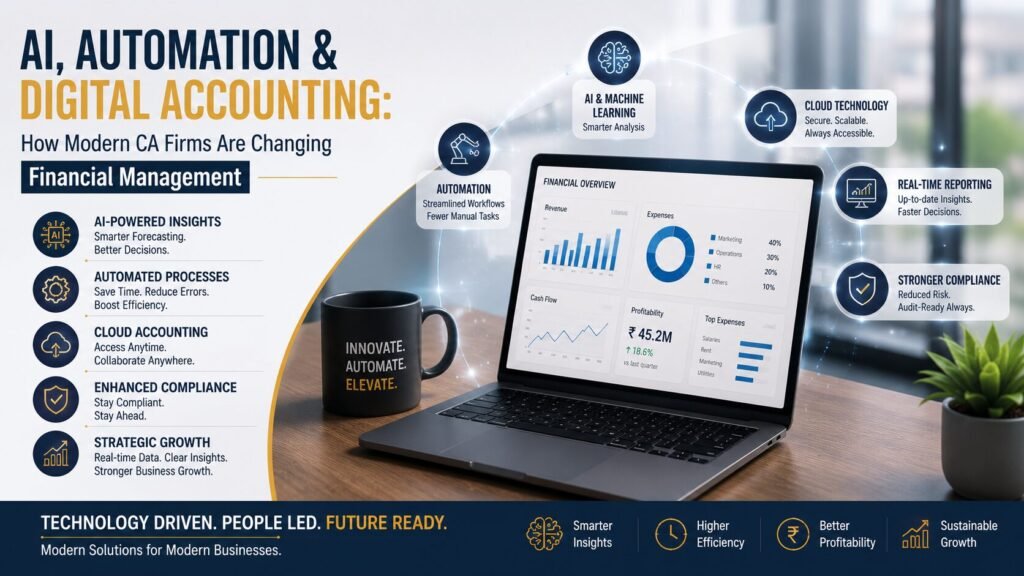
TL;DR AI and digital accounting are transforming how businesses manage finances, compliance, bookkeeping, and reporting. Modern CA firms now use automation, cloud platforms, and AI-driven tools to reduce manual work, improve accuracy, streamline GST compliance, and deliver real-time financial insights. Businesses that adopt digital accounting systems gain better operational control, faster decision-making, and improved compliance readiness. Why Traditional Accounting Is No Longer Enough For years, accounting relied heavily on spreadsheets, manual entries, paper invoices, and delayed reporting cycles. While this approach worked for smaller operations in the past, it struggles to meet the speed and complexity of modern business environments. Today’s businesses generate financial data continuously through: Ecommerce platforms Digital payments UPI transactions GST invoices Payroll systems Banking integrations Inventory software Managing this volume manually increases: Human error Compliance risks Reconciliation delays Tax filing mistakes Audit complications Modern businesses require real-time financial visibility, faster compliance workflows, and smarter forecasting. This shift is why AI and digital accounting are becoming essential. What Is Digital Accounting? Digital accounting refers to the use of cloud-based software, automation tools, and AI technologies to manage financial records electronically instead of manually. It includes: Automated bookkeeping Cloud accounting platforms AI-assisted reconciliation Digital invoicing Automated GST tracking Real-time dashboards Integrated payroll systems Financial analytics Unlike traditional accounting, digital accounting provides live financial data access from anywhere. How AI Is Transforming Financial Management Artificial intelligence is helping CA firms move beyond data entry and compliance support. Modern accounting firms now use AI to improve speed, accuracy, and strategic decision-making. AI can help automate: Invoice processing Expense categorization Bank reconciliation GST matching Fraud detection Tax calculations Financial forecasting Cash flow analysis Instead of spending hours manually checking transactions, accountants can now focus on: Financial planning Risk management Business advisory Tax optimization Growth strategy This evolution is changing the role of CA firms from “compliance providers” to “financial growth partners.” Major Technologies Used by Modern CA Firms 1. Cloud Accounting Cloud accounting platforms allow businesses to access financial records securely from any location. Benefits include: Multi-user access Real-time reporting Automated backups Faster collaboration Improved transparency Popular integrations often include: Banking systems GST platforms Payroll software Ecommerce marketplaces 2. OCR & Automated Data Entry Optical Character Recognition (OCR) technology converts invoices, bills, and receipts into digital accounting entries automatically. This reduces: Manual data entry Typing mistakes Processing delays Businesses handling large invoice volumes benefit significantly from this automation. 3. AI-Based Reconciliation Reconciling bank transactions manually is time-consuming and error-prone. AI tools now: Match transactions automatically Detect duplicate entries Flag suspicious activity Identify missing invoices This improves accounting accuracy and reduces month-end stress. 4. GST Automation GST compliance remains one of the biggest operational challenges for Indian businesses. Automation tools now assist with: GST invoice validation Input tax credit matching Return preparation Reconciliation Filing reminders This minimizes filing errors and improves compliance consistency. 5. Real-Time Reporting Dashboards Modern businesses no longer wait until quarter-end to understand financial performance. Digital dashboards now provide: Cash flow visibility Revenue tracking Expense monitoring Profitability analysis Compliance alerts Real-time reporting improves faster decision-making. Benefits of AI & Automation for Businesses Business Challenge Digital Accounting Benefit Manual errors Improved accuracy Delayed reporting Real-time insights Compliance stress Automated reminders Audit preparation issues Organized documentation Cash flow confusion Better financial visibility Time-consuming bookkeeping Workflow automation Poor decision-making Data-driven reporting Common Financial Problems Automation Solves Missed Compliance Deadlines Automation tools generate alerts for: GST filing TDS returns ROC filings Tax audit due dates Duplicate Data Entry Integrated accounting systems reduce repetitive work across departments. Lack of Financial Clarity AI dashboards help businesses track: Outstanding receivables Vendor liabilities Operational costs Profit margins Audit Difficulties Digitized records simplify audit preparation and reduce missing documentation issues. AI in GST, ROC & Tax Compliance Compliance management has become increasingly data-driven. Modern CA firms now use digital systems to: Track filing schedules Verify GST data accuracy Maintain audit trails Monitor statutory obligations Organize compliance documentation This reduces the likelihood of: Late filings Penalties Notice risks Mismatched returns Businesses operating across multiple states or handling high transaction volumes benefit significantly from automated compliance monitoring. How Modern CA Firms Add Strategic Value Beyond Bookkeeping Traditional accounting focused mainly on: Record maintenance Tax filing Compliance reporting Modern CA firms now contribute to: Financial forecasting Business planning Risk analysis Budgeting strategies Process optimization Growth consulting Technology allows accountants to spend less time on repetitive administrative tasks and more time advising clients strategically. Digital Accounting vs Traditional Accounting Feature Traditional Accounting Digital Accounting Data Entry Manual Automated Reporting Periodic Real-time Accessibility Office-based Cloud access Error Risk Higher Lower Compliance Tracking Manual Automated Scalability Limited High Decision Speed Slower Faster Risks of Ignoring Financial Automation Businesses that avoid digital accounting often face: Inefficient workflows Compliance delays Higher operational risk Inaccurate reporting Poor cash flow visibility Limited scalability As regulatory systems become increasingly digital, businesses relying entirely on manual processes may struggle to keep pace. How Businesses Can Transition to Digital Accounting Step 1: Assess Existing Systems Review: Current accounting workflows Compliance processes Reporting gaps Manual dependencies Step 2: Digitize Financial Records Convert paper-based records into organized digital systems. Step 3: Integrate Financial Platforms Connect: Bank accounts GST systems Payroll software Billing platforms Step 4: Automate Repetitive Tasks Focus automation on: Reconciliation Invoice management Tax reminders Expense tracking Step 5: Work With a Technology-Driven CA Firm Choose a CA firm that combines: Financial expertise Compliance knowledge Automation capability Strategic advisory support Why Mumbai Startups and SMEs Are Adopting Automation Faster Mumbai businesses operate in highly competitive and fast-moving markets. Growing startups and SMEs increasingly prioritize: Faster reporting Operational efficiency Investor readiness Better compliance control Scalable financial systems Digital accounting supports these goals by improving speed, transparency, and financial visibility. Industries adopting automation rapidly include: Ecommerce Logistics SaaS startups Retail Professional services Manufacturing How CA Arihant Lodha Supports Modern Financial Management CA Arihant Lodha focuses on helping businesses streamline financial management through structured accounting systems, compliance support, audit readiness, and technology-driven financial processes. A modern CA firm should not only maintain accounts but