
Best Practices for Maintaining Audit-Ready Books of Accounts Throughout the Year
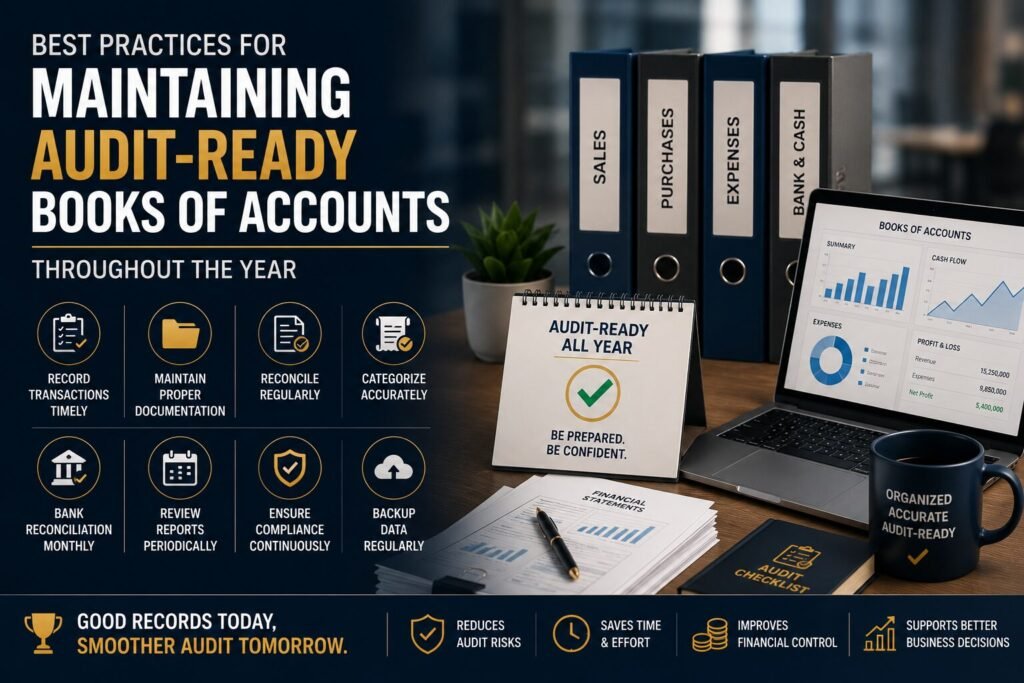
TL;DR Businesses that maintain audit-ready books throughout the year face fewer compliance risks, smoother audits, better GST accuracy, and improved financial decision-making. Key practices include regular bookkeeping, GST reconciliations, document management, internal controls, and periodic financial reviews with experienced chartered accountants. Why Audit-Ready Accounting Matters More Than Ever In today’s regulatory environment, businesses cannot afford weak accounting practices. Income tax scrutiny, GST notices, statutory audits, and investor due diligence have become increasingly data-driven and documentation-focused. For many businesses in Mumbai, audit stress does not come from the audit itself. It comes from: Missing records Incomplete bookkeeping GST mismatches Unreconciled bank entries Improper expense classification Last-minute accounting corrections When books of accounts are maintained properly throughout the year, audits become significantly smoother and less disruptive. Well-maintained accounts also help businesses: Improve cash flow visibility Detect financial leakages early Build investor confidence Reduce compliance penalties Strengthen operational control What Are Audit-Ready Books of Accounts? Audit-ready books of accounts are financial records that are: Accurate Updated regularly Properly categorized Supported by documentation GST-compliant Easily verifiable during audit or scrutiny These records should allow an auditor to verify transactions without delays, confusion, or missing evidence. Audit-ready accounting is not a year-end activity. It is a continuous financial discipline. Essential Financial Records Every Business Must Maintain Businesses should consistently maintain the following: Financial Record Purpose Sales invoices Revenue verification Purchase invoices Expense validation Bank statements Cash flow tracking GST returns Tax compliance Vendor ledgers Liability tracking Customer ledgers Receivable management Payroll records Salary compliance Expense vouchers Audit support Fixed asset register Depreciation tracking TDS records Tax deduction compliance Missing even a few of these documents can delay audits and create unnecessary scrutiny. Common Accounting Mistakes That Create Audit Problems Many businesses unknowingly create audit risks through poor accounting habits. 1. Delayed Bookkeeping Entering transactions months later leads to inaccuracies and missing data. 2. GST Mismatches Differences between GSTR-1, GSTR-3B, and vendor filings often trigger notices. 3. Improper Expense Classification Personal and business expenses mixed together create compliance complications. 4. Missing Supporting Documents Invoices without proper backup documentation weaken audit credibility. 5. No Bank Reconciliation Unmatched bank entries raise red flags during audits. 6. Weak Internal Controls Lack of approval systems increases fraud and accounting errors. Best Practices for Maintaining Audit-Ready Books 1. Record Transactions Daily Daily bookkeeping prevents backlog accumulation and improves accuracy. Businesses should: Record invoices immediately Update expense entries daily Maintain payment references Track receivables and payables consistently Real-time accounting also improves financial visibility for management decisions. 2. Maintain Proper Invoice Management Invoices are among the most important audit documents. Ensure: Sequential invoice numbering Proper GST details Vendor verification Digital copies of invoices Easy retrieval systems A centralized invoice management process reduces audit delays significantly. 3. Perform Monthly Bank Reconciliations Bank reconciliation ensures accounting records match actual banking activity. Monthly reconciliation helps identify: Duplicate entries Missed transactions Unauthorized payments Banking errors Outstanding cheques Businesses that delay reconciliation often face year-end accounting confusion. 4. Reconcile GST Data Regularly GST reconciliation is critical for audit preparedness. Businesses should reconcile: GSTR-1 vs sales register GSTR-3B vs books GSTR-2B vs purchase register Input tax credit claims Frequent GST reconciliation reduces the risk of: ITC reversals GST notices Penalties Vendor mismatch issues 5. Separate Personal and Business Expenses One of the most common audit issues in SMEs is mixing personal expenses with business accounts. Maintain: Separate bank accounts Dedicated business cards Clear expense policies Proper authorization procedures This improves accounting transparency and compliance credibility. 6. Maintain Vendor & Customer Ledgers Clean ledgers help businesses track: Outstanding receivables Vendor dues Advance payments Credit periods Disputed balances Periodic ledger confirmation also improves audit accuracy. 7. Implement Internal Financial Controls Internal controls reduce operational and financial risks. Examples include: Approval workflows Expense authorization limits Dual verification systems Restricted accounting access Inventory controls Strong internal controls strengthen both audit readiness and fraud prevention. 8. Use Cloud Accounting Systems Modern accounting software improves: Data accessibility Financial reporting Backup security Multi-user collaboration Compliance tracking Cloud systems also simplify audit sharing with accountants and auditors. 9. Conduct Quarterly Internal Reviews Quarterly reviews help identify issues before year-end. Internal reviews should evaluate: GST reconciliations TDS compliance Outstanding liabilities Revenue recognition Expense categorization Documentation gaps This proactive approach prevents last-minute panic. 10. Maintain Proper Documentation Backup Businesses should maintain: Digital backups Cloud storage Organized folders Vendor contracts Tax filings Signed agreements Proper documentation protects businesses during audits, litigation, or tax scrutiny. Monthly Audit-Readiness Checklist Task Frequency Update bookkeeping Daily Bank reconciliation Monthly GST reconciliation Monthly Vendor ledger review Monthly Customer outstanding review Monthly Expense verification Monthly Payroll reconciliation Monthly TDS compliance review Quarterly Internal audit review Quarterly Financial statement review Quarterly Role of Professional Chartered Accountants in Audit Preparedness Professional chartered accountants help businesses: Maintain compliant accounting systems Improve financial accuracy Detect accounting weaknesses Reduce audit risks Strengthen internal controls Handle GST and tax reconciliations Prepare for statutory and tax audits For growing businesses in Mumbai, professional accounting support often becomes essential as transaction complexity increases. Suggested internal linking opportunities: “GST compliance services” “Tax audit support” “Business accounting solutions” “Internal audit services” “Startup compliance advisory” How Audit-Ready Accounting Improves Business Growth Businesses often see accounting only as a compliance requirement. In reality, accurate accounting directly supports growth. Audit-ready books improve: Financial forecasting Loan eligibility Investor confidence Cash flow management Budget planning Tax efficiency Decision-making speed When financial records are reliable, business owners can make strategic decisions with confidence. Final Thoughts Maintaining audit-ready books of accounts throughout the year is no longer optional for businesses operating in India’s increasingly regulated environment. Businesses that adopt disciplined accounting practices experience: Smoother audits Better compliance Reduced penalties Stronger operational control Faster business decision-making Instead of treating audits as year-end emergencies, companies should build a year-round accounting system focused on accuracy, transparency, and compliance. Working with experienced professionals like CA Arihant Lodha can help businesses establish reliable accounting processes, strengthen financial controls, and stay consistently audit-ready. FAQ SECTION What are audit-ready books of accounts? Audit-ready books of accounts are organized, accurate,