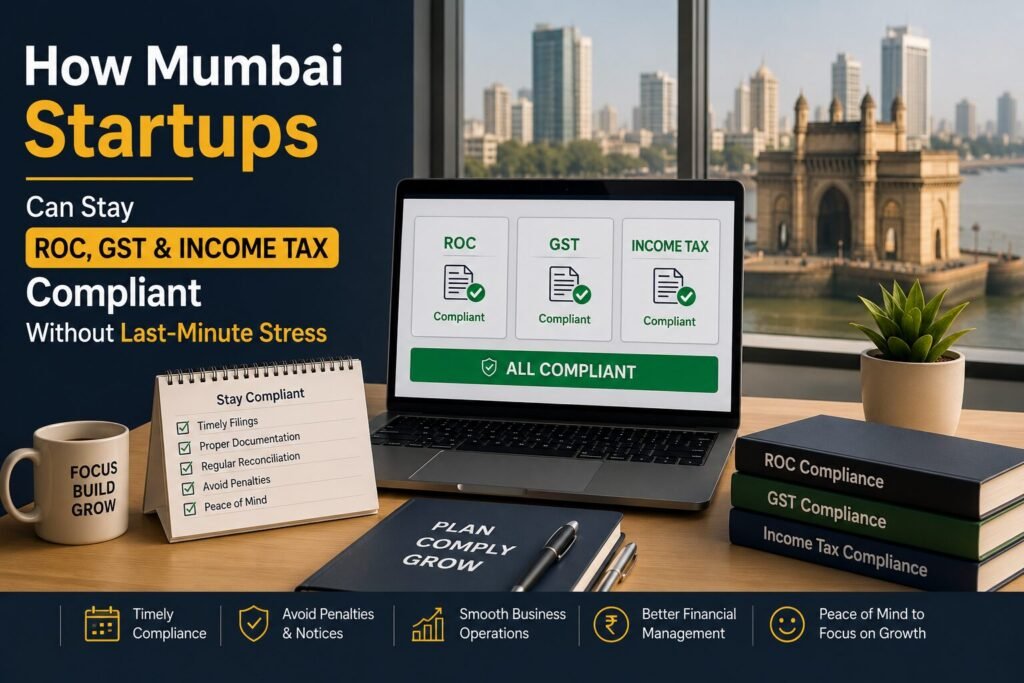
How Mumbai Startups Can Stay ROC, GST & Income Tax Compliant Without Last-Minute Stress
TL;DR Mumbai Startup often struggle with ROC filings, GST returns, bookkeeping gaps, and tax deadlines because compliance is treated as a year-end activity instead of an ongoing business process. To avoid penalties, notices, director disqualification risks, and operational stress in 2026, startups should: Maintain monthly bookkeeping Track ROC and GST deadlines Reconcile GST regularly Maintain clean financial records Conduct periodic compliance reviews Work with experienced chartered accountants A proactive compliance strategy saves time, improves investor confidence, and protects business continuity. Why Startup Compliance Is Becoming More Important in 2026 India’s compliance ecosystem is becoming increasingly data-driven. Government departments now use automated matching systems, AI-assisted scrutiny, PAN-GST integration, TDS analytics, and MCA cross-verification to identify inconsistencies quickly. For startups operating in Mumbai, this means compliance errors are no longer easy to ignore. Even small issues such as: Delayed GST filing Incorrect input tax credit claims ROC filing delays Mismatch between turnover and income tax returns Missing invoices can trigger: Notices Penalties Interest liabilities Funding complications Vendor trust issues In 2026, compliance is not just a legal requirement. It directly impacts: Investor due diligence Banking relationships GST credibility Tender eligibility Business reputation Understanding the Three Major Compliance Areas ROC Compliance ROC (Registrar of Companies) compliance applies primarily to: Private Limited Companies LLPs OPCs It includes: Annual filings Director disclosures Financial statement submission Board meeting documentation MCA updates Failure to comply can result in: Heavy late filing penalties Director disqualification Company status issues GST Compliance GST compliance involves: GST registration Monthly or quarterly returns Invoice management ITC reconciliation E-invoicing (where applicable) GST authorities increasingly track: Invoice mismatches Fake ITC claims Return delays Supplier compliance gaps Income Tax Compliance Income tax compliance includes: Accurate bookkeeping Advance tax payments TDS compliance Income tax return filing Audit requirements Incorrect filings can lead to: Scrutiny notices Penalties Cash flow disruptions Common Compliance Mistakes Mumbai Startup Make 1. Treating Compliance as a Year-End Task Many startups ignore bookkeeping and reconciliations for months and attempt to complete everything near filing deadlines. This creates: Data inconsistencies Missing invoices GST mismatches Filing errors 2. Poor Documentation Practices Startups often fail to maintain: Vendor invoices Expense proofs Board resolutions Employee payroll records Incomplete records create major problems during: GST assessments Income tax scrutiny Investor due diligence 3. Mixing Personal and Business Transactions Founders frequently use: Personal bank accounts Personal credit cards Informal expense reimbursements This complicates: Tax calculations Expense claims Audit trails 4. Ignoring ROC Filings Many startups focus only on GST and income tax while ignoring MCA compliance. Late ROC filings can accumulate substantial penalties over time. 5. Inconsistent GST Reconciliation Failure to reconcile: GSTR-1 GSTR-3B Purchase records Vendor filings can create ITC disputes and notices. ROC Compliance Checklist for Startups Compliance Area Frequency Importance Board Meetings Periodic Governance compliance Annual ROC Filing Annual Mandatory under Companies Act Director KYC Annual Director validation Financial Statement Filing Annual MCA reporting Statutory Registers Ongoing Audit readiness Best Practice Maintain a digital compliance tracker instead of relying on manual reminders. GST Compliance Checklist for Startups Maintain Proper GST Invoicing Ensure invoices contain: GSTIN Invoice number HSN/SAC codes Tax breakup Reconcile GST Monthly Monthly reconciliation helps identify: Vendor filing mismatches Missing ITC Duplicate entries Wrong tax calculations File Returns Consistently Avoid irregular filing patterns even during low-revenue periods. Nil returns are also mandatory where applicable. Monitor Vendor Compliance Your ITC eligibility may be affected if vendors fail to file returns properly. Income Tax Compliance Checklist Maintain Updated Books of Accounts Monthly bookkeeping prevents: Profit calculation errors Tax estimation problems Cash flow confusion Track Advance Tax Obligations Businesses with tax liability beyond prescribed thresholds should monitor advance tax obligations carefully. Maintain Expense Documentation Keep organized records for: Rent Salaries Professional fees Marketing expenses Software subscriptions Conduct Quarterly Financial Reviews Quarterly reviews help startups: Detect compliance risks early Estimate taxes accurately Improve financial planning Compliance Calendar Every Mumbai Startup Should Maintain A structured compliance calendar significantly reduces last-minute pressure. Recommended Tracking Areas GST filing deadlines ROC filing due dates TDS payment schedules Advance tax dates Payroll compliance Audit preparation timelines Using cloud-based accounting systems can automate reminders and improve visibility. How Poor Bookkeeping Creates Compliance Problems Many compliance failures originate from weak bookkeeping systems. Poor accounting creates: Wrong GST returns Inaccurate tax filings Vendor disputes Cash flow confusion Audit complications Common bookkeeping issues: Delayed entries Missing invoices Duplicate transactions Incorrect expense classification Warning Signs Your Startup Is Falling Behind You may already have compliance risks if: GST returns are filed late regularly Bank reconciliation is incomplete Directors are unaware of ROC deadlines Vendor ledgers are inconsistent TDS compliance is irregular Financial statements are delayed Ignoring these indicators increases future scrutiny risk. How Professional CA Support Reduces Compliance Risk An experienced chartered accountant firm helps startups: Build compliance systems Maintain accurate books Reduce filing errors Improve audit preparedness Handle notices professionally Maintain investor-ready records For startups in Mumbai, working with specialists familiar with startup ecosystems and regulatory frameworks provides operational clarity and long-term compliance stability. Best Practices to Stay Compliant Year-Round Automate Accounting Processes Use cloud accounting software integrated with GST systems. Separate Personal and Business Finances Maintain dedicated business banking and expense management. Conduct Monthly Compliance Reviews Monthly reviews are easier and safer than annual panic corrections. Maintain a Compliance Folder Store: GST returns ROC acknowledgements Tax filings Audit reports Financial statements digitally and securely. Work Proactively — Not Reactively Most compliance penalties are preventable with proper planning. Final Thoughts Startups that treat compliance as an operational discipline gain a major advantage in 2026. Strong ROC, GST, and income tax compliance: Improves business credibility Supports fundraising Reduces regulatory risks Improves financial clarity Prevents last-minute stress For growing startups in Mumbai, proactive compliance management is no longer optional. It is a core business requirement. A structured compliance framework supported by experienced chartered accountants can help startups focus on growth while remaining fully aligned with regulatory requirements. FAQ SECTION What compliances are mandatory for startups in India? Startups generally need ROC, GST, income tax, TDS, and bookkeeping compliance