
GST Registration vs GST Compliance: What Mumbai Businesses Often Get Wrong
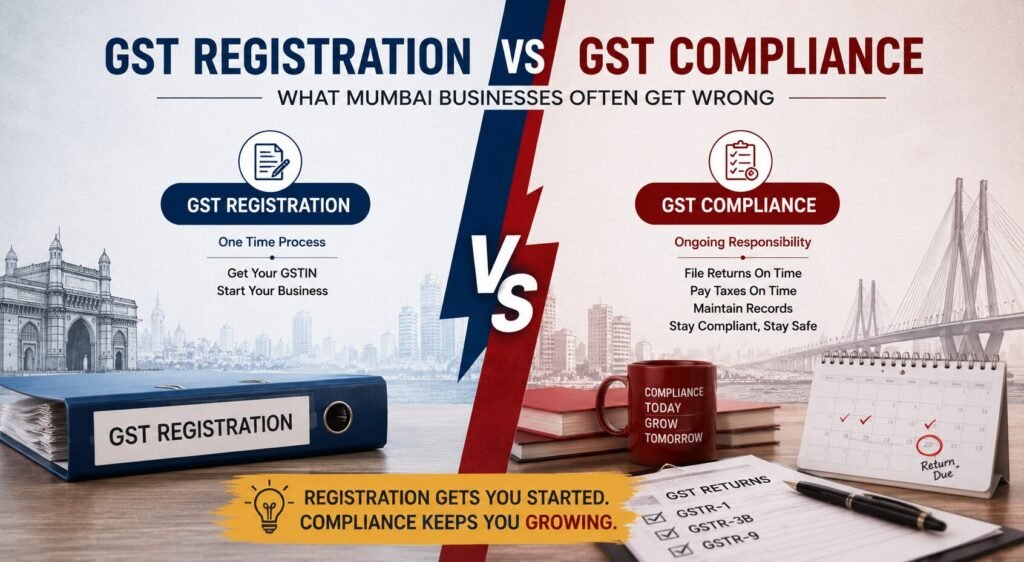
TL;DR gst registration is only the first step—not full compliance Many Mumbai businesses mistakenly believe registration alone is sufficient GST compliance includes filing, reconciliation, invoicing, and reporting Errors can trigger notices, penalties, and audits Professional GST management significantly reduces compliance risks Introduction Many businesses celebrate after receiving their GST number. But that’s where the real work actually begins. One of the biggest misconceptions among startups and SMEs in Mumbai is believing that gst registration equals GST compliance. It doesn’t. In 2026, GST systems are more automated, interconnected, and scrutiny-driven than ever before. Businesses that fail to maintain ongoing compliance face: Penalties Input Tax Credit (ITC) reversals GST notices Departmental scrutiny This guide explains the crucial difference between GST registration and GST compliance—and the mistakes businesses must avoid. Understanding GST Registration GST registration is the process of obtaining a GST Identification Number (GSTIN) from the government. Businesses typically require registration if: Turnover exceeds threshold limits They sell interstate They operate through e-commerce platforms They fall under mandatory GST categories Registration legally enables businesses to: ✔ Collect GST✔ Claim Input Tax Credit✔ Issue GST invoices However: Registration alone does not mean you are compliant. What is GST Compliance? GST compliance refers to the ongoing responsibilities businesses must fulfill after registration. This includes: Filing GST returns Paying GST on time Reconciling invoices Maintaining proper records Following e-invoicing rules Reporting accurate turnover GST compliance is continuous—not one-time. GST Registration vs GST Compliance: Key Differences Factor GST Registration GST Compliance Nature One-time process Ongoing process Purpose Obtain GSTIN Maintain legal compliance Timeline Initial setup Monthly/Quarterly/Annual Includes Filing? No Yes Includes Reconciliation? No Yes Risk if Ignored Cannot legally collect GST Penalties & notices Common GST Mistakes Mumbai Businesses Make 1. Assuming Registration is Enough Many businesses register under GST and then: Skip return filing Ignore reconciliations Delay tax payments This quickly creates compliance issues. 2. Ignoring Monthly & Quarterly Filings Businesses often miss: GSTR-1 GSTR-3B Annual returns Late filing results in: Interest Late fees Compliance risk scores 3. Incorrect ITC Claims Input Tax Credit errors are among the top reasons for GST notices. Common problems include: Claiming ineligible ITC Vendor non-compliance Duplicate claims 4. GST Reconciliation Failures Mismatch between: Books of accounts GST returns E-way bills E-invoices …can trigger automated scrutiny. 5. E-Invoicing Non-Compliance Businesses crossing prescribed turnover thresholds must comply with e-invoicing regulations. Non-compliance can result in: Invalid invoices ITC denial Penalties Penalties & Risks of GST Non-Compliance Compliance Failure Possible Consequence Late filing Interest + penalties Incorrect ITC ITC reversal Under-reporting turnover GST notice E-invoice errors Compliance action Persistent non-compliance GST registration suspension GST Compliance Checklist for 2026 Monthly Tasks File GSTR-1 File GSTR-3B Reconcile ITC claims Quarterly Tasks Review vendor compliance Validate turnover reconciliation Annual Tasks Annual GST return filing Financial audit support Why Businesses Need Professional GST Support GST regulations continue evolving rapidly. Professional GST consultants help businesses: ✔ Reduce notice risks✔ Maintain filing accuracy✔ Optimize Input Tax Credit✔ Ensure audit readiness✔ Improve compliance efficiency This becomes especially important for: Startups SMEs Multi-state businesses E-commerce sellers Why CA Arihant Lodha is a Strong Compliance Partner CA Arihant Lodha offers: GST registration assistance End-to-end GST compliance support GST reconciliation & audit preparation Startup and SME-focused advisory Conclusion GST registration gets your business into the system. GST compliance keeps your business safe inside it. In 2026, the difference between these two concepts is no longer minor—it directly impacts: ✔ Financial stability✔ Tax efficiency✔ Compliance risk✔ Business reputation Businesses that treat GST strategically avoid unnecessary penalties and operational stress. CTA Need help with GST compliance, return filing, or GST notices? Consult CA Arihant Lodha for professional GST advisory and compliance services in Mumbai. FAQ SECTION 1. What is the difference between GST registration and GST compliance? GST registration is obtaining a GSTIN, while GST compliance involves ongoing filing, reconciliation, and reporting obligations. 2. Is GST registration enough for businesses? No. Businesses must continue complying through regular filings and tax payments. 3. What happens if GST returns are not filed? Late filing can lead to penalties, interest, notices, and even suspension of GST registration. 4. Why do businesses receive GST notices? Common reasons include mismatches, incorrect ITC claims, and delayed filings. 5. What is GST reconciliation? It is the process of matching invoices, GST returns, and financial records for accuracy. 6. Can GST non-compliance affect Input Tax Credit? Yes. Incorrect or non-compliant filings can result in ITC reversal or denial. Blog By : CA Arihant Lodha