
Virtual CFO Services in Mumbai: Cost, Benefits & When Your Business Actually Needs One

A Virtual CFO provides strategic financial leadership without full-time cost Ideal for startups and SMEs scaling beyond basic accounting Costs range from ₹15,000 to ₹1,00,000+/month depending on scope Helps with cash flow, fundraising, compliance, and growth strategy Hiring at the right stage prevents financial chaos Introduction Most businesses don’t fail because of bad products—they fail because of poor financial decisions. In Mumbai’s competitive business environment, founders often rely on accountants for compliance—but lack strategic financial direction. That’s where Virtual CFO services come in. In 2026, businesses are increasingly shifting to outsourced CFO models to access high-level financial expertise without hiring a full-time executive. What is a Virtual CFO? 🤔 A Virtual CFO (Chief Financial Officer) is a financial expert who provides: Strategic financial planning Cash flow management Business forecasting Compliance oversight 👉 Unlike accountants, a CFO focuses on future growth, not just past records. What Does a Virtual CFO Actually Do? A Virtual CFO handles: Strategic Functions Financial planning & budgeting Business growth strategy Fundraising support Operational Functions Cash flow monitoring Expense optimization Profitability analysis Compliance & Risk Tax planning Regulatory compliance Financial reporting Key Benefits of Virtual CFO Services 🚀 1. Cost Efficiency No full-time salary burden Pay only for required expertise 2. Strategic Decision-Making Data-driven insights Growth-focused planning 3. Improved Cash Flow Management Predictive cash flow tracking Reduced financial stress 4. Investor & Funding Readiness Financial projections Due diligence preparation 5. Risk Reduction Compliance monitoring Early error detection Cost of Virtual CFO Services in Mumbai 💰 Service Level Monthly Cost Basic Advisory ₹15,000 – ₹30,000 Growth Stage Support ₹30,000 – ₹75,000 Advanced Strategic CFO ₹75,000 – ₹1,50,000+ 💡 Cost depends on: Business size Complexity Frequency of engagement Virtual CFO vs Full-Time CFO Factor Virtual CFO Full-Time CFO Cost Low Very High Flexibility High Low Expertise Access Wide Limited to one person Scalability Easy Difficult 👉 For startups & SMEs, Virtual CFO is the smarter choice. When Does Your Business Need a Virtual CFO? ⚠️ You should consider one if: Revenue crosses ₹50 lakh – ₹5 crore Cash flow issues are frequent You’re planning to raise funds Financial decisions feel unclear Compliance complexity increases Industries That Benefit the Most Startups & SaaS companies E-commerce brands Manufacturing SMEs Professional services firms Common Mistakes Without CFO Support Scaling without financial planning Poor cash flow management Overpaying taxes Lack of profitability insights Financial misreporting How to Choose the Right Virtual CFO in Mumbai Look for: ✅ Industry experience ✅ Strategic thinking ability ✅ Strong compliance knowledge ✅ Tech-driven reporting systems ✅ Transparent pricing Why CA Arihant Lodha is a Strong Choice Deep expertise in startups & SMEs End-to-end financial advisory Strong compliance + strategy integration Mumbai-focused business understanding Conclusion Financial clarity is no longer optional—it’s a competitive advantage. A Virtual CFO doesn’t just manage numbers—they shape business outcomes. In 2026, businesses that invest in financial strategy: ✔ Scale faster✔ Avoid costly mistakes✔ Attract investors CTA 🚀 Ready to scale your business with clarity?Consult CA Arihant Lodha for expert Virtual CFO services in Mumbai. FAQ SECTION 1. What does a virtual CFO do? Provides financial strategy, planning, and business insights. 2. How much does a virtual CFO cost in India? Typically ₹15,000 to ₹1,50,000+ per month. 3. When should a startup hire a CFO? When financial complexity increases or funding is planned. 4. Is a virtual CFO worth it? Yes, especially for growing businesses needing strategic insights. 5. What is the difference between CFO and accountant? Accountants manage records; CFOs manage strategy. Blog by : CA Arihant Lodha
Income Tax Filing Mistakes Business Owners in Mumbai Must Avoid This Financial Year
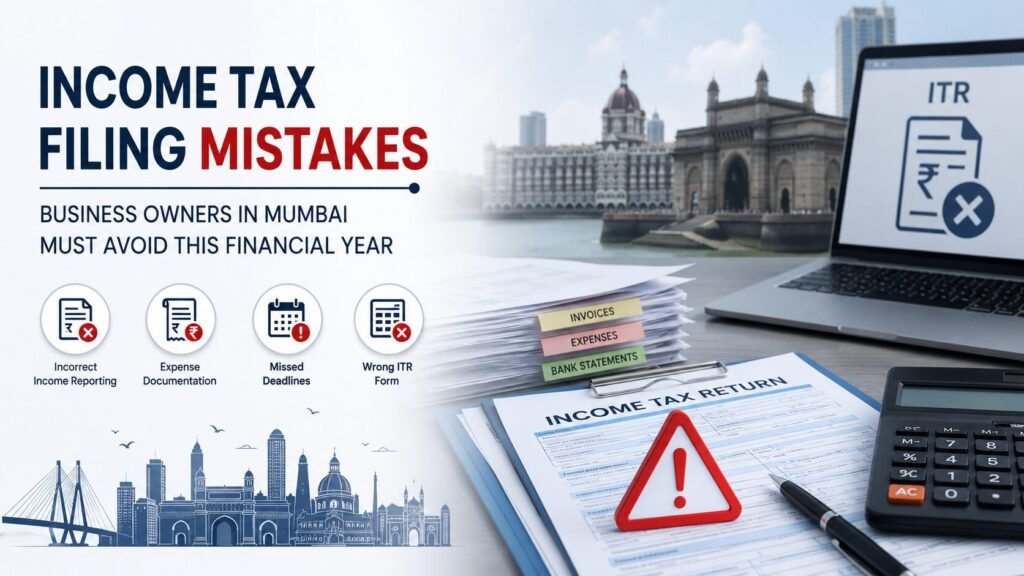
Tax filing errors can trigger penalties, notices, and audits Common mistakes include wrong income reporting and missed deductions Advance tax and GST mismatches are major red flags in 2026 A structured filing approach eliminates most risks CA guidance significantly improves accuracy and savings Introduction Income tax filing for business owners is no longer a routine compliance task—it’s a high-risk activity if done incorrectly. In 2026, the Income Tax Department uses AI-driven scrutiny systems, cross-verifying GST data, bank transactions, and reported income. Even small errors can trigger: Notices Penalties Scrutiny assessments This guide highlights the most critical income tax filing mistakes business owners in Mumbai must avoid—and how to fix them proactively. Why Tax Filing Errors Are Increasing in 2026 📊 Several structural changes have increased error detection: Automated reconciliation with GST returns Integration with banking and financial systems Real-time data validation Increased audit focus on SMEs 👉 Result: Mistakes that were previously ignored are now flagged instantly. Top Income Tax Filing Mistakes 1. Incorrect Income Reporting 🚨 Many businesses: Underreport revenue Exclude cash transactions Misclassify income 💡 This is the fastest way to trigger a tax notice. 2. Missing Eligible Deductions Common missed deductions: Business expenses Depreciation Rent & utility costs 👉 Missing deductions = higher tax liability unnecessarily 3. Choosing the Wrong ITR Form Using the incorrect ITR form leads to: Rejection of return Compliance complications 4. Ignoring Advance Tax Payments ⏱️ Businesses must pay advance tax in installments. Failure results in: Interest penalties under Sections 234B & 234C 5. Poor Record Keeping 📂 Missing invoices Unorganized expenses No audit trail 👉 Leads to compliance issues and weak defense during scrutiny. 6. GST & Income Tax Mismatch Mismatch between: GST turnover Income tax declared revenue This is a major red flag in 2026. Financial Impact of These Mistakes 💸 Mistake Possible Consequence Underreporting income Heavy penalties + scrutiny Late filing Interest + fines Incorrect deductions Higher tax liability GST mismatch Audit trigger Step-by-Step Checklist for Error-Free Filing ✅ Reconcile financial statements Match GST returns with income Verify deductions Select correct ITR form Pay advance tax on time Maintain proper documentation How to Correct Mistakes After Filing Made an error? Act fast: File a revised return before deadline Rectify errors via income tax portal Consult CA for major discrepancies How to Avoid Tax Notices in 2026 🚫 Maintain clean financial records Ensure GST & ITR consistency Avoid aggressive tax claims File returns on time Conduct periodic audits Why Hiring a CA is a Smart Move A professional CA: Identifies errors before submission Maximizes deductions legally Ensures compliance accuracy Represents you in case of notices Conclusion Tax filing mistakes are no longer minor errors—they are compliance risks with financial consequences. In a system driven by automation and data intelligence, accuracy is non-negotiable. The solution is simple: ✔ Stay organized✔ Follow structured processes✔ Work with experts CTA 🚀 Avoid costly tax mistakes this year.Consult CA Arihant Lodha for accurate, compliant, and optimized income tax filing in Mumbai. FAQ SECTION 1. What are common income tax filing mistakes? Incorrect income reporting, missed deductions, and wrong ITR forms are the most common. 2. Can tax filing mistakes lead to penalties? Yes. Errors can result in interest, fines, and scrutiny notices. 3. How to correct ITR mistakes? File a revised return before the deadline. 4. What is GST mismatch in tax filing? When GST turnover differs from income tax data. 5. How to avoid tax notices? Maintain accurate records, file on time, and ensure compliance. BLOG BY : CA Arihant Lodha
CA Firm in Mumbai for Startups: Complete Guide to Company Registration, GST & Compliance (2026)

Startups need CA support from day one to avoid costly mistakes Choose the right business structure (Pvt Ltd, LLP, OPC) GST registration is critical for most startups Compliance in 2026 is stricter due to automation A specialized CA firm ensures legal safety + growth readiness Introduction Starting a business in Mumbai is exciting—but compliance complexity can derail even the most promising startups. From company registration to GST filings and ongoing compliance, founders often underestimate the legal and financial groundwork required. The reality in 2026:👉 Compliance is no longer optional—it’s algorithmically enforced. This guide breaks down everything you need to know about working with a CA firm in Mumbai for startups, ensuring your business starts strong and scales safely. Why Startups Need a CA Firm Early 🚀 Many founders delay hiring a CA to “save cost.” That usually backfires. A startup-focused CA helps you: Choose the right legal structure Avoid tax inefficiencies Ensure compliance from day one Prepare for funding & due diligence 💡 Early mistakes in structure or GST can cost lakhs later. Types of Company Registration in India Choosing the correct structure is critical. Type Best For Key Benefit Private Limited Fundraising startups Scalability LLP Small businesses Lower compliance OPC Solo founders Full control 👉 For most startups aiming to scale, Private Limited Company is preferred. Step-by-Step Company Registration Process 🧾 Name Approval (RUN/DIR) Digital Signature Certificate (DSC) Director Identification Number (DIN) MOA & AOA Drafting Incorporation Filing (MCA) PAN & TAN Allotment ⏱️ Timeline: 7–12 working days (if documents are correct) GST Registration for Startups Is GST Mandatory? Yes, if: Turnover exceeds ₹40 lakh (₹20 lakh for services) You sell interstate You operate e-commerce GST Registration Process Apply on GST portal Submit business documents Verification & ARN generation Startup Compliance Requirements in 2026 📊 Compliance is stricter than ever. Key Requirements: GST returns (monthly/quarterly) TDS filings ROC compliance Income tax returns Accounting & bookkeeping Common Mistakes Startups Make ⚠️ Choosing wrong business structure Delaying GST registration Mixing personal & business finances Ignoring compliance deadlines DIY accounting without expertise How to Choose the Right CA Firm in Mumbai Look for: ✅ Startup Expertise ✅ End-to-End Services ✅ Transparent Pricing ✅ Technology-driven processes ✅ Advisory beyond compliance Cost Breakdown for Startup Services 💰 Service Estimated Cost Company Registration ₹8,000 – ₹25,000 GST Registration ₹2,000 – ₹5,000 Monthly Compliance ₹3,000 – ₹15,000 Why CA Arihant Lodha is Ideal for Startups Specialized in startup advisory End-to-end services (registration → compliance → tax planning) Mumbai-focused expertise Practical, business-first approach Conclusion Launching a startup is challenging—but compliance doesn’t have to be. The right CA firm acts not just as a service provider—but as a strategic partner. In 2026, startups that prioritize compliance early: ✔ Avoid penalties✔ Build investor trust✔ Scale faster CTA 🚀 Looking for a reliable CA firm in Mumbai for your startup?Connect with CA Arihant Lodha for expert guidance on registration, GST, and compliance. FAQ SECTION 1. Which CA firm is best for startups in Mumbai? A startup-focused CA firm offering end-to-end services is ideal. 2. Is GST required for startups? Yes, if turnover or business model meets GST criteria. 3. What is the cost of company registration? Typically between ₹8,000–₹25,000 depending on structure. 4. What compliances are required after registration? GST filing, ROC filing, tax returns, and accounting. 5. Can I register a company without a CA? Technically yes, but not recommended due to complexity. Blog by : CA Arihant Lodha