
US consumer confidence edges up despite $4 gas prices; inflation worries rise amid Iran war

US consumer confidence rose marginally in March even as fuel prices surged due to the Iran war, highlighting resilience in spending but growing concerns around inflation and economic outlook, according to AP.The Conference Board said its consumer confidence index increased to 91.8 in March from 91 in February, indicating a modest improvement despite rising cost pressures.While the headline number remained stable, underlying indicators pointed to rising anxiety among consumers. The survey noted increasing pessimism, particularly around inflation expectations, as oil and gas prices climbed sharply amid the Middle East conflict.Mentions of oil, gas and the war rose significantly in respondents’ feedback, while 12-month inflation expectations jumped to levels last seen in August 2025, when concerns over tariffs had peaked.US gasoline prices crossed $4 per gallon for the first time since 2022, with the national average reaching $4.02, according to AAA. Prices have risen by over $1 since the conflict began.“This is the key concern as the war in Iran enters the second month – will the oil price shock turn into a demand destruction shock?” said Heather Long, chief economist at Navy Federal Credit Union.She noted that consumer spending remained steady in March, based on credit card data, but warned that pressures could intensify in the coming months “as the worst of the inflation shock hits consumers.”A key gauge of short-term expectations for income, business conditions and employment declined by 1.7 points to 70.9 — the 14th straight month below 80, a level often associated with recession risks.In contrast, the index measuring current economic conditions rose 4.6 points to 123.3.Inflation remains elevated. Government data showed a key inflation gauge rose 2.8% in January, even before the recent surge in energy prices. Core inflation, excluding food and energy, increased to 3.1%, the highest in nearly two years.Elevated prices and the likelihood of further inflation due to the Iran war have reduced expectations of near-term rate cuts by the Federal Reserve.The Fed had cut rates three times in 2025 to support the labour market but has paused further action in recent meetings amid persistent inflation above its 2% target.Labour market signals remain mixed. While views on current employment conditions improved slightly, expectations for the next six months weakened.Data from the Labour Department showed US employers cut 92,000 jobs in February, contrary to expectations of job gains, while the unemployment rate rose to 4.4%.Another report showed job openings declined to 6.9 million in February from 7.2 million in January.Economists describe the current labour market as “low hire, low fire”, with businesses cautious on hiring amid uncertainty over tariffs and high interest rates.Economic growth also slowed to 1.4% in the final quarter of last year, weighed down by a government shutdown and softer consumer spending.Survey data showed demand trends remain uneven. Plans to purchase cars increased in March, particularly for used vehicles, while homebuying expectations declined amid a prolonged housing slowdown.Expectations for stock market gains over the next year also dropped sharply, reflecting growing uncertainty among consumers.
Jerome Powell says Fed has limited scope to counter energy price rise; flags inflation risks

Federal Reserve Chair Jerome Powell on Monday said the central bank is closely monitoring inflation risks arising from the spike in energy prices due to the Iran war, but cautioned that there is limited scope for policy intervention in such supply-driven shocks.Speaking at Harvard University before nearly 400 students, Powell said energy shocks typically tend to be short-lived and monetary policy works with a lag.He said policymakers must remain alert to shifts in inflation expectations. “You have to carefully monitor inflation expectations because you could have a series of big supply shocks and that can lead, you know, the public generally, businesses, price setters, households … to start expecting higher inflation over time. Why wouldn’t it?” Powell said, AP quoted.His remarks come as US gasoline prices approach $4 per gallon, reflecting rising global oil prices triggered by the ongoing conflict in the Middle East.Powell noted that while inflation expectations remain contained for now, repeated shocks could pose a broader challenge to price stability.In his interaction, he also highlighted concerns around the labour market, particularly for young job seekers. While unemployment remains low, hiring activity has been subdued, creating what economists describe as a “low-hire, low-fire” environment.Employers added fewer than 10,000 jobs per month in 2025 — the weakest pace outside a recession since 2002. After a relatively strong start this year with 126,000 jobs added in January, the economy saw 92,000 job losses the following month.Powell said technological changes, including the rise of artificial intelligence, may also be influencing hiring decisions, particularly at entry-level roles.Despite near-term challenges, he expressed optimism about long-term economic prospects, noting that innovation has historically boosted productivity and living standards.“You’re in a situation where you need to really invest the time to master the use of these new technologies,” Powell said. “There’s no denying it’s a challenging time to enter the labor market, It may take some patience and all that, but in the longer term, this economy is going to give you great opportunities. Just be a little optimistic.”Powell also underscored the importance of maintaining the Federal Reserve’s independence amid political pressures.“It’s very hard to build great democratic institutions and much easier to bring them down,” he said.The Fed chair’s comments come amid continued criticism from President Donald Trump, who has urged the central bank to cut interest rates. However, Powell reiterated that the Fed must remain focused on its mandate of price stability and maximum employment.“We have very powerful tools. They’re supposed to be for maximum employment and price stability and financial stability,” he said. “There’s always a time when an administration looks and say it would be good to use that tool for something else … We just have to be in a situation where we’re not trying to work against any politician or any administration, but we have to be careful to stick to what we’re doing.”
US-Iran war bleeds Sensex! Rs 51 lakh crore gone, record $12 billion FII wipeout, stock market down over 11% – is there an end in sight to selloff?

In a span of just a month, BSE Sensex is down over 9,300 points or 11.48%! (AI image) Blood bath on Dalal Street, foreign investors’ exodus, mass selloff, several lakh crore of investors’ wealth wiped out – these are the headlines that have dominated financial news this month. The US-Israel-Iran war has dealt a massive blow to the Indian stock market indices BSE Sensex and Nifty50 which were already struggling for the last few months after Donald Trump announced tariffs.With global crude oil prices rising to levels not seen in several years, the inflationary impact globally and its resultant blow to GDP growth has kept investors on tenterhooks forcing them to flee riskier assets like equities.The selloff by foreign institutional investors (FIIs) has been particularly pronounced. Rupee has seen its worst financial year in over 14 years, breaching the 95 per dollar mark in trade on the last trading day (March 30) of the fiscal year.At the start of the new financial year 2026-27, what’s the outlook for BSE Sensex and Nifty50? When will foreign investors become net investors? Sensex & Nifty Round-Up – Facts & Figures: A Telling Picture From the start of the Middle East conflict on February 28 (Saturday), investors have lost Rs 51.7 lakh crore so far! The market capitalisation of BSE-listed companies has come down to Rs 4,12,41,172.45 crore (March 30 closing) from Rs 46,325,200.41 crore (February 27 closing). The current market cap stands at $4.3 trillion. In a span of just a month, BSE Sensex is down over 9,300 points or 11.48%! Sensex is actually down almost 16.5% from its all-time high level of 86,159.02. It’s been a bad month for foreign investors’ exodus, with over Rs 1 lakh crore (around $12 billion) withdrawn from domestic equity markets in March. This is the worst monthly outlook in Indian stocks. In the financial year 2025-26, Sensex dropped 7%, ending on a bearish note with no clear horizon on when an uptrend will begin. Nifty50 has dropped 5% in the same fiscal year. In fact, the market cap of BSE-listed firms has not budged in the last year. According to a TOI analysis, BSE’s market capitalization at Rs 412 lakh crore is exactly the same as it was on March 31, 2025! Not only that, the March 2026 closing is even below the closing for March 2024! On March 28, 2024, Sensex closed at 73,651.35. At present, Sensex is at 71,947.55, down 1,700 points from two years ago! In FY26, foreign funds took money out of Indian stocks at a record pace. The total net outflow stands at Rs 1.8 lakh crore, which is the biggest annual outflow. Domestic players continue to cushion the stock market fall. In FY26, domestic institutional investors bought stocks of around Rs 8.3 lakh crore. Analysts are of the view that the risk aversion seen in stock markets in March is one of the worst since the Covid pandemic back in 2020. Why are foreign institutional investors rushing out of India? Experts say the factors driving the current selloff is a mix of factors: attractive valuations in developed markets, rupee depreciation, recent US-Iran war which has driven up global crude oil prices.Pabitro Mukherjee, Associate Vice President – Technical Research Bajaj Broking blames external factors for this month’s exodus.“The current wave of FPI outflows has been primarily driven by escalating geopolitical tensions in West Asia, which have triggered a global “risk-off” sentiment. This has been further compounded by macroeconomic pressures, including a weakening Indian Rupee breaching ₹95/USD, and a sharp rise in crude oil prices, which has heightened inflation concerns and widened the current account deficit,” he told TOI. “These factors appear largely external and cyclical in nature, linked to global uncertainty and risk aversion rather than domestic structural weaknesses,” he believes.Tanvi Kanchan, Associate Director at Anand Rathi Share and Stock Brokers Limited explains that with Brent crude prices above $100, a classic risk-off move has been fuelled. This has been compounded by the rupee hovering near ₹92-95 against the dollar, elevated US bond yields, and a mixed Q4 earnings outlook.Rising US bond yields and tightening global liquidity have improved the relative attractiveness of developed market fixed income, prompting reallocation away from emerging markets including India, she tells TOI.She is also of the view that most of these drivers are cyclical, not structural – the West Asia conflict, crude spike, and dollar strength are external shocks. “India’s domestic fundamentals, 7%+ GDP growth, fiscal consolidation, and a robust DII ecosystem, remain intact. The one structurally evolving factor is FPI reassessment of IT earnings amid AI disruption, which will take 12-18 months to play out,” she opines.What’s spooking investors is the possible economic fallout of the persistent Middle East crisis.“Approximately 70-80% of the selling is externally driven on the backs of weakness in global equity markets following the West Asia war, steady rupee depreciation, fears of declining Gulf remittances, and the impact of high crude on India’s growth and corporate earnings are all contributing to sustained FPI selling. FPIs were also sellers in other emerging markets like Taiwan and South Korea, confirming this is a global risk-off move, not an India-specific rejection,” says Tanvi Kanchan. Also, domestically, Indian valuations continue to remain relatively elevated compared to several emerging market peers, which may still be prompting selective profit-booking and reallocation, but this is a secondary factor, not the primary driver, she adds.One pointer of structural strength is the continued faith that domestic investors are showing. “While domestic institutional investors have shown strong participation, with record buying of ₹1.28 lakh crore, their support has only partially offset the scale of FPI selling, indicating that global developments are the dominant influence in the current phase,” says Pabitro Mukherjee.For Tanvi Kanchan, the silver lining is DIIs, whose monthly SIP inflows of Rs 30,000 crore and deployable mutual fund cash of around $6 billion provide a strong floor, preventing a disorderly market collapse. What’s The Road Ahead? Experts are of the view that the FII selling may continue
Iran oil returns: India set to receive first cargo in 5 years, tanker heads to Gujarat

India is set to receive its first shipment of Iranian crude oil since 2019, with a tanker carrying 600,000 barrels of oil en route to Gujarat following a temporary sanctions waiver by the US, according to PTI.Ship-tracking data indicates that the vessel Ping Shun is headed towards Vadinar port, marking a potential revival of Indo-Iran oil trade after nearly five years.“The Indo-Iranian oil trade has flickered back to life. Following the US administration’s decision to grant a 30-day window for Iranian oil “on the water” due to regional conflict, the vessel Ping Shun is now en route to Vadinar (in Gujarat) with 600,000 barrels of crude. This is the first such delivery since May 2019 and comes at a critical time for Indian refiners facing tightening inventories,” said Sumit Ritolia, Lead Research Analyst, Refining and Modelling at Kpler.The development follows Washington’s decision earlier this month to allow a 30-day window for the purchase of Iranian oil already at sea, aimed at easing global oil prices amid the ongoing US-Israel conflict with Iran. The window is set to expire on April 19.While the buyer of the cargo remains unidentified, Vadinar houses a 20 million tonnes per annum refinery operated by Rosneft-backed Nayara Energy and also serves as a landing point for crude supplies to inland refineries such as BPCL’s Bina unit.India’s oil ministry has so far maintained that any decision to resume imports from Iran will depend on techno-commercial viability.Before sanctions were tightened in 2018, India was among the largest buyers of Iranian crude, importing both Iran Light and Iran Heavy grades due to refinery compatibility and favourable pricing terms.Imports ceased in May 2019 after US sanctions were reimposed, with India shifting to alternative suppliers including the Middle East and the US. At its peak, Iranian crude accounted for 11.5 per cent of India’s total imports.India had imported about 518,000 barrels per day (bpd) of Iranian oil in 2018, which declined to 268,000 bpd between January and May 2019 during a sanctions waiver period before dropping to zero thereafter.“The Aframax Ping Shun (IMO 9231901) loaded with Iranian crude oil from Kharg Island in early March has emerged as the first vessel observed signalling a destination of Vadinar, India since May 2019, following sanction reimposition on Iranian oil by the first Trump administration,” Ritolia said.The tanker is estimated to have loaded around 600,000 barrels from Kharg Island around March 4 and is expected to reach Vadinar on April 4.An estimated 95 million barrels of Iranian oil are currently stored on vessels at sea, of which around 51 million barrels could be supplied to India, while the rest may be directed to China and Southeast Asian markets.However, payment mechanisms remain uncertain as Iran continues to be excluded from the SWIFT global banking system, complicating international transactions.Earlier, payments were routed in euros through Turkish banks, but that channel is no longer available following renewed sanctions restrictions.Iran was first disconnected from SWIFT in 2012 due to EU sanctions over its nuclear programme, with further disruptions in 2018 after the US reimposed sanctions, limiting its ability to receive payments and access foreign currency reserves.
US stock markets today (March 31, 2026): Wall Street rallies on de-escalation hopes; S&P 500 jumps over 1.6%, tech stocks lead gains
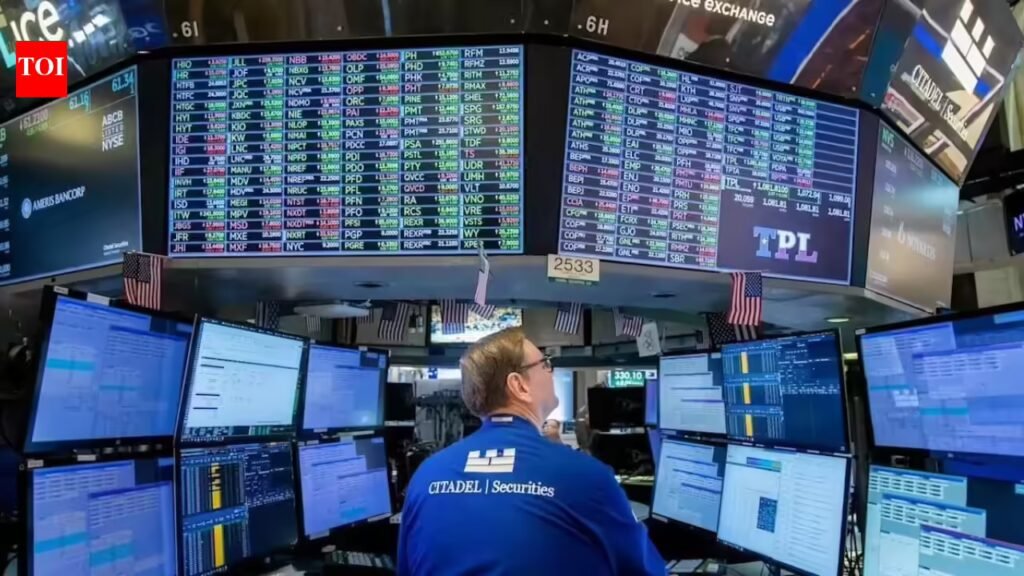
US stock markets moved sharply higher on Tuesday as investors cheered signs of possible de-escalation in the Middle East conflict, even as major indexes remain on track for their steepest monthly declines in years.At 10:05 a.m. ET, the Dow Jones Industrial Average surged 627.92 points, or 1.39%, to 45,844.06. The S&P 500 gained 103.78 points, or 1.64%, to 6,447.50, while the Nasdaq Composite advanced 432.71 points, or 2.08%, to 21,227.35, reported Reuters.Market sentiment improved after a Wall Street Journal report said US President Donald Trump had indicated willingness to end the military campaign against Iran, even if the Strait of Hormuz remains largely closed.The development eased investor concerns after weeks of volatility triggered by the conflict, which has pushed the S&P 500 and the Dow toward their largest monthly losses since September 2022. The benchmark index is also on track for its weakest quarterly performance since 2022.Oil prices remained volatile but are set for a record monthly gain. The S&P 500 energy index has risen more than 11% in March, making it the only sector expected to end the month in positive territory and marking its strongest quarterly performance on record.“The move in markets is reflecting what traders want to see, what they hear. They would like to hear that resolution to this is quick,” said Mark Malek, CIO at Siebert Financial, Reuters quoted.He cautioned that elevated oil prices, driven by continued disruption in the Strait of Hormuz, could “cause damage” to the broader economy.Technology stocks led Tuesday’s gains, with the S&P 500 technology index rising 2% after a weak quarter marked by concerns over heavy capital expenditure and AI-led disruption in software services.CoreWeave climbed 8.4% after securing an $8.5 billion loan to expand AI infrastructure, while Marvell Technology rose 6.8% following a $2 billion investment from Nvidia.Communication services stocks also advanced, with Meta Platforms gaining 3.9% and Alphabet rising 2.5%, lifting the sector index by 2.2%.Overall, nine of the 11 major sectors in the S&P 500 traded in positive territory.Last week, both the Dow and Nasdaq confirmed correction territory after falling more than 10% from their record highs, while the small-cap Russell 2000 had entered correction earlier in the month.On the macro front, the Job Openings and Labor Turnover Survey (JOLTS) showed vacancies declined to 6.882 million in February, slightly below expectations of 6.918 million, while consumer confidence came in above estimates.Investors are also watching comments from Federal Reserve officials, including Austan Goolsbee and Michelle Bowman, for signals on the policy outlook.The surge in oil prices has revived inflation concerns, prompting markets to scale back expectations of rate cuts this year, according to CME Group’s FedWatch Tool.Among other stocks, McCormick fell 6% after Unilever agreed to spin off its food business and merge it with the company in a deal valuing the spice maker at about $44.8 billion. Constellation Energy dropped 7.1% after issuing a weaker-than-expected profit forecast for 2026.Market breadth remained strong, with advancing stocks outnumbering decliners by a 5.23-to-1 ratio on the NYSE and 4.21-to-1 on the Nasdaq. The S&P 500 recorded three new 52-week highs and three lows, while the Nasdaq saw 19 new highs and 85 new lows.
US gas prices cross $4/gallon for first time since 2022; Iran war drives global spike

US gasoline prices have crossed $4 per gallon for the first time since 2022, as the ongoing Iran war continues to disrupt global oil supplies and push up fuel costs.According to the American Automobile Association (AAA), the national average price for regular gasoline stood at $4.02 per gallon on Tuesday — more than $1 higher than levels seen before the conflict began on February 28.The last time US consumers faced such prices was nearly four years ago, in the aftermath of Russia’s invasion of Ukraine. Watch ‘Global Oil Crisis May Push India Closer To Iran’: US Expert Robert Pape Hints Big Diplomatic Shift Fuel prices vary across states depending on supply dynamics and local taxes, with some regions already witnessing higher-than-average rates.The surge has been driven by sharp increases in crude oil prices–the primary input for gasoline– amid supply chain disruptions and production cuts across the Middle East following the escalation of hostilities involving the US, Israel and Iran.The price shock is global in nature. In Paris, for instance, gasoline is priced at 2.34 euros per litre ($2.68), translating to about $10.27 per gallon.Rising fuel costs add to inflation pressuresHigher fuel prices are adding to cost-of-living pressures for households and raising operating costs for businesses.As spending on essentials such as fuel increases, consumers may be forced to cut back on discretionary purchases. Analysts warn that the ripple effects could extend to groceries and everyday goods as transportation costs rise.Logistics and delivery services are already feeling the impact. The United Postal Service is seeking a temporary 8 per cent surcharge on services including Priority Mail.Diesel prices — critical for freight movement– have also surged, with the national average reaching $5.45 per gallon, up from about $3.76 before the war, according to AAA.If the conflict persists, prices could climb further as disruptions continue in the Strait of Hormuz, through which roughly one-fifth of global oil supply typically passes.With tanker movements constrained and energy infrastructure targeted in the conflict, supply concerns have intensified.Policy steps to ease pressureIn response, the International Energy Agency has pledged to release 400 million barrels of oil from emergency reserves of member nations, including the US.The Trump administration has also eased sanctions to allow additional oil supply from Venezuela and temporarily from Russia. It has further waived maritime shipping requirements under the Jones Act for 60 days to improve logistics.However, it remains uncertain how quickly these measures will translate into relief at the pump, as refineries typically process crude purchased earlier at higher prices.Seasonal factors are also contributing to the rise. Increased travel demand and the shift to costlier summer-blend fuel are adding upward pressure on prices.Global market dynamics keep US exposedDespite being a net oil exporter, the US remains sensitive to global price movements.Oil is traded globally, and while the US produces largely light, sweet crude, many refineries are configured to process heavier, sour crude, necessitating imports.Geopolitical shocks have historically driven sharp increases in fuel prices. In June 2022, US gasoline prices had surged above $5 per gallon following the Ukraine war.While prices later moderated, they had remained below $4 per gallon since mid-August 2022 until the latest spike, according to AAA data.
Dubai rolls out AED 1 billion incentives; fee deferrals, policy support to cushion war-led disruptions

Dubai has announced a package of economic measures, including incentives worth AED 1 billion, to support businesses and individuals over the next three to six months amid global supply disruptions linked to the ongoing West Asia conflict.The initiatives, approved by the Executive Council of Dubai in a meeting chaired by Crown Prince Sheikh Hamdan bin Mohammed bin Rashid Al Maktoum, will come into effect from April 1, PTI reported.The measures aim to ease financial pressures across sectors, promote trade and investment, and strengthen workforce support systems as economies grapple with disruptions caused by the war involving the US, Israel and Iran.As part of the package, the government will defer payment of certain fees for three months. Hotels will also be allowed to postpone payment of 100 per cent of sales-related fees and Tourism Dirham for the same period to improve liquidity in the hospitality and tourism sectors.A total of AED 1 billion in economic incentives will be implemented over three to six months starting April 1, 2026.In addition, Dubai will streamline the issuance and renewal of residency permits, making it easier for skilled professionals to live and work in the emirate.“Dubai has earned a reputation for credibility, transparency, and trust among businesses and investors worldwide, and stands ready to meet any challenge through the determination of its people and the strength of its inclusive society,” Sheikh Hamdan said.He added that the Executive Council approved five key initiatives, including the AED 1 billion incentive package, updated GDP measurement methodology, the Virtual Warehouses Initiative, the Dubai Empowerment Strategy, and a new Health and Safety Strategy for Workers’ Accommodation.The health and safety initiative aims to improve living and working conditions, targeting 100 per cent access to essential services and full compliance with safety regulations in workers’ accommodations by 2033. It aligns with the Dubai 2040 Urban Master Plan and International Labour Organization standards.The council also reviewed Dubai’s economic performance, noting a 6.4 per cent growth in the fourth quarter of 2025 and an overall GDP expansion of 5.4 per cent for the year, with the economy reaching AED 937 billion.An updated methodology for measuring GDP has also been approved, expanding survey coverage and improving data accuracy to better reflect economic activity.Meanwhile, the Virtual Warehouses Initiative is expected to facilitate smoother movement of goods through temporary import mechanisms. The scheme allows duty-free import of artworks under specific conditions, removes geographical restrictions, simplifies extensions, and introduces digital tracking.The move is aimed at strengthening Dubai’s position as a global hub for trade, investment and high-value sectors, while providing immediate relief to businesses navigating current economic challenges.
Vedanta tells Supreme Court its revised Jaypee bid tops Adani offer
Mining billionaire Anil Agarwal’s Vedanta Ltd has told the Supreme Court that its tweaked bid for the bankrupt Jaiprakash Associates Ltd was rejected despite being better than Adani Group’s offer.In its petition challenging the lenders’ decision to accept Adani’s takeover offer, Vedanta contended that its addendum bid is about Rs 3,400 crore higher in gross value terms and roughly Rs 500 crore more in net present value compared to the Adani Group’s offer.In the bid challenge process and final resolution plan submitted on October 14, 2025, Vedanta offered Rs 3,770 in upfront payment and Rs 3,100 crore at the end of the 365th day from the effective date to secured financial creditors. It also offered an equity infusion of Rs 400 crore into Jaypee.Thereafter, on November 8, 2025, Vedanta submitted an addendum via email, offering to raise the upfront cash payout to Rs 6,563 crore and equity infusion to Rs 800 crore while keeping the overall bid value at Rs 12,505.85 crore.The committee of creditors (CoC) accepted Adani’s bid because it offered around Rs 6,000 crore upfront cash payment and faster payments for the remaining amount within two years, compared to Vedanta’s longer payment timeline of up to five years.According to sources, Vedanta, in its petition before the Supreme Court, has alleged that lenders acted “arbitrarily” while rejecting its bid to acquire Jaiprakash Associates Ltd (JAL) and also questioned the role of the resolution professional in the ongoing insolvency process.Vedanta Ltd has also mentioned that the National Company Law Tribunal (NCLT) erred in appreciating that the commercial wisdom of lenders is not ‘absolute’ and therefore, the same can be set aside in cases of ‘arbitrariness, perverseness or capricious exercise’ of power.In November last year, the CoC of JAL, which went into insolvency in June 2024, approved the Rs 14,535 crore resolution plan of Adani Enterprises Ltd to acquire the debt-ridden Jaypee Group’s flagship firm that has a presence in many sectors, including cement, hospitality, power and real estate, among others.The grand total of Vedanta’s bid was Rs 17,926.21 crore, which included a Rs 1,200 crore payment towards settlement for sports city dues.Earlier this month, the NCLT approved the Adani bid. Vedanta moved the appellate tribunal NCLAT, which declined to stay the implementation of Adani’s bid. This forced Vedanta to approach the apex court the next day.In the petition, Vedanta Ltd has requested the apex court to pass an ex parte ad interim order staying the operation, implementation and effect of the order passed by the National Company Law Appellate Tribunal (NCLAT).In its petition, Vedanta Group has said Adani’s financial bid is substantially lower in value compared to its bid, which defeats the primary objective of value maximisation under the Insolvency & Bankruptcy Code.Vedanta group contended that the Allahabad bench of NCLT “erred in characterising the net present value differential” of Rs 500 crore as a “slightly higher amount” and the gross value differential of Rs 3,400 crore as capable of being overridden by subjective qualitative parameters.It further said the Evaluation Matrix, RFRP and Process Note relied on by the NCLT are instruments designed to achieve value maximisation and must be read harmoniously with the objectives of the Code.The NCLT has erred in not appreciating that the lack of transparency in the challenge process, particularly the failure to disclose the two identified criteria as per the Process Note, which vitiated the entire process, the mining conglomerate said.Moreover, the NCLT’s finding that there is no legislative intent for recording reasons by the CoC while approving or rejecting a resolution plan is erroneous and contrary to the settled law, the petitioner said.It further said CoC’s decision-making process lacked the requisite deliberation and reasoning in as much as the lenders abdicated their entire decision-making responsibility to an external consultant.The Vedanta group had also said that the appellate tribunal NCLAT has failed to appreciate that permitting the implementation of the resolution plan would result in ‘irreversible’ consequences.This includes the acquisition of shares of JAL by Adani Enterprises, transfer of management of the company, handover of key assets, and operational takeover, which will make its appeal ‘infructuous’.Moreover, the NCLAT has also failed to appreciate that the implementation of Adani’s resolution plan during the pendency of its appeal would lead to “creation of third-party rights”, including disbursement of upfront payments to creditors, which cannot be unwound.Besides, the NCLAT failed to appreciate that once the approved resolution plan is implemented, execution of next steps, such as acquisition of shares of JAL by Adani, payment to creditors, grant of statutory approvals, and assumption of control over the Corporate Debtor’s business and assets, would create a fait accompli, effectively reducing its appeal to a mere academic exercise.Moreover, the NCLAT failed to consider that the approved resolution plan of Adani Enterprises has provisions for time-bound implementation, and there is a real, well-founded apprehension that the successful bidder shall take “irreversible steps” towards the implementation that would render Vedanta’s appeal practically infructuous.Vedanta also said that the Resolution Professional of JAL ‘exceeded his neutral role’ by offering an opinion on the addendum and characterising it as violative of the Process Note, without providing the CoC with a proper opportunity for independent evaluation.
Indian business delegation visits China after five-year gap; focus on EV, clean energy ties

In a significant step following the recent thaw in bilateral ties, an Indian business delegation has travelled to China, marking the first such visit in over five years after relations were frozen due to the 2020 Eastern Ladakh military standoff.A delegation from the Punjab, Haryana, Delhi Chambers of Commerce and Industry (PHDCCI) is currently visiting Shanghai and Jiangsu province–one of China’s most industrialised regions–from March 29 to April 4, reported news agency PTI.The visit comes after India and China moved towards normalisation of ties last year, following engagements between Prime Minister Narendra Modi and Chinese President Xi Jinping in 2024 and 2025 on the sidelines of BRICS and SCO summits.During the visit, the Indian Consulate General in Shanghai, led by Pratik Mathur, hosted a Business Round Table with the PHDCCI delegation and leading companies and financial institutions from Eastern China.Welcoming the delegation, Mathur told PTI that India continues to be the world’s fastest-growing major economy with a young demographic profile, offering strong opportunities for global partnerships and investments.He highlighted emerging sectors such as New and Renewable Energy, Electric Vehicles (EVs), infrastructure, connectivity and information technology as key areas for collaboration.The visit aims to strengthen engagement between Indian businesses and their counterparts in Eastern China, particularly in Shanghai and the provinces of Zhejiang and Jiangsu, while encouraging new trade and investment partnerships.Apart from industrial discussions, the delegation is also engaging in technology partnerships and business-to-business (B2B) meetings to deepen cooperation.These interactions are aligned with India’s broader goal of strengthening domestic capabilities, fostering innovation and advancing its long-term vision of becoming a developed nation by 2047, according to a Consulate release.The roundtable saw participation from major Chinese firms and financial institutions, including HSBC and Wuxi Technology Development Corporation, reflecting interest in expanding cooperation with Indian companies.Representatives from European business groups also took part in the discussions, sharing perspectives on opportunities arising from the proposed India–European Union Free Trade Agreement.Participants underlined the importance of building resilient and sustainable global supply chains with a central role for Indian businesses.According to a brochure on the visit, the delegation is focusing on exploring partnerships in clean energy ecosystems, studying China’s advancements in electric mobility and battery technologies, and identifying investment and collaboration opportunities.The objectives include fostering B2B ties, visiting industrial and innovation parks, and understanding renewable integration and supply chain models.
Asia to face worst impact of Iran war energy crisis as Hormuz choke hits supplies, says Kpler

Asia is likely to face the worst impact of the ongoing Iran war and the resulting energy disruptions, with supply gaps emerging across key economies, global maritime analytics firm Kpler has warned, as reported AFP.“We think Asia will, for now, be the ones suffering the most,” Kpler president Jean Maynier told AFP in an interview at the company’s Singapore office.He said the region lacks sufficient domestic energy resources to offset supply disruptions caused by restricted flows through the Strait of Hormuz.“It will not be enough in China, it will not be enough to cover in big countries like the Philippines or Indonesia. So it’s a real energy crisis,” Maynier said.The disruption has already begun to show visible effects. Maynier pointed to the Philippines, where authorities have declared a national energy emergency amid tightening supplies.“It’s really bad for Asia and we are not optimistic if the event continues,” he said, adding, “We hope at some point that politicians will find a solution.”Kpler, a Brussels-based firm founded in 2014 that owns the MarineTraffic platform, tracks global commodity flows and shipping activity.Data from the firm shows a sharp decline in vessel movement through the Strait of Hormuz since the conflict escalated following US-Israel strikes on Iran on February 28.While 17 commodities vessels crossed the strait over the weekend — including 12 on Saturday — overall traffic remains significantly lower. As of 1700 GMT on Monday, only 196 commodities vessels had crossed the route this month, far below pre-war levels.Of these, 120 were oil tankers and gas carriers, with most shipments moving eastward out of the strait.The Strait of Hormuz is a critical artery for global energy trade, and continued disruption is expected to intensify supply constraints and price pressures, particularly for energy-import dependent Asian economies.