
Gold price prediction today: Is gold in bearish territory? Key levels to watch out for March 30, 2026 week

Gold is witnessing sharp swings in a broad range amidst mixed signals. (AI image) Gold price prediction today: Gold prices seem to be exhibiting a corrective phase with a bearish tone, feels Manav Modi, Senior Analyst, Commodity Research at Motilal Oswal Financial Services Ltd. The analyst shares his outlook on the yellow metal:Gold is witnessing sharp swings in a broad range amidst mixed signals around a potential US–Iran ceasefire, with optimism fading after Iran denied negotiations despite positive remarks from Donald Trump. Prices later rebounded on bargain buying following a sharp 15% monthly decline driven by ETF outflows and reduced investor exposure. While geopolitical tensions and risks around the Strait of Hormuz offered support, gains remained capped by a stronger dollar and elevated bond yields amid “higher-for-longer” rate expectations. Physical demand showed slight improvement in India, while China stayed subdued. Focus now shifts US consumer confidence and jobs market data later this weekGold on MCX daily chart reflects a corrective phase after a steep rally, forming a potential bearish continuation structure with volatility still elevated. Immediate resistance is seen at 148,500–150,000 (near the middle Bollinger Band), while stronger resistance lies at 158,000; on the downside, support is placed at 136,000, followed by a crucial level at 128,500. Fibonacci retracement of the broader up move highlights 143,000 as a key pivot (38.2%), 135,000 as strong support (50%), and 127,000 as major demand (61.8%). Price recently touched the lower Bollinger Band and is attempting a mean reversion, but wide bands suggest continued high volatility. Overall bias remains sell-on-rise unless gold sustains above 150,000, while a break below 136,000 could accelerate downside pressure toward deeper support zones.(Disclaimer: Recommendations and views on the stock market, other asset classes or personal finance management tips given by experts are their own. These opinions do not represent the views of The Times of India)
Rupee rebounds from record low: Currency rises 128 paise to 93.57 against US dollar

Rupee opened the week in green, recovering sharply in early trade after regulatory intervention aimed at curbing banks’ currency exposure. The currency climbed to 93.57 against the US dollar, on Monday, gaining 128 paise from its previous close, after opening at 93.62 in the interbank foreign exchange market. This comes days after the currency had hit a record low of 94.85 on Friday, following a steep fall of 89 paise. The turnaround follows a directive issued by the Reserve Bank of India on March 27, 2026, which placed a cap of $100 million on the Net Open Position (NOP-INR) that banks can hold overnight. Lenders have been asked to comply with the new limit by April 10. Market participants said the move is prompting banks to reassess their positions, particularly those with long dollar holdings in the onshore market. As these positions are reduced, dollar sales are expected to increase, lending short-term support to the rupee. “As banks begin adjusting their positions, they are likely to sell dollars in the market, which can temporarily support the rupee. This creates a phase of relief, driven by position unwinding, not by a major shift in fundamentals, but still meaningful in the near term,” Amit Pabari, Managing Director at CR Forex Advisors told PTI. Even so, the broader environment remains challenging for the Indian currency. The dollar continues to draw strength from safe-haven demand, keeping the dollar index above the 100 mark and restricting any sustained appreciation in the rupee. The dollar index was last seen marginally lower by 0.06% at 100.09. At the same time, rising crude oil prices are adding to pressure, with Brent crude trading 2.16% higher at $115 per barrel in futures. Geopolitical tensions have played a key role in pushing oil prices higher amid concerns over supply disruptions. “For India, this is critical. Being a major oil importer, higher oil prices increase dollar demand, which directly puts pressure on the rupee,” Pabari said. He added that despite the current relief, the rupee’s outlook remains sensitive to global factors such as oil price movements, geopolitical developments and the strength of the US dollar. Dalal Street also reflected the cautious mood, with the BSE Sensex dropping 1,191.24 points to 72,391.98 in early deals, and the Nifty 50 declining 349.45 points to 22,470.15. Foreign institutional investors were also seen pulling back, having sold equities worth Rs 4,367.30 crore on a net basis on Friday, as per exchange data.
Hormuz energy crunch: Centre rolls out PDS kerosene in 60-day relief push to ease LPG pressure on consumers

As global energy supplies come under strain due to the ongoing Middle East conflict, the Centre has introduced a temporary measure to ease pressure on cooking fuel availability in the country. Under the 60-day emergency plan, announced on Monday, states and Union Territories will receive additional kerosene for essential household use, including cooking and lighting.The decision also signals a short-term reintroduction of kerosene in 21 regions where it had previously been phased out or classified as PDS SKO-free. This step is intended to ensure that households facing shortages of LPG continue to have access to a basic source of energy. Watch India Secures Vital LPG Supply as BW Tyr and BW Elm Successfully Cross Tense Hormuz Route To facilitate this, the ministry of petroleum and natural gas has authorised selected fuel stations in kerosene-free regions to store and distribute Superior Kerosene Oil for household consumption. According to the notification, up to two fuel stations in each district, preferably company-owned outlets run by public sector oil firms, will be allowed to stock up to five thousand litres of kerosene.In order to speed up the process, certain licensing requirements for dealers and transporters have been relaxed, although safety and monitoring standards will continue to be enforced. The ministry has clarified that this provision is strictly for kerosene meant for household cooking and lighting.This move comes after the government sanctioned an additional 48,000 kilolitres of kerosene over and above regular allocations for all States and Union Territories. Local administrations have been asked to identify district-level distribution points. Earlier, 17 States and Union Territories received SKO allocation orders, while Himachal Pradesh and Ladakh maintained that they do not require any such allocation. These include regions like Delhi, Uttar Pradesh, Gujarat, and Rajasthan.At the same time, enforcement efforts have been stepped up to curb irregularities in the energy supply chain. Authorities have carried out nearly 2,900 raids in recent days, seizing close to 1,000 cylinders as part of action against hoarding and black marketing. States have also been instructed to intensify monitoring, conduct daily briefings, counter misinformation, and speed up approvals for gas-related infrastructure. “The government reiterates its advice to the public not to believe rumours,” the statement said.Amid these developments, a section of consumers has begun shifting away from LPG. As of Saturday, 6,000 piped natural gas (PNG) users had surrendered their LPG connections. “6000 PNG consumers surrendered their LPG till yesterday! A big thanks to them!!” said the secretary, ministry of petroleum and natural gas Neeraj Mittal on X.In terms of supply management, the government has prioritised domestic and transport needs, ensuring full allocation for PNG and CNG segments. Industrial and commercial users are currently receiving around 80% of their average consumption, while fertiliser plants are operating at 70–75% capacity. Additional LNG cargoes are also being arranged, as part of efforts to secure fuel and gas supplies, according to a government statement reported by PTI.
Gold, Silver Rate Today Live Updates: Gold, silver futures rise, but gains capped on rising oil prices amid continuing US-Iran war; what’s the outlook?

Gold and silver prices began Monday’s session on a weaker note on the Multi Commodity Exchange of India (MCX), as an appreciating U.S. dollar, driven by escalating tensions in the oil-rich Middle East, weighed on bullion. Gold futures for June delivery slipped 0.68%, or Rs 1,000 per 10 grams, to trade at Rs 1,46,255 per 10 grams in early deals on Multi Commodity Exchange of India. Contracts for April and August maturities also declined by around 0.6% each. Silver futures for May delivery on the same exchange fell about 0.5%, or Rs 1,059 per kilogram, to trade at Rs 2,26,895 per kg.
Top stocks to buy: Stock recommendations for March 30, 2026 week – check list

Top stocks to buy (AI image) Stock market recommendations: Ipca Laboratories, and AU Small Finance Bank are the stocks that Motilal Oswal Wealth Management Research Desk recommends buying for the week starting March 30, 2026. Target prices and potential upsides are listed below: Stock Name CMP (Rs) Target (Rs) Upside (%) Ipca Laboratories 1595 1820 14% AU Bank 883 1250 42% Ipca LaboratoriesIpca Laboratories is witnessing improving growth visibility driven by a recovery in its domestic formulations business and a gradual pickup in exports. The company is strengthening its domestic portfolio through therapy expansion in cardiology, pain management, and entry into high-end dermatology, while reinforcing key brands like Zerodol. Export growth is supported by increasing traction in branded markets and a steady ramp-up in generics, aided by product relaunches in the United States and participation in European tenders. The integration of the Unichem business is progressing, with focus on improving cost efficiencies through API integration and rebuilding the product pipeline, although near-term performance remains impacted by pricing pressure. Overall, improving operating leverage, portfolio optimization, and better execution across segments position the company for steady earnings growth.AU Small Finance BankAU Small Finance Bank’s transition from a SFB to a universal bank expands its addressable market across retail, MSME, and mid-corporate lending, while lower priority sector requirements and broader product capabilities improve portfolio flexibility, cross-selling opportunities, & long-term return potential. A granular deposit base, improving CASA mix, and expanding network of 2,700+ touchpoints support liability growth and operating leverage. The secured-heavy loan portfolio and disciplined underwriting are expected to keep credit costs contained, supporting sustainable long-term profitability. Loans are expected to grow at ~24% CAGR over FY26-28, driven by a strong branch-led distribution network and expansion across secured lending segments. This, along with moderating funding costs and stable asset quality, is likely to drive ~36% earnings CAGR over FY26-28.(Disclaimer: Recommendations and views on the stock market, other asset classes or personal finance management tips given by experts are their own. These opinions do not represent the views of The Times of India)
Asian stocks today (March 30, 2026): Kospi down 4%, Nikkei sheds 2,400 points; markets sink as Middle East crisis intensifies
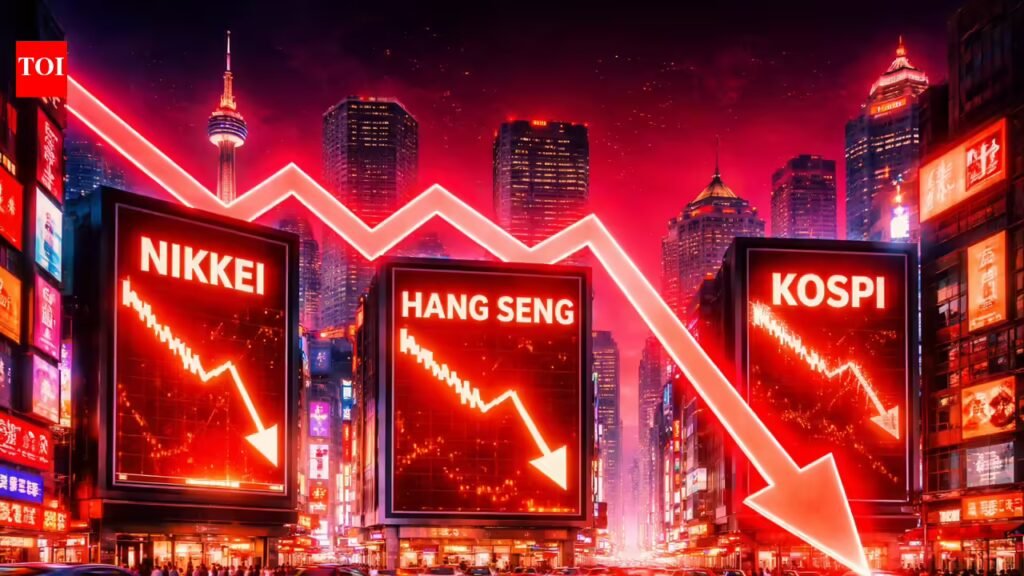
Asian markets opened the week on a weak footing, with investor sentiment weighed down by surging oil prices and escalating tensions in the ongoing US-Iran conflict. While Nikkei slid 5%, South Korea’s Kospi fell over 4%, though the indices later pared some of the losses.On Monday, Hong Kong’s Hang Seng Index fell 412 points or 1.65% to 24,539 as of 7:50 am IST. Shanghai and Shenzhen also traded in red, down 0.75% and 1.29%, respectively. In Japan, Nikkei was down 2,467 points or 4.6% to 50,905. South Korea’s Kospi also extended its fall, reaching 5,251 shedding 177 points or 3.5%.Meanwhile in commodity markets, oil extended its rally as the conflict entered its second month with no clear resolution in sight. West Texas Intermediate (WTI) climbed to $103.1, up $3.44 or 3.45%, after posting a 5.5% gain last week.Brent crude also surged past $110, reaching $116.4 per barrel, up $3.84 or 3.41%, building on gains of over 4% in the previous session.The strong momentum in oil prices comes against the backdrop of an escalating regional conflict. Iran has stepped up retaliatory strikes targeting Gulf states and the Strait of Hormuz shipping lane, a critical artery for global energy supplies. The widening hostilities have sent energy markets into a tailspin, fuelling fears for the broader world economy.Tensions heightened further after Iran’s parliamentary speaker, Mohammad Bagher Ghalibaf, accused the United States of planning a ground offensive, despite its public push for negotiations. His remarks followed the arrival of a US warship carrying around 3,500 military personnel to the region. The developments come after more than a month of aerial bombardments of Iran by US and Israeli forces. The situation has grown more complex with Yemen’s Iran-aligned Houthis entering the fray, launching their first attacks on Israel since the conflict began, adding another layer of uncertainty to an already volatile region.On the diplomatic front, Pakistan said it is preparing to host “meaningful talks” in the coming days aimed at resolving the conflict. This comes even as Tehran earlier accused Washington of gearing up for a land assault. Poll Do you think the tensions between the US and Iran will escalate further? Meanwhile, The Financial Times reported that US President Donald Trump said that the United States could seize Kharg Island in the Persian Gulf, a key hub for Iran’s oil exports, while also indicating that a ceasefire could come quickly.
Oil prices today: Crude jumps as Houthis enter Iran war; US boosts troop presence in Middle East

Oil prices surged sharply on Monday, with Brent crude crossing the $110 mark and West Texas Intermediate (WTI) climbing past $100 a barrel, as the Middle East conflict completed its one month. Markets remained on edge as Houthis enter the Iran war and US plans to extend onground presence in the region, further fueling uncertainty over the trajectory of the war.Around 7 am IST, Brent Crude stood at $116.4 per barrel, up 3.84 or 3.41%, after gaining over 4% in its previous session on Friday. WTI Crude followed the rally, jumping to $103.1, up 3.44 or 3.45%, after recording a gain of 5.5% last week. Watch ‘Petrol, Diesel Crisis Developing Worldwide’: PM Modi Urges Unity Amid West Asia Conflict So far this month, Brent has climbed 59%, marking its steepest monthly rise and exceeding gains seen during the 1990 Gulf War. The surge comes after Iran tightened its noose on the Strait of Hormuz effectively disrupting the strategically crucial route that sees around one-fifth of global oil and gas supplies pass.The conflict, which began on February 28 with US and Israeli strikes on Iran, has expanded across the Middle East. Over the weekend, Yemen’s Iran-aligned Houthis carried out their first attacks on Israel since the start of the war, raising further concern over key shipping lanes in the Arabian Peninsula and the Red Sea. The US also stepped up its military footprint in the Middle East, with around 3,500 Marines and sailors aboard the USS Tripoli deployed to the region. The move, described as potentially the largest US buildup there in nearly two decades, was confirmed by US Central Command. It comes after almost a month of conflict involving Iran and is being viewed as part of Washington’s effort to expand its operational options in the region.Meanwhile, according to data from Kpler, cited by Reuters, Saudi crude exports redirected from the Strait of Hormuz to the Yanbu port in the Red Sea reached 4.658 million barrels per day last week.JP Morgan analysts said that if exports from Yanbu were disrupted, Saudi oil flows could be forced to shift towards Egypt’s Suez-Mediterranean (SUMED) pipeline to the Mediterranean.Tensions in the region intensified further over the weekend after attacks damaged Oman’s Salalah terminal, despite ongoing attempts to advance ceasefire discussions.Iran has said it is prepared to respond to a US ground offensive, accusing Washington of planning a land attack while simultaneously pursuing negotiations. Poll Which factor do you think is most responsible for the recent spike in oil prices? Meanwhile, Pakistan’s foreign minister Ishaq Dar said that efforts had been discussed on possible ways to achieve an early and lasting end to the conflict, along with potential US-Iran talks in Islamabad.
Bank account portability RBI’s priority for ‘Vision 2028’
MUMBAI: RBI has placed consumer empowerment through portable bank accounts and cross-border efficiency at the centre of its Payments Vision 2028, signalling a new focus to improving user experience and reducing friction in money movement.While customers can freely open accounts with any bank, savings accounts are considered ‘sticky’ because of multiple standing instruction to send and receive money into the specified account. RBI’s work around this stickiness is a Payments Switching Service where all standing instructions are centralised. This centralised interface will allow customers to view and migrate all payment mandates, both incoming and outgoingreducing dependence on individual banks making accounts portable.A key thrust is on making cross-border payments faster, cheaper and more accessible. The central bank plans a comprehensive review of the ecosystem to identify regulatory, operational and technological bottlenecks, aligning domestic systems with global standards shaped by the G20.Proposed changes aim to lower entry barriers for firms, promote innovation and reduce delays in cross-border fund transfers, even as India has been signing agreements with other countries to link domestic fast payments systems and enable CBDC acceptance.
WTO talks stuck over e-commerce moratorium
NEW DELHI: WTO talks in Cameroon are deadlocked over a moratorium on e-commerce with the US seeking a long freeze on countries for levying tax on digital downloads and streaming, while India is so far unwilling to agree to this period.Starting from two years, India has indicated its willingness to go up to four, with the WTO draft proposing a moratorium until June 2031, two persons familiar with the ministerial level talks told TOI.But before ministers move to that the US and Brazil have to reach common ground on farm sector liberalisation. Talks between the US and Brazil are currently underway before ministers move to the issue of e-commerce. Here, the African countries have also demanded support and technical assistance before a final text can be agreed to.For over 25 years, members of the WTO have upheld a rule — no customs duties on electronic transmissions. While India has used it as a bargaining chip at every ministerial meeting.For India, the big win is managing to keep investment facilitation for development out of the WTO framework despite standing alone at the end. It has demanded “guardrails” against using plurilaterals, which are agreements between a select group of member nations. India has indicated its willingness to support discussions on reforms but it is the US which is stalling issues despite in the past signalling that WTO wasn’t moving anywhere.Talks are expected to conclude in the next few hours as ministers have started leaving Cameroon and the ministerial meeting is not going into extra time.
Govt eyes flexible-fuel vehicles’ faster rollout

NEW DELHI: The ongoing West Asia conflict and concerns over energy supplies have prompted govt to explore faster rollout of flexible-fuel vehicles (FFVs), which can run on blended petrol as well as 100% ethanol. At a meeting called by the petroleum ministry on Saturday, original equipment manufacturers (OEMs) flagged the need to address consumer concerns, particularly regarding the need to lower fuel costs as vehicle mileage decreases when using ethanol, for faster adoption.People aware of the developments said since major car and two-wheeler manufacturers have their prototype FFV models ready, now govt needs to create the ecosystem for adoption of these vehicles. Govt has maintained that 20% ethanol blending in petrol has helped India save imports of around 4.5 crore barrels (700 crore litres) of crude annually. Watch Big Fuel Tax Cut By Centre, But No Price Relief: Why Petrol And Diesel Still Cost The Same In India Crude crisis: A ‘visible option’ Officials and industry sources said that FFVs are more viable option than increasing ethanol blending in petrol, as higher blending levels would impact performance of existing vehicles. A person aware of the discussions said, the meeting focused on enabling conditions for FFVs. TOI has learnt that the industry sought clear road map about the fuel stations that would dispense ethanol, compensation for mileage loss, which is around 27%-30% less than petrol. “Industry made a clear point that consumers should not feel ‘cheated’ for buying such vehicles on account of less mileage ,” said a person who attended the meeting. Last year, petroleum minister Hardeep Singh Puri had written to FM Nirmala Sitharaman seeking GST parity of FFVs with EV. Currently, the GST for FFVs is 28% compared to 5% for EVs.