
RIL shares fall over 4% as windfall tax returns on fuel exports; Rs 82,000 crore wiped off market value
Shares of Reliance Industries Ltd (RIL) fell more than 4% on Friday after the government reintroduced windfall taxes on diesel and aviation turbine fuel (ATF) exports, eroding over Rs 82,000 crore from the company’s market capitalisation in intra-day trade.At 3:30 pm, shares of Reliance Industries Ltd were trading at Rs 1,350.80, down Rs 62.30 or 4.41% for the day, reflecting sharp selling pressure in the stock.The decline in the Mukesh Ambani-led company’s stock also dragged benchmark indices lower, with the Sensex and Nifty slipping nearly 2% during the session.According to an order issued on Thursday, the government reversed its earlier decision to scrap such levies, as it looks to recalibrate revenue from the energy sector amid heightened volatility in global oil markets.Finance minister Nirmala Sitharaman said the revised duties –Rs 21.5 per litre on diesel exports and Rs 29.5 per litre on ATF –are aimed at ensuring adequate domestic availability of these fuels.The move was accompanied by a reduction in excise duty on fuels meant for domestic consumption. The government cut the special additional excise duty on petrol to Rs 3 per litre and scrapped it on diesel.The policy shift came a day after Nayara Energy, India’s largest private fuel retailer, increased petrol prices by Rs 5 per litre and diesel by Rs 3 per litre. The company, majority-owned by Russia’s Rosneft, operates over 7,000 fuel outlets across the country.Dealers have flagged concerns over the price hike, warning of potential impact on demand and indicating possible protests. Some also said fuel supplies had been curtailed in recent days.Reliance Industries, India’s most valuable company with a market capitalisation of over Rs 18 lakh crore, is a major exporter of diesel and ATF. Its twin refineries at Jamnagar produce nearly 5 million tonnes of ATF, a significant portion of which is exported, accounting for about one-fourth of India’s total ATF output.Separately, the company on Thursday dismissed media reports claiming it had purchased Iranian crude oil. “These claims are entirely baseless, factually incorrect, and misleading. We urge media outlets to verify facts thoroughly before publication and to refrain from disseminating unsubstantiated reports that can misinform stakeholders and the public,” it said in a statement.RIL shares have declined nearly 4% over the past five trading sessions and about 3% over the last month, adding to pressure on the broader market.(Disclaimer: Recommendations and views on the stock market, other asset classes or personal finance management tips given by experts are their own. These opinions do not represent the views of The Times of India)
US-Iran war: India prepares to re-start LNG buys from Russia; seeks Trump admin waiver, says report

India imports a big portion of its LPG and LNG needs and has been looking to step up procurement from alternative sources. (AI image) Amid Strait of Hormuz-linked supply disruptions, India has reportedly sought a waiver from the US for buying liquified natural gas (LNG) from Russia. According to a Reuters report, India has approached the Donald Trump administration, asking for the waiver that would help ease supply constraints.According to two individuals aware of the developments, India and Russia have agreed to begin preparations for restarting direct supplies of liquefied natural gas from Russia, something that has not occurred since the outbreak of the Ukraine conflict. One of the sources told Reuters that if India chooses to move ahead, discussions could wrap up within a matter of weeks, even though such an arrangement may risk breaching Western sanctions. India Looks To Russian LNG To Ease Hormuz Supply Disruptions The understanding to explore an LNG agreement was reached during a March 19 meeting in New Delhi between Russian Deputy Energy Minister Pavel Sorokin and India’s Petroleum and Natural Gas Minister Hardeep Singh Puri, the sources said according to Reuters. Separately, India has advised domestic energy importers to prepare for a possible restart of Russian LNG purchases, one of the sources said. India has also reached out to the United States to explore the possibility of securing a waiver from sanctions, according to this source and another individual familiar with the matter.According to one of the sources, any fresh LNG agreement is expected to be less advantageous for India compared to the long-term supply contract signed between state-run GAIL and Russia’s Gazprom in 2012. “It is now a seller’s market,” the person said.Also Read | US-Iran war impact: India’s crude imports from Russia near all time highs; will such high numbers continue?Foreign ministry spokesperson Randhir Jaiswal stated last week that India is in discussions with multiple countries to ensure energy security, including sourcing LNG. Officials have also noted that India continues to import Russian liquefied petroleum gas, which is primarily used for cooking and is not subject to sanctions.India has already aggressively stepped up procurement of Russian crude oil after the US-Israel-Iran war disrupted supply of crude oil via the important maritime route Strait of Hormuz. Estimates from Kpler suggest that India has already bought around 50-60 million barrels of Russian crude since the start of the war in late February. The US has said that it has granted a 30-day waiver to India for purchasing Russian crude oil with an aim to keep global oil prices in check. Apart from crude oil disruptions, the supply of LPG and LNG have also been hit. India imports a big portion of its LPG and LNG needs and has been looking to step up procurement from alternative sources. Global LNG Supplies Hit Due To Middle East Conflict Yet another factor that has impacted LNG supplies is the attack on Middle East energy infrastructure. The US-Iran conflict has triggered consequences that extend well beyond the immediate spike in global oil and gas prices. Escalating tensions in the Middle East have resulted in damage to critical energy infrastructure across Gulf nations, raising concerns over future liquefied natural gas production and supply.The turmoil has unsettled the global LNG market, with higher prices, disruptions to key export facilities in Qatar and potential delays in upcoming projects creating uncertainty around demand outlook, particularly among cost-sensitive buyers in Asia.Also Read | Petrol, diesel price today: After excise duty cuts, will petrol and diesel rates in your city come down?“We expect this gas price crisis will lead some countries to reconsider growing their gas demand at the rate we previously forecast and so LNG demand growth will be lower than our pre-war forecast,” said Lucien Mulberg, an analyst at S&P Global.Supply constraints are expected to persist as Iran’s closure of the Strait of Hormuz, a vital route handling around 20% of global LNG trade, and damage to Qatar’s liquefaction infrastructure have disrupted flows. The affected facilities could take 3 to 5 years to restore, sidelining about 12.8 million tonnes per year of capacity. As a result, consultancies including S&P Global, ICIS, Kpler and Rystad Energy have lowered their global supply estimates by as much as 35 million tonnes.This shortfall is equivalent to roughly 500 LNG cargoes, sufficient to meet over half of Japan’s annual LNG imports or cover Bangladesh’s requirements for nearly five years.Before the conflict, analysts had expected global LNG supply to grow by up to 10% this year, reaching between 460 million and 484 million metric tonnes, supported by new capacity additions mainly in the United States and Qatar, with demand projected to rise at a similar pace.S&P Global now estimates that exports from Qatar and the United Arab Emirates could decline by about 33 million tonnes this year. It has also cut its supply outlook by a further 19 million tonnes annually between 2027 and 2029, citing likely delays in Qatar’s North Field expansion and ADNOC’s Ruwais LNG projects currently under development.
Centre announces extra 20% LPG allocation to states amid global energy crisis — what it means
As ongoing Middle East conflict continues to weigh energy supplies across the globe, the Centre has approached states to step up commercial LPG allocation, inceasing the distribution to 70%. In a letter to chief secretaries of all states and Union territories, secretary of the ministry of petroleum and natural gas, Dr Neeraj Mittal, outlined a revised plan to expand LPG availability for industrial use. The letter read, “in addition to the existing 50% allocation above, an additional 20% is now proposed, that would bring the total commercial LPG allocation to 70% of the pre-crisis level of the packed non-domestic LPG.” Which industries will benefit from the additional allocation? Commenting on the priority of the distribution, the minister laid out further propositions:Additional supplies are to be directed towards industries such as steel, automobile, textile, dye, chemicals and plastics, given their labour-intensive nature and their role in supporting other essential sectors. Within these, preference will be given to process industries or units that depend on LPG for specialised heating needs that cannot be replaced by natural gas.At the same time, industries will be required to meet conditions such as registration with oil marketing companies (OMCs) and applying for PNG connections with city gas distribution (CGD) entities in order to be eligible for LPG under the additional 20% allocation. In this case, if a certain sector uses LPG, such that it can not be substituted by natural gas, these requirements “would stand waived.”The official also called on all states to immediately utilise the 10% reform-based allocation, if they have not already done so. “I also urge all states to avail of the 10% reform-based allocation immediately, if they have not already done so.”“With this the allocation to commercial/industrial LPG will rise to 70% (with 10% reform based) and enable relief to industrial operations in the state,” the letter added. Government reassures sufficient energy supply The latest direction comes a day after the government issued a public assurance on fuel security, stating that there is no shortage of petrol, diesel or LPG anywhere in the country. The ministry said that the supply network remains firmly under control and cautioned against what it termed a coordinated misinformation campaign aimed at triggering panic among consumers. The ministry also reiterated its earlier clarification rejecting claims that LPG refill booking timelines had been altered. Responding to concerns amid the ongoing Middle East crisis, it said domestic LPG availability remains sufficient and output has been ramped up significantly following the LPG Control Order. Refinery production within the country has increased by 40% to 50 TMT per day, meeting more than 60 per cent of the estimated daily demand of around 80 TMT. This has reduced the need for imports to 30 TMT per day. The government has already secured 800 TMT of LPG cargoes, which are currently on their way from the United States, Russia and Australia, with deliveries being handled through 22 import terminals, compared to 11 in 2014. Officials said that the country currently has around one month’s LPG supply secured, while procurement efforts continue. Oil marketing companies are distributing over 50 lakh cylinders each day. Demand had briefly spiked to 89 lakh cylinders amid panic buying but has since stabilised. Earlier, commercial LPG allocation had been raised to 50 per cent in consultation with states to curb hoarding and black marketing. To cushion consumers from rising oil prices, the government has reduced central excise duty on petrol and diesel by Rs 10 per litre each for domestic consumption. Union Finance Minister Nirmala Sitharaman said in a social media post that the decision was taken in view of the West Asia crisis and would help protect consumers from rising prices. To ensure adequate domestic availability, export duties have been imposed on diesel at Rs 21.5 per litre and on Aviation Turbine Fuel at Rs 29.5 per litre.
Petrol, diesel price today: After excise duty cuts, will petrol and diesel rates in your city come down?
Despite the sharp rise in global oil prices, retail fuel rates have remained unchanged. (AI image) Petrol and diesel prices have been in focus since the start of the US-Iran war which has led to a huge rise in global crude oil prices. Several neighbouring countries have either raised petrol prices or rationed its use. In India, the government has cut the excise duty on both petrol and diesel, with an aim to absorb the global crude oil shock.The government has announced a reduction in excise duty on petrol and diesel. While excise duty on petrol has been cut, the levy on diesel has been removed altogether with an aim to cushion consumers from the surge in global crude oil prices triggered by the ongoing Middle East conflict. Global Price Hike That Led To Excise Duty Cut International crude prices have climbed nearly 50% since the United States and Israel carried out strikes on Iran on February 28, prompting strong retaliation from Tehran. Global oil prices had briefly surged to $119 per barrel earlier this month amid escalating tensions involving Iran, before easing to around $100 per barrel.India depends on imports for about 88% of its crude oil requirements and roughly half of its natural gas needs, much of which passes through the Strait of Hormuz. Following the attacks on Iranian government, military and nuclear facilities, Tehran warned vessels to avoid the route, while insurers withdrew coverage, effectively disrupting tanker movement.What the rising global crude oil prices have led to is a pressure on oil marketing companies which have not raised prices and have so far been absorbing the rise in crude prices.In a notification issued late on March 26, the Finance Ministry lowered the excise duty on petrol from Rs 13 per litre to Rs 3, while cutting the duty on diesel from Rs 10 per litre to zero. The revised rates came into effect immediately. Following the cut in excise duty, the total tax incidence on petrol now stands at Rs 11.9 per litre, which includes Rs 1.40 as basic excise duty, Rs 3 as special additional excise duty, Rs 2.50 as agriculture infrastructure and development cess, and Rs 5 as road and infrastructure cess. For diesel, the overall duty has been reduced to Rs 7.80 per litre, including Rs 1.80 basic excise duty, Rs 4 agriculture infrastructure and development cess, and Rs 2 road and infrastructure cess. Based on annual consumption of around 175 billion litres of automotive fuel, including 115 billion litres of diesel and 60 billion litres of petrol, the reduction in duties is estimated to have a financial impact of about Rs 1.75 lakh crore each year. This relief is being offset against the price increases of roughly Rs 24 per litre for petrol and Rs 30 per litre for diesel that would otherwise have been required due to rising global crude oil prices. Will Petrol, Diesel Prices Come Down After Excise Duty Cuts? Excise duty is a tax imposed by the central government on fuel, and it forms a significant part of the retail price of petrol and diesel. When this duty is high, it directly pushes up the price consumers pay at the pump. A reduction in excise duty lowers this tax component, which can either bring down retail prices or help oil companies offset rising crude costs without increasing prices, thereby easing the burden on consumers.Despite the sharp rise in global oil prices, retail fuel rates have remained unchanged, putting pressure on the finances of oil marketing companies. The duty reduction is intended to ease this strain and provide some relief to these firms.Earlier, rating agency ICRA had indicated that if crude prices average between $100 and $105 per barrel, fuel retailers could face losses of around Rs 11 per litre on petrol and Rs 14 per litre on diesel. It had also suggested that a reduction in excise duties could help maintain stable retail prices while giving companies more room to offset refining losses.The government’s intention of cutting excise duty and taking a tax revenue hit is to prevent a pass-on of higher crude prices to consumers in the form of a petrol and diesel price hike. Hence, the current excise duty cut is unlikely to result in petrol, diesel prices coming down for you. In effect, the aim is to maintain the petrol, diesel prices at current levels, so that consumers don’t bear the brunt of rising global oil prices.Hence, retail prices of petrol and diesel by state-run oil companies such as Indian Oil Corp, Bharat Petroleum Corp, and Hindustan Petroleum Corp are expected to remain the same: No cut, no hike!State-run fuel retailers account for around 90% of the market. In Delhi, petrol continues to be sold at Rs 94.77 per litre, while diesel is priced at Rs 87.67 per litre.Meanwhile, private fuel retailer Nayara Energy, which operates 6,967 outlets out of India’s 102,075 petrol pumps, has partially passed on higher input costs by increasing petrol prices by Rs 5 per litre and diesel by Rs 3 per litre. Petrol at its outlets is now priced at Rs 100.71 per litre, while diesel costs Rs 91.31 per litre.Jio-bp, the fuel retailing joint venture between Reliance Industries and BP Plc with 2,185 outlets, has not raised prices so far despite facing significant losses on fuel sales.Last week, state-owned oil marketing companies raised prices of premium petrol variants by over Rs 2 per litre. The hike applies only to high-performance fuels such as BPCL’s Speed, HPCL’s Power and IOCL’s XP95, with increases ranging from Rs 2.09 to Rs 2.35 per litre. What government said on excise duty cut Finance Minister Nirmala Sitharaman said in a post on X that the excise duty reduction “will provide protection to consumers from rise in prices,” adding that the government remains committed to shielding citizens from fluctuations in supply and costs of essential commodities. She also noted that export duties of Rs 21.5 per litre on diesel and Rs 29.5 per litre on
Gold price prediction: Will gold prices continue to move up on March 27, 2026 after crash? Check outlook amid US-Iran war

Gold is moving from the mid-band toward the upper band, suggesting strengthening momentum. (AI image) Gold price prediction today: Gold prices are seeing a steady recovery and Jateen Trivedi, VP Research Analyst – Commodity and Currency, LKP Securities recommends a buy on dip strategy.Gold futures on MCX are trading near ₹1,45,500 after witnessing a steady recovery from recent lows. The price action suggests stabilization above key short-term supports, with momentum gradually turning positive. The structure indicates that dips are being bought into, keeping the intraday bias tilted towards a recovery move.Technical SetupPrice has reclaimed the short-term EMA cluster, with EMA 8 crossing above EMA 21, indicating improving bullish momentum. Sustaining above ₹1,45,000 keeps the short-term trend supportive.Gold is moving from the mid-band toward the upper band, suggesting strengthening momentum. Any pullback toward the mid-band is likely to attract fresh buying interest.The chart reflects higher lows formation after a recovery phase, indicating accumulation at lower levels and supporting a buy-on-dips approach.RSI is near 66, showing strong momentum but still below extreme overbought levels, leaving room for further upside.MACD is in positive territory with a bullish crossover, confirming strengthening upward momentum.Strategy: Buy on dips Entry Level: ₹1,45,000 Stop-Loss: Below ₹1,43,500 Target: ₹1,48,000 Bias: Bullish above ₹1,45,000; weakness only below ₹1,43,500 Gold’s intraday technical structure remains constructive, supported by bullish EMA alignment, strong RSI momentum, and positive MACD signals. The formation of higher lows indicates sustained buying interest at lower levels. Traders are advised to buy on dips near ₹1,45,000, maintain a strict stop-loss below ₹1,43,500, and look for an upside move toward ₹1,48,000 during the session.(Disclaimer: Recommendations and views on the stock market, other asset classes or personal finance management tips given by experts are their own. These opinions do not represent the views of The Times of India)
To keep fuel prices stable, govt hikes ATF duty, cuts excise on petrol, diesel
As the Middle East conflict continues to disrupt global oil supplies, the Centre has stepped in to ensure better fuel availability for citizens. In a bid to cushion local consumers from the ripples, the government has imposed fresh duties on fuel exports while easing the domestic excise duties. Finance minister Nirmala Sitharaman announced that export duties have been set at Rs 21.5 per litre on diesel and Rs 29.5 per litre on aviation turbine fuel (ATF), alongside a reduction in excise duty on petrol and diesel meant for domestic consumption. Watch Modi Govt Slashes Excise Duty On Fuel Even As Global Oil Crisis Hits Neighbours Like Pakistan In a post on social media platform X, the FM wrote, “In view of the West Asia crisis, the central excise duty on petrol and diesel for domestic consumption has been reduced by Rs 10 per litre each. This will provide protection to consumers from rise in prices. Hon. PM Modi has always ensured that citizens are protected from vagaries of supply and costs of essential goods.”“Further, duties have been imposed on exports of Diesel at Rs 21.5 per litre and on ATF at Rs 29.5 per litre. This will ensure adequate availability of these products for domestic consumption. The Parliament has been notified about the same,” Sitharaman further added. What’s new for aviation sector? The FM said that the excise rate on Aviation Turbine Fuel export had been raised to ensure that the fuel is prioritized for use in the domestic sector. “ATF is very important. It is necessary for India’s aircraft and our companies to get ATF. For that reason, there are many refineries in India that buy goods from abroad, refine them here, and also export them abroad and give them to us. But we have now increased the rate on that export, increased the excise duty, so that instead of exporting, they will sell it in India itself, which will ensure plenty of availability in India and people won’t feel a shortage,” she stated.The government has reworked the tax structure for Aviation Turbine Fuel (ATF). It has set an excise duty of Rs 50 per litre, but built-in exemptions mean the actual levy will come down to Rs 29.5 per litre in certain cases, offering some relief to the aviation sector. The official notification lists ATF at Rs 50 per litre under special additional excise duty, while also providing for exemptions that reduce the effective rate to Rs 29.5 per litre.These revised rules will not apply to exports, except in the case of supplies by public sector oil companies to neighbouring countries such as Nepal, Bhutan, Bangladesh and Sri Lanka, which will continue under the updated system.Changes to the Central Excise Rules, 2017, further state that rebate and export procedures will not be applicable to petrol, diesel and ATF, apart from such supplies to neighbouring nations by public sector firms.The government said that the measures are in public interest, aimed at striking a balance between consumer relief, revenue considerations and industry needs at a time of global energy uncertainty. Relief for consumers The finance ministry, in a notification issued late on Thursday, also revised the domestic duty cuts, bringing excise duty on petrol down to Rs 3 per litre from Rs 13 earlier, while diesel was fully exempted from the levy, which previously stood at Rs 10 per litre. The changes have taken effect immediately.The twin move, raising export duties while lowering domestic taxes, comes against the backdrop of a sharp surge in global crude oil prices. Oil prices have soared almost 50% since February 28, when the United States and Israel carried out strikes on Iran. Earlier this month, prices had climbed as high as $119 per barrel earlier this month before easing to around $100. India’s reliance on foreign fuels India, which imports 88% of its crude oil and around half of its natural gas requirements, remains particularly exposed to disruptions in the Strait of Hormuz. Following the strikes on Iranian government, military and nuclear facilities, Iran warned shipping away from the route, while insurers pulled back coverage, effectively halting tanker movements.Even as global prices climbed, retail fuel rates in India have largely remained unchanged, putting pressure on oil marketing companies. The reduction in excise duty is expected to ease some of this strain.Prior to the announcement, rating agency ICRA had flagged the financial stress on fuel retailers, estimating losses of Rs 11 per litre on petrol and Rs 14 per litre on diesel if crude prices averaged $100–105 per barrel. It had also suggested that a cut in excise duty could help keep pump prices stable while offering companies some relief.Among private retailers, Nayara Energy has already increased prices, raising petrol by Rs 5 per litre and diesel by Rs 3 per litre. Its petrol now sells at Rs 100.71 per litre and diesel at Rs 91.31. Jio-bp, however, has not revised rates so far despite incurring losses.State-run fuel retailers, which dominate nearly 90% of the market, have continued to hold prices steady. In Delhi, petrol is priced at Rs 94.77 per litre and diesel at Rs 87.67 per litre.
Gold, Silver Rate Today Live Updates: Gold, silver prices continue to climb after worst crash in over 40 years; what’s the outlook?

The weakening of the dollar made bullion, which is priced in the greenback, more affordable for investors using other currencies. “For weeks, gold has been treated as a liquidity asset sold to cover volatility and margin calls elsewhere, but at current levels, it is now looking more like a value proposition for investors, which is why it’s back in favour today,” said Tim Waterer, chief market analyst at KCM Trade. “However, hawkish central banks wary of persistent oil-driven inflation, continue to act as a heavy lid on gold’s ambitions to the upside, keeping any rally firmly in check.”
Stock market today (March 27, 2026): Nifty50 goes below 23,000; BSE Sensex down over 1,000 points as US-Iran war, oil prices weigh on sentiment

Stock market today (AI image) Stock market today: Nifty50 and BSE Sensex dropped in opening trade on Friday as US-Iran war tensions and crude oil prices continued to weight on sentiment. While Nifty50 went below 23,000, BSE Sensex was down over 1,000 points. Around 10:30 am, Nifty50 was trading at 22,994.40, down 312.05 points or 1.34%. BSE Sensex was at 74,256.59, down 1,016.86 points or 1.35%.Dr. VK Vijayakumar, Chief Investment Strategist, Geojit Investments Limited says, “The on and off reaction of the market to news and events regarding the war is likely to continue in the near-term. The spike in Brent crude back to around $108 level will again trigger another round of risk-off in the Indian market. The market correction since the war began has brought down Nifty valuations to fair levels. Nifty is now trading at about 19 times, which is lower than the last 10-year average of 22.4 times. But if India’s macros take a hit due to this energy crisis, valuations may again decline factoring-in the feared hit to earnings growth in FY27.”“The Indian economy is strong enough to absorb the shock if the war ends, crude cools down and gas availability becomes normal. But if the war prolongs, crude remains elevated for months together, and gas availability constraints continue, the stress on India’s macros will be significant and the market will discount that. In brief, everything boils down to how long the war will last. The market hope is that since a prolonged war is in nobody’s interests, it may end soon. The US itself is now looking for an exit strategy. Market corrections and rising retail price of petroleum products may exert pressure on the US regime to cool down the conflict.”Global cues remained weak. US markets declined sharply, with the Nasdaq Composite dropping more than 2% to enter correction territory, while the S&P 500 and the Dow Jones Industrial Average fell over 1% each. Investors moved towards safer assets amid concerns over a potential escalation in the US-Israeli conflict with Iran, which has driven oil prices higher and intensified inflation worries.The weakness in Wall Street spilled over to Asian markets, with traders remaining cautious even after Donald Trump once again extended the deadline for Iran to reach an agreement. Crude oil prices, however, edged lower.On the domestic front, foreign institutional investors were net sellers on Wednesday, offloading equities worth Rs 1,805.37 crore. In contrast, domestic institutional investors remained net buyers, purchasing shares worth Rs 5,429.78 crore.(Disclaimer: Recommendations and views on the stock market, other asset classes or personal finance management tips given by experts are their own. These opinions do not represent the views of The Times of India)
Petrol Price: Govt cuts excise duty to Rs 3 a litre on petrol, to nil on diesel amid Middle East tensions
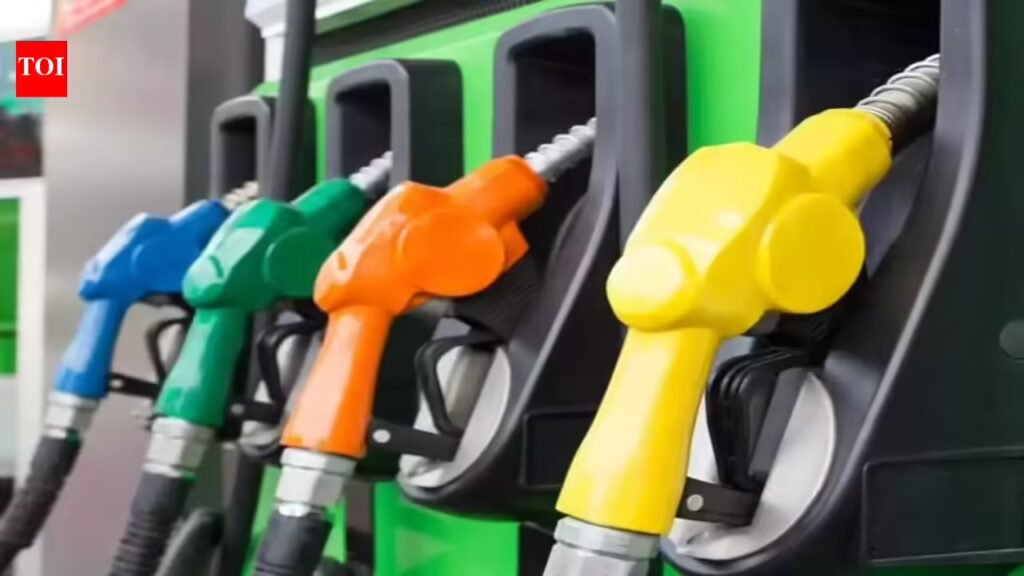
Government has revised its fuel duty structure, lowering the special additional excise duty on petrol to Rs 3 per litre while removing it entirely on diesel. The decision comes against the backdrop of ongoing disruptions in global oil supply chains due to the conflict in the Middle East, where Iran continues to tighten control over the Strait of Hormuz.According to a government order dated Thursday, “the additional excise duty on petrol was cut to Rs 3 per litre from Rs 13 per litre earlier. Meanwhile, the excise duty on diesel was cut to Rs 0 from Rs 10 per litre earlier.” Watch Modi Govt Slashes Excise Duty On Fuel Even As Global Oil Crisis Hits Neighbours Like Pakistan After the last revision back in April 2025, the excise duty on petrol stood at Rs 13 per litre, while for diesel it was Rs 10 per litre.Meanwhile in global markets, crude prices cooled on Friday after the United States indicated that negotiations with Iran were “going very well” and extended its deadline with the country by 10 days. The shift in sentiment saw both major benchmarks decline by around 2% in early trade.Brent crude, which had climbed as high as $108 per barrel, slipped to $105.75 per barrel, down 2.08%. Meanwhile, West Texas Intermediate (WTI) fell 1.94% to $92.67 as of 7:50 am IST. The pullback follows a sharp rally in the previous session, when Brent rose 4.8% to settle at $101.89 per barrel, as hopes of a return to normal operations in the Strait weakened. Prices remain well above the roughly $70 levels recorded before the conflict began, with the US benchmark also having risen 4.6% to $94.48 per barrel.Earlier on Thursday, Nayara Energy, India’s largest private fuel retailer, raised petrol prices by Rs 5 per litre and diesel by Rs 3 per litre amid rising input costs tied to the Middle East situation. The company, which operates 6,967 of the country’s 102,075 petrol pumps, has decided to pass on part of the increased costs to consumers, PTI sources said.
First since 1861: US paper currency to bear Donald Trump’s signature
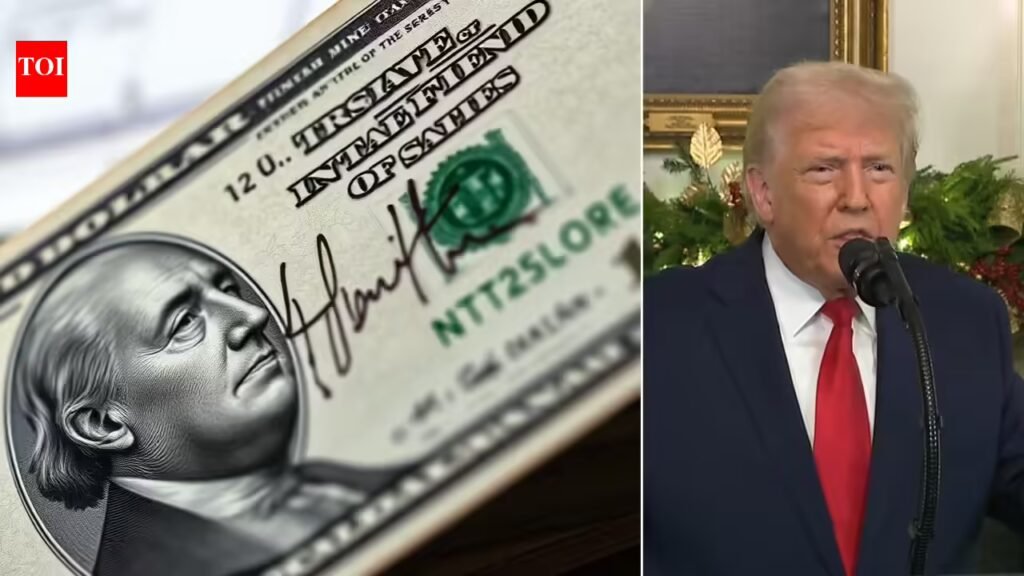
US Dollar bill bearing Trump’s signature (AI-generated image) US President Donald Trump‘s administration has once again stirred controversy, this time with a proposal to include his signature on American paper currency ahead of the country’s 250th anniversary.The US Treasury Department announced on Thursday that future US dollar notes will carry Trump’s signature alongside that of the Treasury Secretary, marking the first time in history that a sitting president’s signature will appear on paper currency.Treasury Secretary Scott Bessent said the move is intended to commemorate the United States’ semiquincentennial celebrations in 2026, according to CNN. Explaining the rationale behind the decision, Bessent said in an official statement, “Under President Trump’s leadership, we are on a path toward unprecedented economic growth, lasting dollar dominance, and fiscal strength and stability.”“There is no more powerful way to recognize the historic achievements of our great country and President Donald J Trump than US dollar bills bearing his name, and it is only appropriate that this historic currency be issued at the Semiquincentennial,” Bessent added. Providing further context, the Treasury said the move is part of a broader effort to mark the 250th anniversary of the United States, during which Trump’s likeness is also expected to feature on commemorative materials.US Treasurer Brandon Beach linked the proposal to the administration’s economic narrative. “As the 250th anniversary of our great nation approaches, American currency will continue to stand as a symbol of prosperity, strength, and the unshakable spirit of the American people under President Trump’s leadership,” he said.Beach further added, “The President’s mark on history as the architect of America’s Golden Age economic revival is undeniable. Printing his signature on the American currency is not only appropriate, but also well deserved.”However, the announcement has raised legal and political questions. US law has long restricted the depiction of living individuals on currency, a rule dating back to 1866 aimed at preventing any perception of monarchy-like practices.In 1861, the US government issued its first general circulation paper money, known as Demand Notes to finance the Civil War due to coin shortages and war expenses. According to the Act of July 17, 1861, $5, $10 and $20 notes were payable on demand in coin and were nicknamed “greenbacks” due to their green reverse side. The currency proposal comes alongside another contentious plan under consideration which includes issuing a $1 coin featuring Trump to mark the anniversary. Draft designs shared by officials show the president’s profile on one side and an image of him standing before the American flag on the other.