
Strait Of Hormuz Reopening: Toll system in Strait of Hormuz? Iran drafts bill to charge ships for safe passage amid war

The Middle East war has pushed global oil markets deeper into crisis, as Iran’s tightening grip over the Strait of Hormuz continues to squeeze energy supplies worldwide. These tensions could escalate further, with Iran warning it may completely shut the passage if the US targets its power plants. At the moment, for those considering alternative routes, options remain limited and uncertain. As the disruption nears the one-month mark, Tehran is now moving to further formalise its control over the vital waterway. Iran’s parliament is reportedly working on a draft bill to introduce a system of charges on vessels passing through the Strait, requiring ships to pay for safe passage. Iran moves to leverage its chokehold As the disruption nears the one-month mark, Iran is planning to introduce a system to charge ships passing through the Strait. According to the semi-official Fars news agency, parliament is working on a draft bill that would require vessels to pay for safe passage.Fars, citing an unnamed lawmaker, said that the proposal could be finalised next week, giving legal backing to Iran’s control over the Strait. Watch Trump Pushed To Corner? Merz’s Blunt Message To Trump; ‘End Iran War To Control Oil Prices’ Shipping activity has remained very limited since US and Israeli strikes on Iran began nearly a month ago. Only a small number of vessels have crossed the Strait, mostly those linked to Iran or China, along with a few that reportedly received clearance from the Islamic Revolutionary Guard Corps.Reports from the shipping industry suggest that an informal system is already in place. Ship operators have been asked, often through intermediaries, to share details about crew, cargo and routes, and in some cases to pay up to $2 million, although these demands have not been consistent.The idea of a formal toll, along with promises of safe passage, has created a dilemma for shipping companies. While they are keen to move stranded crews and cargo out of the Persian Gulf, concerns remain over sanctions risks and security challenges. Key sea routes such as Hormuz are typically governed by international laws that ensure freedom of navigation. Meanwhile, India’s shipping ministry has dismissed reports of any proposed toll or levy on vessels passing through the Strait of Hormuz, calling such claims “baseless” and reiterating that the crucial maritime route is governed by international conventions guaranteeing freedom of navigation. Special secretary in the ministry of shipping, Rajesh Sinha, emphasised that no charges can be imposed on ships transiting the strait under global regulations.“On the question of any toll or levy while crossing the Strait of Hormuz, this is an international strait. As per international conventions, it ensures the right to freedom of navigation and no levy can be imposed under global regulations. Therefore, any such claim or argument has no basis—it is baseless,” he said. Alternatives to Hormuz At the time, rerouting shipments through the Red Sea may appear to be a viable alternative after the Hormuz disruption, but that route carries its own risks. Just a day earlier, Iran raised fresh concerns by threatening the safety of vessels attempting to pass through a key Red Sea passage.The Bab el-Mandeb Strait, located between Yemen and Djibouti and around 1,200 miles from the Strait of Hormuz, is now also under scrutiny. The possibility of military threats from Iran’s proxies has added another layer of uncertainty to already strained global shipping routes.The Strait of Hormuz, a crucial artery for global oil and gas flows, has remained disrupted since February 28. The closure has reduced tanker traffic, pushed up fuel prices and unsettled global markets. On one hand, Iran is seeking to tighten its grip on the situation by considering legislation to impose transit fees on ships passing through the Strait of Hormuz. On the other, questions are raised over what is preventing other nations from stepping in to restore normal passage through the vital waterway. Can other nations push open the Strait of Hormuz? With the conflict ongoing, a return to normal shipping remains distant. Even if hostilities ease, uncertainty lingers over how quickly vessels can return and in what numbers.With few viable alternatives available, the question remains: How can ships eventually resume passage through the Strait of Hormuz?First hurdle: Overcoming the strait’s geographyReopening the passage is far from simple, largely due to its geography. The strait stretches about 140 miles and narrows to just 25 miles at its tightest point, leaving vessels with little room to manoeuvre and exposing them to potential attacks from the shore or small boats. Fully loaded tankers take between 10 and 14 hours to cross at limited speeds, while relatively shallow waters increase the risk of mines being laid, Bloomberg reported.The mountainous terrain along Iran’s coastline further complicates the situation, offering cover for missile and drone launch sites and making efforts to restore safe passage more challenging.Another challenge: Escorting the ship with safetyAny reopening is likely to depend heavily on security arrangements. Naval escorts are seen as one option, with warships accompanying commercial vessels to guard against threats such as missiles, drones and underwater weapons. However, this would first require shipping lanes to be cleared of mines, a process that can only begin once active hostilities cease and could take around two weeks. Air support would also be needed, with warplanes monitoring the area for incoming threats.Even then, restoring full traffic would be difficult. The number of vessels that typically pass through the strait each day would require coordination between multiple countries. Defence officials, cited by Bloomberg, suggest a multinational coalition would be needed to secure the route, particularly if a ceasefire encourages broader participation.But what if ships get escorted?Significant challenges would still remain. The proximity of Iran’s coastline leaves little time to detect and intercept incoming threats, and even advanced warships could be overwhelmed by large-scale “swarm” attacks. Iran’s strikes on land targets in the region have shown that some missiles and drones can penetrate air defences.At the same time, the US Navy alone does not have enough vessels to protect
Gold, silver price prediction today (March 26, 2026): Will gold rally to Rs 1.55 lakh/10 grams & silver touch Rs 2.60 lakh/kg?

Gold appears poised to extend its rally toward the 155,000 level in the upcoming sessions. (AI image) Gold and silver price prediction today: Gold and silver prices may sustain their up move in the coming sessions, says Abhilash Koikkara, Head – Forex & Commodities, Nuvama Professional Clients Group. MCX Gold Price Outlook On the weekly timeframe, MCX Gold has bounced back from recent lows, finding support near the 30-week moving average, indicating a likely resumption of the upward trend following a brief pullback. The metal is displaying an intermediate bullish stance, potentially creating a buying window. A firm close below key support, however, could trigger a more pronounced correction. Nevertheless, the broader uptrend remains intact as long as prices hold above the recent swing lows.In the coming week, the area around the weekly low of 137,000 is likely to serve as a key support zone, underscoring its technical significance. Any pullback toward this level could attract fresh buying interest, thereby limiting near-term downside risk. As long as prices hold above this mark, the broader bullish structure is expected to remain intact. However, a close below this level would negate the bullish outlook.Gold appears poised to extend its rally toward the 155,000 level in the upcoming sessions. This upward move would signal a rebound from support and could sustain near-term bullish momentum. Moreover, the consistent strength in price action supports the positive outlook and suggests the recovery may continue.In summary, gold maintains a bullish bias, supported by a positive underlying trend that points to further upside potential. As long as prices stay above the key support level of 137,000, the broader bullish structure should remain intact. With momentum indicators aligned and sentiment remaining favourable, the metal is likely to trade with a positive bias and continue its upward trajectory in the sessions ahead. MCX Gold Trading Strategy CMP: 144,000 Target: 155,000 Stop Loss: 137,000 MCX Silver Price Outlook From a weekly perspective, silver has staged a recovery off its support base while continuing to trade above a crucial moving average. Following the bounce from recent lows, the price structure reflects a positive tone. As the larger trend remains upward, short-term dips may offer accumulation opportunities, as long as the previous week’s low is not breached. Market participants should align their positions with the dominant trend and consider keeping protective stop-loss levels close to the latest weekly lows to effectively control risk.The market opened the week on a firm note, staging a recovery from recent lows and signalling continued upward strength. The positive outlook is likely to remain intact as long as prices hold above key weekly support levels. The first line of support is seen near the previous week’s low at 217,000, and a confirmed close below this point may challenge the current positive bias. Until then, short-term corrections are expected to invite buying interest, supporting the continuation of the broader upward trend.On the upside, silver looks poised to retest the breakdown level around the 260,000 resistance zone in the near to medium term. A sustained move toward this area would reinforce the ongoing bullish trend, backed by steady momentum and supportive technical indicators. Overall, as long as prices remain above the 217,000 support zone, the broader uptrend is expected to stay intact, potentially opening the door for further gains amid improving positive sentiment. MCX Silver Trading Strategy CMP: 235,400 Target: 260,000 Stop Loss: 217,000 (Disclaimer: Recommendations and views on the stock market, other asset classes or personal finance management tips given by experts are their own. These opinions do not represent the views of The Times of India)
‘Friendly nations’ only: Iran allows India, Pakistan, 3 other countries to use Strait of Hormuz amid war

Strait of Hormuz (AP photo) Iran on Thursday said that, despite ongoing military escalation in the Middle East, it has allowed transit through the Strait of Hormuz for “friendly nations,” including India.Access to the conflict-hit Strait of Hormuz for India comes as New Delhi, according to a Bloomberg report, has purchased its first LPG cargo from Iran since 2018. Imports had come to a halt in 2019 after the West imposed sanctions on Iran. Watch Iran Denies Permission To Pakistan-Bound Ship Trying To Cross Hormuz As Indian Ships Sail Through Also read – Why India is facing an LPG crisis — explained in chartsThe reported purchase follows a 30-day waiver granted by the Donald Trump administration to help keep global oil and gas prices in check.The consulate general of Iran in Mumbai shared a statement from Iran’s foreign minister Abbas Araghchi, saying: “We have permitted passage through the Strait of #Hormuz for friendly nations, including China, Russia, India, Iraq, and Pakistan.”Araghchi’s remarks came after UN secretary-general Antonio Guterres called for the Strait of Hormuz to remain open.In a post on X, Guterres said, “The prolonged closure of the Strait of Hormuz is choking the movement of oil, gas, and fertilizer at a critical moment in the global planting season. Across the region and beyond, civilians are enduring serious harm and living under profound insecurity. The UN is working to minimise the consequences of the war. And the best way to minimise those consequences is clear: end the war immediately.”The UN chief also urged US-Israel and Iran to end the ongoing military escalation.“My message to the US & Israel is that it’s high time to end the war – as human suffering deepens, civilian casualties mount & the global economic impact is increasingly devastating. My message to Iran is to stop attacking their neighbours that are not parties to the conflict,” he said.“My message to the US and Israel is that it is high time to end the war, as human suffering deepens, civilian casualties mount, and the global economic impact becomes increasingly devastating. My message to Iran is to stop attacking neighbours that are not parties to the conflict,” he said.However, for Western powers, the key oil lifeline remains the Strait of Hormuz, a critical chokepoint now increasingly volatile amid the US-Israel offensive on Iran. The strong retaliatory action by Tehran regime included the choking of key waterway in the Gulf, with fears that any disruption could effectively choke global energy flows.
Strait of Hormuz disruptions: India buys first LPG cargo from Iran in years; tanker was initially bound for China
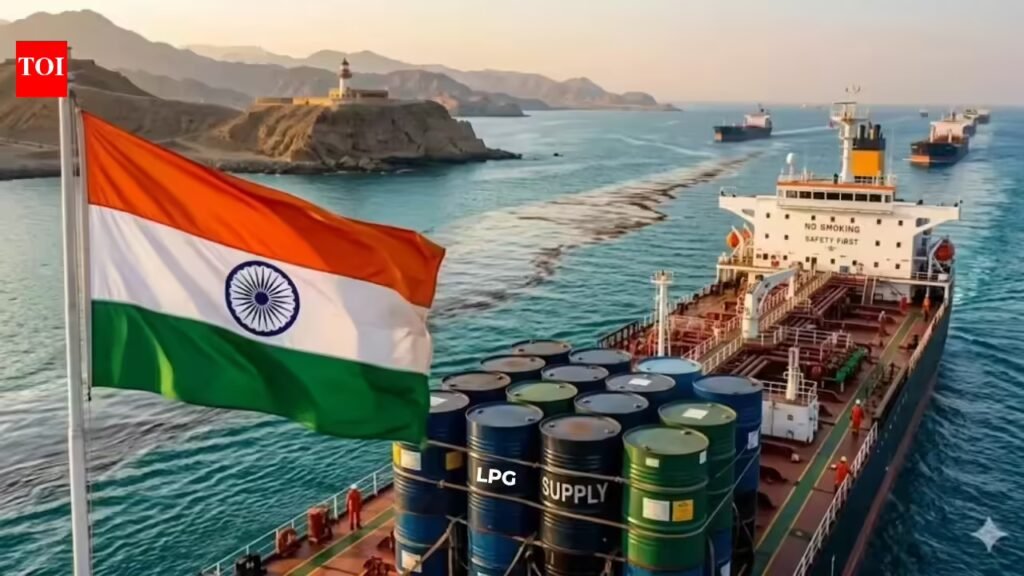
India has faced significant disruption to energy supplies routed through the Strait of Hormuz. (AI image) For the first time in several years, India has reportedly purchased liquified petroleum gas (LPG) from Iran after the Donald Trump administration granted a 30-day sanctions waiver to keep oil and gas prices in check. India had stopped energy imports from Iran in 2019 amid Western sanctions. Data from LSEG indicated that the tanker carrying the cargo was originally headed for China.India has faced significant disruption to energy supplies routed through the Strait of Hormuz due to the ongoing US-Israeli conflict with Iran. Iran LPG headed to India The sanctioned vessel Aurora, transporting Iranian LPG, is expected to arrive today at the west coast port of Mangalore, sources told Reuters. Sources said the cargo was procured through a trader, with payment to be made in rupees. They added that India is also considering additional purchases of Iranian LPG cargoes. Watch LPG Tanker ‘Pyxis Pioneer’ With Over 47,000 Tonnes Of Fuel From US Arrives At New Mangalore Port Also Read | US-Iran war: Why India is facing an LPG crisis — explained in chartsThe LPG shipment will be distributed among three state-run fuel retailers: Indian Oil Corporation, Bharat Petroleum Corporation Limited and Hindustan Petroleum Corporation Limited.However, an official said he was not aware of any purchases of Iranian cargoes. “(There are) no loaded cargoes from Iran, we have not heard of that,” Rajesh Kumar Sinha, Special Secretary in the federal shipping ministry, said at a press conference on Wednesday.India, the world’s second-largest importer of LPG, is grappling with its most severe gas supply crunch in decades, prompting the government to cut allocations to industries in order to safeguard household cooking fuel needs.The country consumed 33.15 million metric tonnes of LPG last year, with imports meeting roughly 60% of the demand. A significant majority of these imports originated from the Middle East.India is also working to clear LPG cargoes stranded in the Strait of Hormuz, with four tankers — Shivalik, Nanda Devi, Pine Gas and Jag Vasant — already moved. In addition, the country has begun loading LPG onto empty vessels that had been stuck in the Persian Gulf.
Oil prices today: Crude climbs amid US-Iran tensions, fresh Hormuz curbs fears linger

Oil price today: Oil prices inched higher on Thursday, once again swinging past the $100 mark after a sharp drop in the previous session. Brent crude rose by $1.13, or 1.1%, to $103.35 a barrel by 0051 GMT, while US West Texas Intermediate crude gained $1.08, or 1.2%, to $91.40 a barrel. The rebound follows a drop of more than 2% for both benchmarks on Wednesday as markets reassess where the Middle East conflict might head next.The recovery, however, comes with a layer of uncertainty, with Iran sugegsting that it is still weighing a US proposal to end the war while simultaneously making it clear that immediate negotiations are off the table, leaving traders caught between cautious optimism and lingering risk.Iran’s foreign minister had earlier said that Tehran has no plans to engage in negotiations to bring the expanding conflict to a close. The stance came as US President Donald Trump signalled a tougher approach, warning that Washington would ramp up pressure if Iran does not accept that it has been “defeated militarily,” according to White House press secretary Karoline Leavitt.Market attention remains firmly on diplomatic and military developments after Iran described the US outreach as significant. The proposal in question, a reported 15-point plan from Trump, includes conditions such as scrapping Iran’s stockpile of highly enriched uranium, halting enrichment activities, curbing its ballistic missile programme and cutting funding to regional allies, according to three Israeli cabinet sources familiar with the plan. Watch ‘SURPRISE FRONTS…’: After Hormuz, Iran Warns Of Shutting Down Another Key Strait; Big Declaration Early Thursday, Trump took a sharp aim at Tehran, alleging that while Iran wants to negotiate, they are afraid to do so openly, “because they figure they will be killed by their own people. They are also afraid they will be killed by us.” Meanwhile, Iran an Iranian military spokesperson mocked US efforts to broker a ceasefire, raising fresh doubts over Washington’s proposed 15-point peace plan. Lt Col Ebrahim Zolfaghari, speaking on state television on Wednesday, dismissed claims by Donald Trump that talks were under way, suggesting instead that the US was “negotiating with itself.”At the same time, the conflict continues to strain global supply chains. Shipments through the Strait of Hormuz, a vital artery that typically handles about one-fifth of global crude oil and liquefied natural gas, have been severely affected. The International Energy Agency has called the situation as the largest oil supply disruption on record.Tehran has laid down its own terms for ending the conflict. It has said that any resolution must begin with a complete halt to attacks and assassinations. It is also seeking firm guarantees against a repeat of the conflict, along with a defined mechanism to assess and secure compensation for war-related damages. Iran has further insisted that hostilities must cease not only against its territory but also against resistance groups across the region.Additionally, Iran has called for recognition of its sovereignty over the Strait of Hormuz, stating that its defensive operations will continue until these conditions are met.
OpenAI hires JioStar’s ex-CEO to lead Apac ops

BENGALURU: OpenAI, the company behind ChatGPT, has hired former JioStar CEO Kiran Mani as managing director for Asia-Pacific, as the AI firm steps up its regional expansion amid strong user growth in markets including India. Mani is set to join in June. He will report to Jason Kwon and lead regional strategy and operations across APAC, according to people aware of the matter.
IHC arm gets RBI nod to buy Sammaan Capital

MUMBAI: Sammaan Capital (formerly Indiabulls) shares rose 6% after the RBI approved the acquisition of a controlling stake by UAE-based International Holding Company (IHC) through an initial investment of about Rs 8,850 crore. In a regulatory filing on March 24, Sammaan Capital said RBI had cleared applications related to the proposed transaction involving Avenir Investment, an entity owned and controlled by IHC. TNN
KVR Murty named as Sebi whole-time member

NEW DELHI: Govt on Wednesday named KVR Murty, a former Indian defence accounts service officer, as whole-time member of markets regulator Sebi, with a three-year tenure. Murty, who retired as additional controller general of defence accounts, has had a long stint in the ministry of corporate affairs. TNN
Sensex jumps 1.2k pts as efforts to end war gain pace

NEW DELHI: With hopes of a resolution to the West Asia conflict rising, sensex rallied over 1,200 points in late session on Wednesday to close above the 75,000 mark again.As diplomatic initiatives to end the war between the US-Israel and Iran picked up pace, markets around the world rallied, crude oil prices slipped, and precious metals gained. The global bullish sentiment also led to a slowdown in foreign fund selling in domestic equities, which, combined with strong domestic buying lifted sensex by 1,205 points (1.6%) to 75,273 points. On the NSE, Nifty gained 394 points (1.7%) to close at 23,306 points. The day’s rally added Rs 8.2 lakh crore to investors’ wealth with BSE’s market capitalisation now at Rs 431 lakh crore, official data showed.According to Vinod Nair, Head of Research, Geojit Investments, markets continued to build on the previous day’s momentum as global risk sentiment improved, with hopes of peace emerging on the radar. “Potential diplomatic progress between the US and Iran-despite mixed geopolitical commentary-led to easing crude oil prices below $100/barrel, which was welcomed by the market. Early signs of normalisation in maritime movement through the Strait of Hormuz are likely to further support investor confidence, although it may be early to comment.“On Wednesday, despite a muted close to the US markets the previous night, global markets rallied. Across Asia, Nikkei in Japan closed nearly 3% up while Hang Seng in Hong Kong was up 1.1% and Shanghai 1.3%. In Europe, in late trades FTSE in the UK was up 1.5% while Dax in Germany was up 1.6%. In early trades in US, Dow Jones and S& indices were up nearly 1% each while Nasdaq Composite was up 1.3%. And in Brazil, iBovespa was up 2% in opening trades.The sensex rally came despite a Rs 1,805-crore net selling by foreign funds, the lowest single-session figure since the war started. During the day, domestic investors were net buyers at Rs 5,430 crore, BSE data showed.
Finance Bill passed with 32 amendments

NEW DELHI: The Lok Sabha on Wednesday passed the Finance Bill, with 32 amendments moved by finance minister Nirmala Sitharaman, including specifying that in case of buyback of shares, additional income tax on capital gains made by promoters will face a 12% surcharge.The Finance Bill had proposed to replace dividend tax applicable to buybacks and had reintroduced capital gains tax. It had provided for an additional capital gains tax applicable in a case where the buyback of shares was from a promoter, where the amendment will now apply.“The Finance Bill 2026 shifts buyback taxation to the shareholder level, but the applicable surcharge was initially unclear, especially for promoters and high-income taxpayers. The amendment now suggests that surcharge on buyback income will be taxed at 12%, which would reduce the effective tax burden,” said Amit Maheshwari, managing partner at consulting firm AKM Global.Besides, there are changes related to tax holiday for startups too which applies to those with turnover up to Rs 100 crore.“The threshold has been increased to Rs 300 crore, with the result that an eligible start-up with turnover up to Rs 300 crore can now qualify for the tax holiday from financial year 2026-27,” said Pranav Sayta, partner and national leader for international tax and transaction services at consulting firm EY India. “Most of the amendments are largely to bring about greater clarity and ensure that the language is in line with the intent of provisions,” he added.He also pointed out that currently, there is no stipulated minimum time for a taxpayer to file an income tax return in response to notice for reopening or reassessment. “Now the amendments specifically provide that the taxpayer must be given a minimum time of 30 days for filing such a return in response to a notice for reopening/reassessments,” Sayta added.Replying to the debate in the Lok Sabha, Sitharaman said that the budget has taken several “facilitative” steps for the middle class and small businesses. She also said there is a trust-based tax administration, that is being improved by reducing unnecessary hardship for honest taxpayers. FM said India is riding on the “reform express” with reforms not happening out of compulsion, but out of conviction, clarity, confidence and commitment.