
WTO reform push: India flags dysfunctional dispute system at MC14, seeks review of e-commerce duty moratorium

India on Thursday urged members of the World Trade Organisation (WTO) to restore a fully functional dispute settlement system, saying the current mechanism has deprived countries of effective redressal, PTI reported.Speaking on the opening day of the WTO’s 14th ministerial conference (MC14) in Yaounde, Cameroon, commerce and industry minister Piyush Goyal stressed the need to revive the automatic and binding nature of dispute resolution within the global trade body.“A dysfunctional Dispute Settlement System has deprived Members from effective redressal. We must restore the automatic and binding dispute settlement system,” he said.The WTO’s dispute settlement mechanism has faced prolonged disruption since 2009 after the US blocked appointments to the Appellate Body.Goyal also called for a reassessment of the moratorium on customs duties on electronic transmissions, which WTO members have periodically extended since 1998. India has repeatedly raised concerns over the potential revenue implications of the arrangement.“In the absence of a common understanding among Members on the scope of the moratorium on customs duties on electronic transmissions and given its potentially significant implications, the continued extension of this moratorium warrants careful reconsideration,” he said.The four-day MC14 is scheduled to conclude on March 29.On broader WTO reforms, Goyal emphasised that any restructuring should be transparent, inclusive and member-driven, with development concerns at the centre. He underlined that core principles such as non-discrimination, consensus-based decision-making and equity must be upheld. The minister added that the principle of special and differential treatment (S&DT) should be made precise, effective and operational.On agriculture negotiations, he said a permanent solution on public stockholding for food security purposes, the special safeguard mechanism and cotton are long-pending mandated issues that member countries “must deliver on them on priority”.“India remains committed to negotiating a comprehensive Fisheries Subsidies Agreement that balances current and future fishing needs, protects the livelihoods of poor fishers, with appropriate and effective S&DT,” Goyal said.He also stated that incorporating plurilateral outcomes into the WTO framework should be based on consensus and should not undermine the rights of non-participants or impose additional obligations on them.“We will engage constructively to show that WTO remains central to global trade and strive to Reform it to remain responsive, Perform in delivering on development, equity, and inclusiveness, and Transform to better serve the interests of the poor, vulnerable, and marginalized people, anchored in consensus and multilateralism,” he said.Other WTO members also highlighted the need for reforms. According to a statement from US Trade Representative Jamieson Greer, the organisation has struggled to address systemic issues such as persistent trade imbalances, structural excess capacity, economic security and supply chain resilience.“As ministers, our focus should be on reforms that would make the WTO more responsive to Members and improve our ability to achieve outcomes that optimize our trading relationships,” Greer said, adding that countries should consider making the e-commerce duty moratorium permanent.Separately, a ministerial statement by the G-33 grouping of developing countries reiterated that public stockholding for food security remains a crucial policy tool for developing and least developed nations.“We urge all WTO Members to work together in reaching a permanent solution on this issue as per the Ministerial mandates,” the statement said.China also called for restoring a fully functioning dispute settlement mechanism at the earliest to strengthen the WTO’s role in global economic governance. The UK said it wanted to “improve accountability by reinstating a functioning dispute settlement system”.EU trade commissioner Maros Sefcovic warned that inaction could weaken the rules-based trading system. “Maintaining the status quo is not an option — we cannot go on as we are. If we do, we risk erosion of the rules-based system and the WTO sliding into irrelevance. Therefore, I strongly believe we must act urgently to reform the WTO,” he said
US mortgage rates hit over six-month high at 6.38% as borrowing costs rise in peak homebuying season

Borrowing costs for homebuyers in the US rose further this week, with the average long-term mortgage rate reaching its highest level in more than six months and adding pressure during the peak spring housing season.Mortgage buyer Freddie Mac said the benchmark 30-year fixed mortgage rate increased to 6.38% from 6.22% a week earlier. The rate was 6.65% at the same time last year. The latest level is the highest since September 4, when the average stood at 6.5%, AP reported.Rising mortgage rates typically translate into higher monthly repayments, reducing the purchasing power of prospective buyers. The increase follows a brief easing phase –just four weeks ago the average rate had dipped below 6% for the first time since late 2022 — before climbing again amid concerns that surging oil prices linked to the Iran war could keep inflation elevated.Rates on shorter-term home loans also moved higher. The average 15-year fixed mortgage, widely used by borrowers refinancing their loans, rose to 5.75% from 5.54% in the previous week. A year ago, the rate was 5.89%, Freddie Mac said.Mortgage pricing is shaped by several factors, including the Federal Reserve’s policy stance and investor expectations in the bond market regarding inflation and economic growth. Lenders generally track movements in the 10-year US Treasury yield while setting home loan rates.The yield on the 10-year Treasury note climbed to 4.39% at midday Thursday, compared with around 4.26% a week earlier. Bond yields have been rising as higher energy prices increase expectations of persistent inflation, pushing up long-term borrowing costs across the economy.Inflation concerns may also delay interest-rate cuts by the Federal Reserve. Although the central bank does not directly determine mortgage rates, its decisions on short-term rates influence bond markets. At its most recent policy meeting, the Fed chose to keep rates unchanged, with Chair Jerome Powell pointing to heightened uncertainty surrounding the economic outlook following the Iran war.The US housing market has been struggling since mortgage rates began climbing sharply in 2022 from pandemic-era lows. Sales of previously owned homes remained largely flat last year, hovering near a three-decade low, and have continued to show weakness this year, declining in both January and February compared with year-earlier levels.Affordability pressures remain a major challenge for buyers, even though price growth has moderated or fallen in several metropolitan areas. Wage gains have not kept pace with property values, limiting access to homeownership for many households.While the current mortgage rate is still lower than a year ago — potentially benefiting buyers who can manage higher borrowing costs — the recent uptrend has made many prospective purchasers cautious just as seasonal demand typically strengthens.Reflecting this hesitation, mortgage applications dropped 10.5% last week from the previous week, according to the Mortgage Bankers Association. Applications for both home purchases and refinancing declined.“Higher borrowing costs, affordability pressures and economic uncertainty are likely prompting some prospective buyers to delay purchase decisions,” MBA chief executive Bob Broeksmit said.
Gulf crisis: British Airways and SWISS add India flights

NEW DELHI: With the big Gulf carriers operating a fraction of their schedules, foreign airlines are expanding their India flights to meet the increased demand for options to the likes of Emirates, Qatar Airways and Etihad. SWISS will operate a second daily light between between Delhi and Zurich from April 1 to May 31, 2026. British Airways will have a third daily service from Delhi starting April 7, followed by a third daily service from Mumbai from May 15. Air India has been adding flights to the west whenever possible during the Iran war.In a statement Thursday, Lufthansa group carrier SWISS said it is increasing its flight offering between Switzerland and India. “From April 1 to May 31, 2026, in addition to its regular service from Zurich to Delhi, SWISS will operate a second daily connection using an Airbus A330. Numerous passengers of other airlines are currently unable to take their originally booked flights via the Gulf region. As a result, many are switching to direct connections to and from Asia. SWISS is seeing a corresponding rise in demand for such nonstop services. We are pleased to offer our customers this additional flight to Delhi over the next two months. The flights are available for booking with immediate effect,” SWISS said in a statement.“Depending on further developments in the Middle East, SWISS continuously assesses how aircraft and capacities that become available can be deployed where demand is particularly strong. In addition to demand, key factors include operational constraints such as available airport slots, traffic rights and fleet deployment capabilities,” SWISS statement added.British Airways also announced additional flights from Delhi and Mumbai “to meet strong travel demand”. “In response to the ongoing situation in the Middle East, the airline is adding short-term capacity from Delhi and Mumbai to meet customer demand. A third daily service from Delhi will launch on April 7, followed by a third daily service from Mumbai from May 15. With this additional capacity, British Airways will operate up to 63 weekly flights with more than 1,000 additional seats per week between India and the UK, offering more options for customers travelling to the UK or connecting onwards across the airline’s global network,” BA said in a statement.Neil Chernoff, British Airways’ chief planning and strategy officer, said: “As we continue to respond to the evolving situation in the Middle East, we’ve been able to reallocate additional capacity to meet strong demand to other destinations across our route network. India remains one of our most important global markets, and these additional services from Delhi and Mumbai respond to customer demand and provide greater choice and flexibility for our customers when travelling to the UK and beyond. We will continue to review our network and make adjustments based on where our customers want to fly this summer.”
Energy shock from Middle East war may lift US inflation to 4.2% this year; OECD warns of weaker global growth

The escalation of the Middle East conflict could push US inflation to 4.2% this year–the highest among G7 economies– while also slowing global growth, the Organisation for Economic Cooperation and Development (OECD) has said, underlining the widening economic costs of the US-Israel war with Iran, the Financial Times reported.In its interim economic outlook, the Paris-based body cautioned that rising oil and gas prices triggered by disruptions to energy exports are likely to increase inflation across major economies and create “significant downside risks” to global expansion if the conflict intensifies.The OECD expects US inflation to climb sharply from 2.6% in 2025, with countries such as China, South Korea and India also facing stronger price pressures due to the energy shock. “The breadth and duration of the conflict are very uncertain, but a prolonged period of higher energy prices will add markedly to business costs and raise consumer price inflation, with adverse consequences for growth,” it said.The report projected that higher living costs could weigh on US household spending and slow economic momentum. US growth is forecast to ease to 2% this year and further to 1.7% in 2027.Globally, economic activity is also expected to moderate. The OECD said world GDP growth could slow from 3.3% last year to 2.9% in 2026, before recovering slightly to 3% in 2027.Earlier in the year, the global outlook had appeared more resilient, supported by strong investment in artificial intelligence and buoyant equity markets. However, the conflict that began with US and Israeli strikes on Iran in late February has pushed up energy prices and triggered ripple effects across commodities including metals and fertilisers.The organisation noted that the resilience of the global economy is now being tested, particularly because of the strategic role of the Strait of Hormuz, which typically handles about one-quarter of global seaborne oil trade and one-fifth of liquefied natural gas shipments.Supply-chain risks have also increased. Gulf countries account for 34% of global urea exports and roughly half of sulphur exports, while the Middle East produces more than one-third of global helium and two-thirds of bromine, both vital for industrial uses including semiconductor manufacturing.“A prolonged period of disruption could also result in the emergence of significant energy shortages that would lower growth further,” the OECD warned.The outlook indicates that earlier improvements in global growth projections have been reversed. Indicators at the start of the year had pointed to a 0.3 percentage point upward revision in global GDP forecasts, but the conflict has effectively erased that boost.Inflation projections have also been revised higher. The OECD now expects headline inflation in the G20 to reach 4% in 2026, an increase of 1.2 percentage points compared with its December forecast, and 2.7% in the following year.Growth prospects in Europe remain subdued, with the eurozone economy projected to expand by 0.8% this year before improving to 1.2% next year.In the US, the organisation said weakening household demand could reduce growth momentum heading into 2026. Despite the inflation risks, it expects the Federal Reserve to keep interest rates unchanged, while the European Central Bank may implement a single rate increase.Members of the US Federal Open Market Committee (FOMC) still anticipate rate cuts this year, although Federal Reserve chair Jay Powell has acknowledged that forecasts have become more uncertain because of geopolitical tensions.The FOMC recently raised its projections slightly, saying headline and core personal consumption expenditures inflation may end the year at 2.7%, compared with earlier estimates of 2.4% and 2.5%. It also lifted its US growth forecast for this year to 2.4% from 2.3%, citing productivity gains.The OECD’s inflation outlook is significantly higher than that of the Federal Reserve and many private forecasters, reflecting expectations of a more persistent energy price shock and continued effects from earlier US tariff increases. It also suggested that the US economy may already be operating under capacity constraints linked to lower immigration.In a downside scenario where oil prices average around $135 per barrel in the second quarter, the OECD estimates global output could be 0.5 percentage points lower than its baseline forecast, while consumer prices could be nearly 1 percentage point higher.While some countries are considering emergency support for households facing higher energy bills, the OECD said such measures should be “well-targeted” towards the most vulnerable households and financially viable firms.
US-Iran war impact: India’s crude imports from Russia near all time highs; will such high numbers continue?
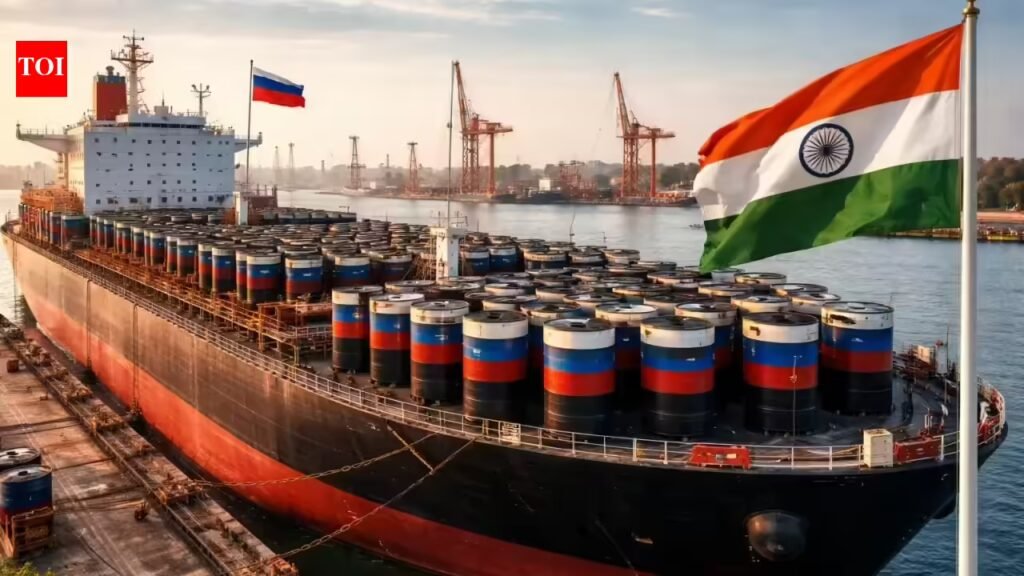
Historically, India’s highest monthly purchases of Russian crude have been around 2.0-2.1 Mbd since the Russia-Ukraine war began in 2022. (AI image) Russian crude has emerged as a major player amid the US-Iran war – global crude oil supply is badly affected via the Strait of Hormuz, Middle East countries are finding it difficult to export oil and global crude oil prices have risen dramatically. The situation has had major implications for India – a country that imports almost 90% of its crude oil.There was a time after the Russia-Ukraine war began in 2022 that Russia had begun to contribute approximately 35-40% of India’s crude oil imports. Come early 2026, sanctions forced India’s procurement of Russian crude to drop. But March 2026 presents a very different picture. Watch Amid Hormuz Disruption, India Locks 60 Million Barrels Of Russian Oil To Secure Energy Supply The inflows of Russian crude oil have risen sharply since the US-Iran war began and imports via the Strait of Hormuz were disrupted. In fact, crude imports from Russia are now nearing lifetime monthly highs!The Donald Trump administration has given a 30-day waiver for purchase of Russian crude to keep global oil prices stable. It’s important to note that India has never stopped buying crude oil from Russia, however imports dropped drastically after sanctions on Russian oil majors. “We source crude from wherever supplies are available, competitively priced and deliverable, and we will continue to do so,” a government source told TOI earlier this month. The source also said that the declaration of a 30-day waiver by the US appears to be for the consumption of their domestic audience. When India Became A Big Importer of Russian Oil For decades, India has mainly imported crude oil from the Middle East, especially from countries like Iraq, Saudi Arabia and the UAE. The decision has been driven by proximity, long‑term contracts and stable shipping routes.After the Russia–Ukraine war began in 2022, Western sanctions pushed Russian oil out of European markets. This is when India started importing large volumes of Russian crude – and a big factor driving this decision was the availability of crude that suited Indian refineries at such steep discounts.This helped India reduce its oil import costs and diversify its supply network. However, in late 2025 and early 2026, India scaled back Russian oil purchases amid US trade negotiations and pressure linked to tariffs and sanctions compliance. In August 2025, the Donald Trump administration imposed a 25% penalty tariff on India for its crude oil buys from Russia. The US called these imports an indirect financing of the war against Ukraine. Within months two Russian crude oil majors, Lukoil and Rosneft, were sanctioned making it difficult for Indian refiners to buy Russian crude, leading to a gradual decline in imports. But that has changed now. The Re-emergence Of Russian Oil An analysis by Kpler, a global real-time data and analytics provider suggests that India has so far purchased around 45–50 million barrels of Russian crude since the start of the Middle East conflict. The figure may even be higher, given that April figures are not confirmed as yet. The trendline suggests March procurement is likely to reach around 1.8–2.0 Mbd, which would make it one of the strongest months for Russian crude intake since India began ramping up purchases after the start of the Russia-Ukraine war. This compares with a pre-conflict run rate closer to around 1.0 Mbd, Sumit Ritolia, Lead Research Analyst, Refining and Modelling at Kpler tells TOI.Historically, India’s highest monthly purchases of Russian crude have been around 2.0-2.1 Mbd since the Russia-Ukraine war began in 2022.Hence, the biggest takeaway is that the current spurt in purchases of Russian crude oil is now nearing peak monthly trends seen before India started dialling down on Moscow’s crude. For Sumit Ritolia, what stands out is the speed of the rebound: as Middle Eastern supplies via Hormuz dried up, Indian refiners were able to lift Russian purchases by close to around 0.8–1.0 Mbd, helping cushion the disruption without materially affecting refinery runs so far.Sourav Mitra, Partner – Oil & Gas at Grant Thornton Bharat points out that India bought the most Russian crude in a single month in May 2023, when imports reached about 66 million barrels, 2.1 million bpd. “The recent rise in March 2026 is expected to be as high, at around 60 million barrels. This implies that the ongoing conflict in West Asia has pushed India’s purchase of Russian crude oil closer to its previous all-time high,” Mitra tells TOI. India vs China: The Russian Crude Factor Experts note that since China has more reserves, it is structurally less exposed to the Strait of Hormuz oil supply shock.Kpler data and analysis suggests that compared with China, India is currently buying similar to slightly higher absolute volumes of Russian crude in March, depending on the month, but Russia’s role in India’s crude slate has become much more critical in the current environment. China continues to take substantial Russian volumes as well, supported by both seaborne crude and pipeline imports, while India’s recent increase has been more directly linked to replacing lost Middle Eastern barrels. “In other words, India and China remain the larger structural buyers of Russian crude overall, but India’s current surge is more pronounced from a substitution and energy-security standpoint,” says Sumit Ritolia.India usually imports 5-5.5 million bpd of crude oil vis-à-vis China’s import of about 11 million bpd.Sourav Mitra says that in 2025, China ramped up crude oil imports to 11.5 million bpd to augment its stockpiles. Russia accounted for 18% of total Chinese crude oil imports in 2025. China’s import of Russian seaborne crude oil surged to almost 2 million bpd in February as India scaled back the import of Russian Urals in February. In the first two months of 2026 alone, Russia’s shipments of crude to China rose about 40 % y-o-y.“Since oil prices are high and China has enough inventory, it’s likely to cut its oil purchases. Shifting of
US stock markets today (March 26, 2026): Wall Street opens lower as oil jumps above $100; Middle East tensions weigh on sentiment

Wall Street’s key indices opened lower on Thursday after gains in the previous session, as investors turned cautious over evolving developments in the Middle East and weighed the prospects of any de-escalation in the conflict.At the opening bell, the Dow Jones Industrial Average slipped 84.8 points, or 0.18%, to 46,344.64. The S&P 500 declined 36 points, or 0.55%, to 6,555.86, while the Nasdaq Composite dropped 236.7 points, or 1.08%, to 21,693.17.US equities tracked weakness in global markets as crude oil prices climbed back above the $100-a-barrel mark amid fading hopes of a ceasefire in the Iran war. Futures for the S&P 500 and Dow Jones Industrial Average had fallen about 0.7% before the opening bell, while Nasdaq futures were down 0.8%.Brent crude, the international benchmark, rose 3.4% to $100.61 per barrel after trading below $95 on Wednesday. US benchmark crude gained 3.2% to $93.25 a barrel. The rise in oil prices lent modest support to energy stocks, with shares of ConocoPhillips and Valero Energy rising about 1%.US President Donald Trump said a deal to end the war was near, even as Tehran dismissed his proposed 15-point ceasefire plan. Iran outlined its own conditions via state television, including a halt to the killing of its officials, guarantees against future conflict, reparations and recognition of its sovereignty over the Strait of Hormuz.Iran also moved to formalise its control over the strategic waterway, through which around 20% of globally traded oil and natural gas moves in normal times. A Gulf Arab bloc official said Iran had begun charging fees for ships to safely transit the strait, while Washington prepared for the deployment of additional US troops to the region.European markets were also trading lower by midday. Britain’s FTSE 100 fell 1.3%, France’s CAC 40 dropped 0.7% and Germany’s DAX declined 1.2%.In Asia, Japan’s Nikkei 225 closed 0.3% lower at 53,603.65, while South Korea’s Kospi plunged 3.2% to 5,460.46. Hong Kong’s Hang Seng slipped 1.9% to 24,856.43 and the Shanghai Composite fell 1.1% to 3,889.08. Australia’s S&P/ASX 200 edged down 0.1%, and Taiwan’s Taiex was trading 0.3% lower.In commodities trade, gold prices dropped 2.3% to $4,446 per ounce, while silver declined 6.2% to $68 an ounce. The fall in precious metals weighed on mining stocks, with companies such as Newmont Corp. and Freeport-McMoRan slipping about 3%, AP reported.(With input from agencies)
US unemployment data: Jobless claims edge up to 210,000; labour market still shows resilience

Applications for unemployment benefits in the United States rose slightly last week, signalling continued labour market resilience even as hiring momentum has slowed over the past year.New filings for jobless aid increased by 5,000 to 210,000 for the week ended March 21, up from 205,000 in the previous week, the US Labour Department said on Thursday, according to AP. The figure was in line with expectations of analysts surveyed by FactSet.Weekly jobless claims are widely viewed as a near real-time gauge of layoffs. Though layoffs have largely remained within a historically healthy range of 200,000–250,000 in recent years, several major companies — including Morgan Stanley, Block, UPS and Amazon — have recently announced job cuts.Earlier this month, the Labour Department reported that US employers unexpectedly shed 92,000 jobs in February. Payroll data for December and January were also revised lower by a combined 69,000 jobs, pushing the unemployment rate up to 4.4%.The weaker employment picture has added to economic uncertainty amid the ongoing conflict involving Iran, which has driven oil prices more than 40% higher and increased cost pressures for businesses and households. Inflation was already elevated before the conflict, with the Commerce Department noting that the Federal Reserve’s preferred price gauge rose 2.8% year-on-year in January, above the central bank’s 2% target.Against this backdrop, the Federal Reserve left its benchmark lending rate unchanged at its latest policy meeting. Policymakers had earlier voted to raise rates three times towards the end of 2025, citing concerns about a softening job market.Economists say the labour market remains in a “low-hire, low-fire” phase — keeping unemployment historically low but making it harder for jobseekers to find new work.The report also showed that the four-week moving average of jobless claims dipped by 250 to 210,500. Meanwhile, the number of Americans continuing to receive unemployment benefits for the week ended March 14 declined by 32,000 to 1.82 million.
OECD pegs India GDP growth at 7.6% in FY26, sees moderation next fiscal

India’s economy is projected to expand by 7.6% in the current fiscal before moderating to 6.1% in 2026-27, the Organisation for Economic Cooperation and Development (OECD) said in its interim Economic Outlook report, PTI reported.The multilateral body said the evolving conflict in the Middle East has “human and economic costs” for countries directly involved and could test the resilience of the global economy by disrupting energy supplies and raising commodity prices.“The decline in (US) tariffs should support growth in India, though gas rationing will disrupt some production activities and fiscal support is expected to fade, with growth easing from 7.6 per cent in fiscal year (FY) 2025-26 to 6.1 per cent in FY 2026-27 and 6.4 per cent in FY 2027-28,” the OECD said.According to the report, disruption of shipments through the Strait of Hormuz and damage to energy infrastructure have triggered a surge in energy prices and affected the global supply of commodities, including fertilisers.The OECD also warned that inflationary pressures could rise as the deflationary effects of earlier food and energy price shocks recede. It projected inflation to increase from 2% in FY 2025-26 to 5.1% in FY 2026-27 before easing to 4.1% in FY 2027-28.Among emerging-market economies, India may need to raise policy rates temporarily in the second quarter of 2026 to counter stronger inflationary pressures, the report said.The OECD noted that US bilateral tariff rates have declined following a US Supreme Court ruling against levies imposed under the International Emergency Economic Powers Act. While this has resulted in significant tariff reductions for several emerging-market economies, including India, the overall US effective tariff rate remains higher than levels seen before 2025.Globally, growth is expected to soften to 2.9% in 2026 before improving slightly to 3% in 2027.“The energy price surge and the unpredictable nature of the evolving conflict in the Middle East will raise costs and lower demand, offsetting the tailwinds from strong technology-related investment and production, lower effective tariff rates and the momentum carried over from 2025,” the OECD said.
India’s voluntary carbon market gains ground as net-zero goals drive ecosystem buildup

NEW DELHI: With Climate action gaining momentum as part of India’s net-zero commitment by 2070, the country’s carbon market is beginning to take shape and gain momentum. Homegrown institutions such as the Carbon Registry of India (CRI) are emerging as important enablers for the voluntary carbon market offering platforms to register and track carbon projects, even as corporates and developers scale up efforts around offsets, credits, and trading in line with evolving global frameworks. While the regulatory framework is still in the development stage across many industries, India is leading the development of platforms for listing of voluntary carbon projects in South Asia, creating implementation partners, enabling trading of credits and audit process — all to to align the processes with international standards having an end-to-end setup. “The carbon market today is split into two clear paths,” says Priya Bahirwani, co-founder of Terrablu Climate Technologies, a carbon project developer with proprietary carbon accounting, offsetting and trading platform. “The compliance market is regulation-led and has different levers and framework within which it operates. But the voluntary carbon market is where intent shows up, where companies invest for credibility, brand and long-term responsibility.” It is this voluntary market that is now steering the path and driving the momentum in India for a climate-driven economy. This market is driven by corporates looking to go beyond compliance and are committed to demonstrating real climate impact and social impact – Indian Carbon for Global Markets. CRI (a public-private registry) and other such reputed organisations are building the ecosystem in a sustainable manner. Especially companies like Varaha, Terrablu, NextNow Green (NNG), and other entities are slowly but steadily building the momentum for a climate resilient economy in India. From large conglomerates to mid-sized firms, companies are increasingly investing in carbon credits not just to meet regulatory norms, but to build long-term brand credibility and stakeholder trust. The is the just the beginning of new wave of building a climate resilient economy. CRI helps companies register and formalise their carbon projects in a standardised format. For India, this shift represents a strategic move — from being a supply-side participant to shaping the rules of the market itself. “Carbon markets will only scale on the foundation of trust, transparency, and traceability. With its depth in innovation and resilience, India is well placed to lead this evolution.,” says Richard Bright, CEO of CRI. CRI, he adds, is focused on building a credible domestic bridge between Indian climate projects and global demand, while leveraging digital frameworks to improve transparency, traceability and access. Companies listed on the CRI for carbon projects include Sahyadri Farms, Piplantri FPO, L&T Metro and others are in the pipeline, says Bright. Terrablu’s Bahirwani says India should not just generate carbon credits, but also own the platforms that certify them. “CRI is creating that opportunity, and we are already seeing increasing interest from corporates in sourcing credits listed on such platforms.” Companies such as NNG, which is a carbon consultancy and ecosystem implementation partner, believes that as India moves from a voluntary to a rules- and penalties-based setup in carbon, companies will increasingly work on carbon and climate strategies to strengthen their play in the area. “We are already seeing efforts in this regard. There are enquiries about how to go about carbon projects, how to carry out assessment and audit of current work, and how to work out credits and even offset them, or trade them, across diverse sectors including agriculture and industrial decarbonisation,” says NNG’s Archana Raha. This push is also being reinforced by ecosystem players such as legal frameworks to project developers. They see value in strengthening India’s own carbon market architecture. “Global registries will continue to play a role, but India needs trusted domestic platforms as well,” says Vishnu Sudarsan, senior partner at law firm JSA. “Platforms like CRI provide visibility and credibility within the Indian ecosystem, which is critical as the market matures, supported by robust, dual-layer governance structures that reinforce transparency and accountability,” Sudarsan adds. On the ground, this shift is already taking shape through projects that are choosing to align with India’s emerging carbon infrastructure. Take Piplantri as an example. It is a model that goes beyond carbon to integrate afforestation, water conservation and community livelihoods. By listing on CRI, stakeholders are signalling a clear intent to prioritise transparency, traceability and alignment with India’s evolving climate ecosystem. The market is gradually maturing as reputed and credible market players with sophistication and focus are shaping the ecosystem . The decision reflects a broader trend. Project developers and intermediaries are increasingly working with platforms like CRI and CCTS, supported by ecosystem players such as Terrablu and implementation partners like NNG. Alongside them, credible validation and verification bodies — including KBS certification, 4K Earth Science, VKU Certification and others — are empanelled with CRI, strengthening the integrity and credibility of the overall ecosystem, and helping create a more locally anchored yet globally credible carbon market framework. Experts say that India’s emerging carbon ecosystem is beginning to offer answers through creation of stronger platforms, better verification, and tighter integration across the value chain. “The direction is clear: India is not just participating in the global carbon market but it is leading the market for other emerging economies,” says Sudarsan. It is believed that with the foundation for the climate economy coming in place, India is well poised to become a hub for high-integrity carbon solutions.
Nayara Energy hikes petrol prices by Rs 5, diesel by Rs 3 amid Middle East crisis

NEW DELHI: India’s largest private fuel retailer Nayara Energy on Thursday raised its prices by Rs 5 per litre and diesel by Rs 3 a litre amid the ongoing Middle East crisis. Nayara Energy, which operates 6,967 of India’s 102,075 petrol pumps, has decided to pass on part of the increase in input costs to consumers, said PTI sources.The majority-owned by Russia’s Rosneft, has raised the prices but the actual increase varies across states due to differences in local levies such as VAT, with petrol prices in certain regions rising by as much as Rs 5.30 per litre.Fuel marketing companies in India are under increasing financial pressure, as retail petrol and diesel prices have been kept unchanged even though global oil prices have climbed nearly 50 per cent since February 28, when US–Israel strikes on Iran sparked a wider conflict and retaliation from Tehran.Private and state-run fuel retailers in India are taking divergent approaches as pressure mounts from elevated global crude prices and a prolonged freeze in retail rates.Jio-bp, the fuel retail joint venture between Reliance Industries and BP Plc, which operates over 2,100 outlets nationwide, has so far held petrol and diesel prices steady despite absorbing significant losses. In contrast, state-owned oil marketing companies—dominating roughly 90 per cent of the market—have also maintained a price freeze on standard fuels, continuing a strategy in place since April 2022.State-run companies—Indian Oil Corporation (IOC), Bharat Petroleum Corporation Ltd (BPCL), and Hindustan Petroleum Corporation Ltd (HPCL)—have been absorbing losses during periods of high crude prices and recovering margins when prices soften. While retail prices for regular petrol and diesel remain unchanged, these companies recently increased the price of premium-grade petrol by Rs 2 per litre and sharply raised bulk diesel rates sold to industrial consumers by about Rs 22 per litre.In Delhi, the price of premium 95-octane petrol now stands at Rs 101.89 per litre, up from Rs 99.89, while bulk diesel rates have jumped to Rs 109.59 per litre from Rs 87.67. Meanwhile, standard petrol and diesel prices remain frozen at Rs 94.77 and Rs 87.67 per litre, respectively.The divergence reflects differences in fuel grades: regular petrol, typically rated at 91–92 octane, caters to standard engines, whereas premium petrol with higher octane levels (95–98) is designed for high-performance vehicles.Globally, crude oil prices surged to as high as $119 per barrel earlier this month amid escalating tensions involving Iran, before easing to around $100 per barrel. India, which imports nearly 88 per cent of its crude oil and about half of its natural gas requirements, remains highly exposed to such volatility—particularly as a significant portion of supplies passes through the strategically sensitive Strait of Hormuz. Recent threats from Iran following US and Israeli strikes, coupled with insurance withdrawals, have disrupted tanker movements through the route.The government has reiterated that petrol and diesel pricing is deregulated and determined by oil marketing companies.Historically, oil firms have navigated sharp price cycles. Crude had previously touched $119 per barrel in June 2022 after Russia’s invasion of Ukraine. While that year saw limited profitability, state-run companies posted record profits of Rs 81,000 crore in FY24, offsetting earlier margin pressures. In the current financial year, the three firms together reported profits of Rs 23,743 crore in the December quarter alone.